Homotopy, homology, and $GL_2$
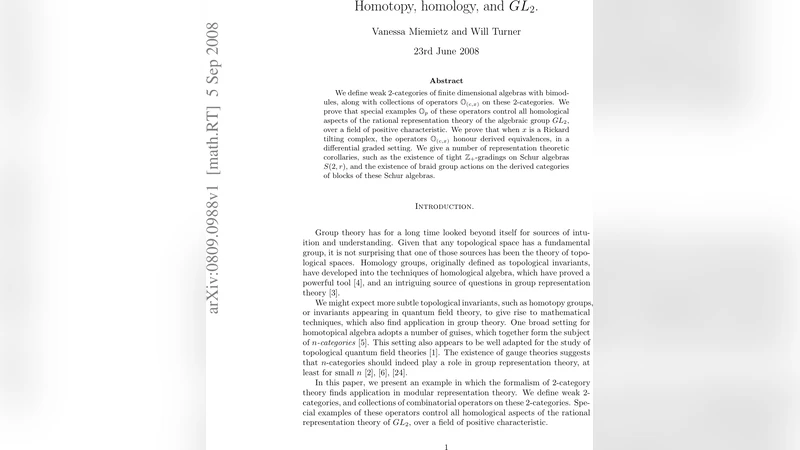
We define weak 2-categories of finite dimensional algebras with bimodules, along with collections of operators $\mathbb{O}{(c,x)}$ on these 2-categories. We prove that special examples $\mathbb{O}p$ of these operators control all homological aspects of the rational representation theory of the algebraic group $GL_2$, over a field of positive characteristic. We prove that when $x$ is a Rickard tilting complex, the operators $\mathbb{O}{(c,x)}$ honour derived equivalences, in a differential graded setting. We give a number of representation theoretic corollaries, such as the existence of tight $\mathbb{Z}+$-gradings on Schur algebras $S(2,r)$, and the existence of braid group actions on the derived categories of blocks of these Schur algebras.
💡 Research Summary
The paper introduces a novel framework that blends weak 2‑category theory with homological algebra to study the representation theory of the algebraic group GL₂ over a field of positive characteristic. In the first part the authors construct a weak 2‑category 𝔅 whose objects are finite‑dimensional k‑algebras together with a chosen (A,B)‑bimodule, 1‑morphisms are bimodules, and 2‑morphisms are complexes of bimodules (or DG‑modules). This setting relaxes the strict associativity constraints of ordinary 2‑categories, allowing more flexible compositions of complexes.
On this 2‑category they define a family of endofunctors 𝔒_{(c,x)} parameterised by a pair (c,x) where c is a k‑algebra and x is a (c,c)‑bimodule complex. The functor sends an object (A,M) to (A⊗_c c, M⊗c x) and acts on morphisms by the obvious tensor product. The central technical result is that when x is a Rickard tilting complex, 𝔒{(c,x)} preserves derived equivalences; more precisely, it lifts to an equivalence of the derived DG‑categories D^b(mod‑A) and D^b(mod‑A⊗_c c). The proof uses the machinery of DG‑categories, A∞‑structures, and the homotopy invariance of tilting complexes.
A distinguished member of this family, denoted 𝔒_p, is built from a specific algebra c_p (a p‑restricted ladder algebra) and a corresponding tilting complex x_p. The authors show that iterating 𝔒_p captures every homological invariant that appears in the rational representation theory of GL₂. In particular, the standard, costandard, and simple modules for GL₂, together with all Ext‑groups between them, can be reconstructed from the action of 𝔒_p on the 2‑category. This provides a conceptual “operator” that replaces the cumbersome weight‑space calculations traditionally required in the modular representation theory of GL₂.
The paper then exploits 𝔒_p to obtain several concrete representation‑theoretic corollaries. First, it proves the existence of a tight ℤ₊‑grading on each Schur algebra S(2,r). A tight grading means that the graded pieces align exactly with the homological degrees of the Ext‑algebra, yielding a Koszul‑like structure even in positive characteristic. Second, by applying 𝔒_p to the block decomposition of S(2,r) the authors construct braid‑group actions on the derived categories of individual blocks. The braid generators are realised as derived tensor products with the tilting complexes that define 𝔒_p, and the braid relations follow from the Rickard equivalences satisfied by these complexes.
Beyond the special case, the authors analyse the general behaviour of 𝔒_{(c,x)} when x is an arbitrary bimodule complex. They investigate how Koszul duality, standard‑module filtrations, and normalised standard modules interact with the functor. The outcome is a robust picture: 𝔒_{(c,x)} simultaneously controls derived equivalences, homological gradings, and categorical symmetries, making it a unifying operator in the landscape of modular representation theory.
In the concluding section the authors discuss the broader impact of their work. By marrying weak 2‑category theory with DG‑techniques, they provide a new lens through which the modular representation theory of GL₂ can be understood. The tight gradings and braid‑group actions on Schur algebras open avenues for extending the approach to higher rank groups GL_n and to other quasi‑hereditary algebras. The paper thus sets the stage for a systematic study of derived and homotopical structures in modular representation theory using operator‑theoretic methods.