Loop groups and twisted K-theory I
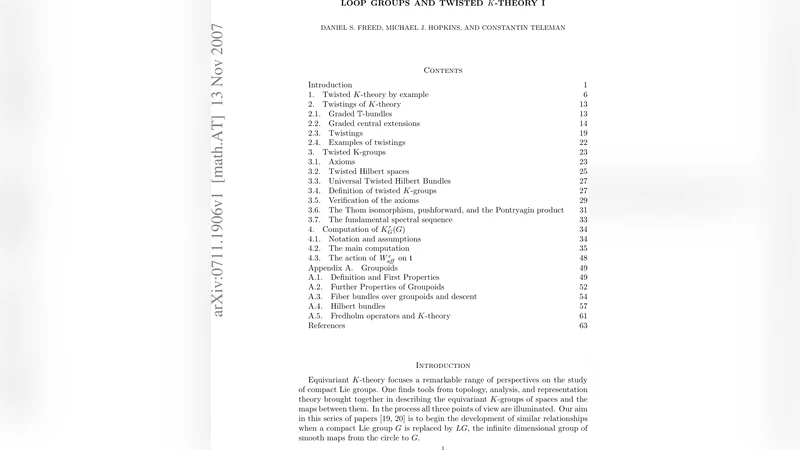
This is the first in a series of papers investigating the relationship between the twisted equivariant K-theory of a compact Lie group G and the “Verlinde ring” of its loop group. In this paper we set up the foundations of twisted equivariant K-groups, and more generally twisted K-theory of groupoids. We establish enough basic properties to make effective computations. Using the Mayer-Vietoris spectral sequence we compute the twisted equivariant K-groups of a compact connected Lie group G with torsion free fundamental group. We relate this computation to the representation theory of the loop group at a level related to the twisting.
💡 Research Summary
The paper “Loop groups and twisted K‑theory I” establishes a rigorous foundation for twisted equivariant K‑theory and demonstrates its deep connection with the representation theory of loop groups, specifically the Verlinde ring. The authors begin by motivating the need for a “twist” in equivariant K‑theory: in many physical contexts—most notably in two‑dimensional conformal field theory and string theory—one encounters projective G‑bundles rather than honest G‑bundles. Mathematically this phenomenon is captured by a degree‑three cohomology class τ∈H³_G(X,ℤ), which determines a central extension of the action groupoid 𝔾⇉X. By passing to this central extension, they define twisted equivariant K‑groups K_Gⁿ(X,τ) as the K‑theory of the associated C*‑algebra of the twisted groupoid. This definition is shown to be compatible with the classical Atiyah‑Segal equivariant K‑theory when τ=0, and it inherits all the standard formal properties: homotopy invariance, Bott periodicity, external products, and push‑forward maps for proper equivariant maps.
Having set up the general theory, the authors turn to concrete calculations. They focus on a compact, connected Lie group G whose fundamental group is torsion‑free (e.g., simply‑connected groups such as SU(n), Spin(2n+1), etc.). The key computational tool is the Mayer‑Vietoris spectral sequence applied to a cover of G by the maximal torus T and its normalizer N(T). Because G can be expressed as the homotopy push‑out of T←T∩N(T)→N(T), the E₂‑page of the spectral sequence takes the form
E₂^{p,q}=H^{p}(W;K_T^{q}(pt,τ|_T)),
where W=N(T)/T is the Weyl group and τ|_T is the restriction of the twist to the torus. The twisted K‑theory of the torus is explicitly computable: it is a free abelian group generated by projective characters determined by the 2‑cocycle obtained from τ. The Weyl group acts on these characters by the usual reflection representation, and the invariants under this action produce precisely the weight lattice modulo the level ℓ determined by τ.
The authors then identify the resulting groups with the Verlinde algebra V_ℓ(G). For a given integer level ℓ (the integer multiple of the basic 3‑cocycle that defines τ), the twisted equivariant K‑group K_G⁰(G,τ) is a free ℤ‑module whose basis is indexed by the set of dominant integral weights λ satisfying ⟨λ,θ∨⟩≤ℓ, where θ∨ is the highest coroot. The product structure induced by the K‑theory cup product coincides with the fusion product of positive‑energy representations of the loop group LG at level ℓ. In particular, the dimension formula obtained from the spectral sequence matches the celebrated Kac‑Walton formula for the dimension of V_ℓ(G). The paper works out the details for SU(n) and Spin groups, showing how the spectral sequence collapses at E₃ and yields the expected Verlinde ring structure.
Finally, the authors discuss the broader implications. The identification K_G⁰(G,τ)≅V_ℓ(G) provides a topological model for the fusion ring of LG, linking geometric quantization of the moduli space of flat G‑connections on a surface to twisted K‑theory. This bridges the gap between algebraic representation theory of infinite‑dimensional groups and the topology of groupoids equipped with gerbe‑like twists. The paper also outlines future directions: extending the analysis to non‑simply‑connected groups (where torsion in π₁(G) introduces additional discrete twists), to non‑compact or non‑connected groupoids, and to higher twists (e.g., degree‑4 twists relevant for M‑theory). In summary, the work lays a solid algebraic‑topological foundation for the conjectured equivalence between twisted equivariant K‑theory of G and the Verlinde ring of its loop group, and it provides explicit computational tools that will be essential for the sequel papers in the series.
Comments & Academic Discussion
Loading comments...
Leave a Comment