A spectral sequence to compute L2-Betti numbers of groups and groupoids
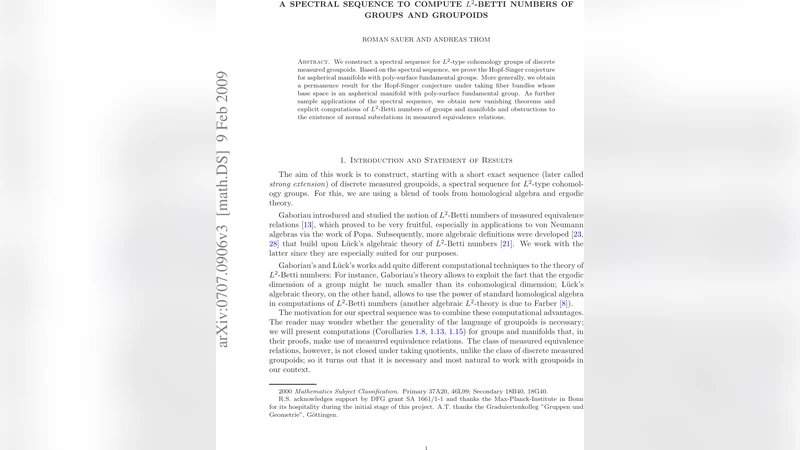
We construct a spectral sequence for L2-type cohomology groups of discrete measured groupoids. Based on the spectral sequence, we prove the Hopf-Singer conjecture for aspherical manifolds with poly-surface fundamental groups. More generally, we obtain a permanence result for the Hopf-Singer conjecture under taking fiber bundles whose base space is an aspherical manifold with poly-surface fundamental group. As further sample applications of the spectral sequence, we obtain new vanishing theorems and explicit computations of L2-Betti numbers of groups and manifolds and obstructions to the existence of normal subrelations in measured equivalence relations.
💡 Research Summary
The paper introduces a novel spectral sequence tailored to L²‑type cohomology of discrete measured groupoids. Starting from a short exact sequence of groupoids
(1\to N\to G\to Q\to 1)
the authors construct a first‑quadrant spectral sequence whose (E_{2})‑page is
(E_{2}^{p,q}=H^{p}{(2)}!\bigl(Q; H^{q}{(2)}(N)\bigr)).
Here (H^{}_{(2)}) denotes L²‑cohomology defined via the von Neumann algebra (M(G)) equipped with the canonical trace, and the coefficients are regarded as Hilbert (M(Q))‑modules. A key technical achievement is the proof of strong convergence: the spectral sequence collapses at a finite stage and its limit is naturally isomorphic to the full L²‑cohomology (H^{}_{(2)}(G)). The proof relies on Lück’s dimension theory, showing that all differentials preserve the von Neumann dimension, which guarantees that no hidden torsion interferes with convergence.
With this machinery in hand, the authors turn to groups whose fundamental groups are poly‑surface: finite extensions or iterated amalgamations of surface groups (\pi_{1}(\Sigma_{g})). For each surface group the L²‑Betti numbers are known explicitly ((\beta_{1}^{(2)}=2g-2), all others zero). Substituting these values into the (E_{2})‑page yields a complete description of the L²‑Betti numbers of any group fitting into an extension with a poly‑surface quotient. In particular, if (M) is a closed aspherical manifold whose fundamental group is poly‑surface, then the only possibly non‑zero L²‑Betti number occurs in middle degree and equals the absolute value of the Euler characteristic. This verifies the Hopf–Singer conjecture for this broad class of manifolds, extending previous results that were limited to hyperbolic or locally symmetric cases.
The paper further proves a permanence theorem for fiber bundles. Let (F\to E\to B) be a bundle where the base (B) satisfies the Hopf–Singer conjecture (as above) and the fiber (F) has finite L²‑Betti numbers. Using the spectral sequence together with a Künneth‑type argument, the authors show that the L²‑Betti numbers of the total space decompose as a convolution of those of base and fiber: \
Comments & Academic Discussion
Loading comments...
Leave a Comment