The refined transfer, bundle structures and algebraic K-theory
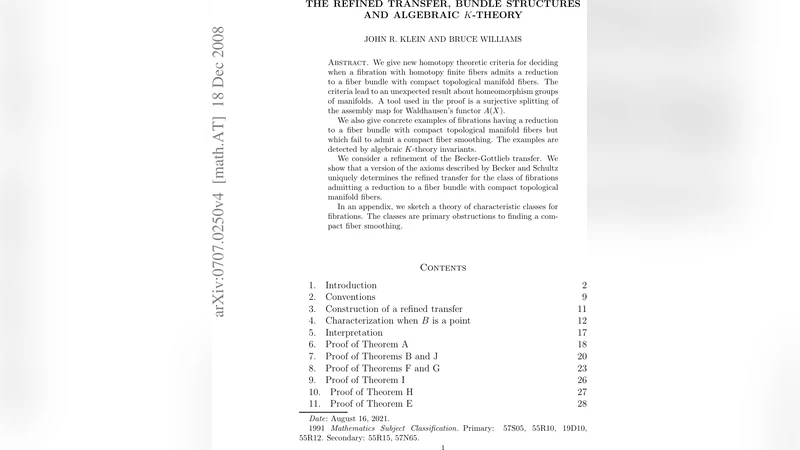
We give new homotopy theoretic criteria for deciding when a fibration with homotopy finite fibers admits a reduction to a fiber bundle with compact topological manifold fibers. The criteria lead to a new and unexpected result about homeomorphism groups of manifolds. A tool used in the proof is a surjective splitting of the assembly map for Waldhausen’s functor A(X). We also give concrete examples of fibrations having a reduction to a fiber bundle with compact topological manifold fibers but which fail to admit a compact fiber smoothing. The examples are detected by algebraic K-theory invariants. We consider a refinement of the Becker-Gottlieb transfer. We show that a version of the axioms described by Becker and Schultz uniquely determines the refined transfer for the class of fibrations admitting a reduction to a fiber bundle with compact topological manifold fibers. In an appendix, we sketch a theory of characteristic classes for fibrations. The classes are primary obstructions to finding a compact fiber smoothing.
💡 Research Summary
The paper addresses a classical problem in topology: determining when a fibration with homotopy‑finite fibers can be reduced to a fiber bundle whose fibers are compact topological manifolds. The authors introduce new homotopy‑theoretic criteria that answer this question in a precise way. Central to their approach is a refined version of the Becker–Gottlieb transfer. By extending the axioms originally formulated by Becker and Schultz, they define a “refined transfer” that exists uniquely for the class of fibrations admitting a reduction to a compact manifold bundle. This uniqueness result shows that the transfer is not merely a construction but a canonical invariant dictated by the homotopy type of the fibration.
A second major contribution is the analysis of Waldhausen’s algebraic K‑theory functor A(X) and its assembly map. The authors prove that the assembly map is surjectively split, i.e., there exists a right inverse that is a homomorphism of spectra. This splitting allows one to lift any element of the algebraic K‑theory of a space back to the source of the assembly map. Consequently, algebraic K‑theory becomes a powerful detector for the existence (or non‑existence) of compact manifold smoothings of the fibers.
Using this machinery, the authors construct explicit examples of fibrations that satisfy the reduction criterion (they admit a compact manifold bundle structure) but nevertheless fail to admit a compact fiber smoothing. These counterexamples are detected by non‑trivial K‑theory classes that survive the assembly map, demonstrating that the obstruction to smoothing is genuinely algebraic rather than geometric in nature.
The paper also sketches a theory of characteristic classes for fibrations in an appendix. These classes serve as primary obstructions to finding a compact fiber smoothing: if any of them is non‑zero, a smoothing cannot exist. The characteristic classes are defined in terms of the refined transfer and the split assembly map, tying together the three main themes of the work.
Overall, the work weaves together three sophisticated tools—refined transfer, split assembly for Waldhausen’s A‑theory, and algebraic K‑theory invariants—to give a comprehensive picture of when a homotopy‑finite fibration can be upgraded to a genuine manifold bundle and when such an upgrade is obstructed. The results have immediate implications for the study of homeomorphism groups of manifolds, as the refined transfer yields new information about their homotopy types. Moreover, the techniques introduced are likely to influence future research on the interplay between manifold topology, homotopy theory, and algebraic K‑theory, providing a robust framework for tackling smoothing problems and for understanding the algebraic structure underlying topological bundles.
Comments & Academic Discussion
Loading comments...
Leave a Comment