A quantitative version of the Besicovitch projection theorem via multiscale analysis
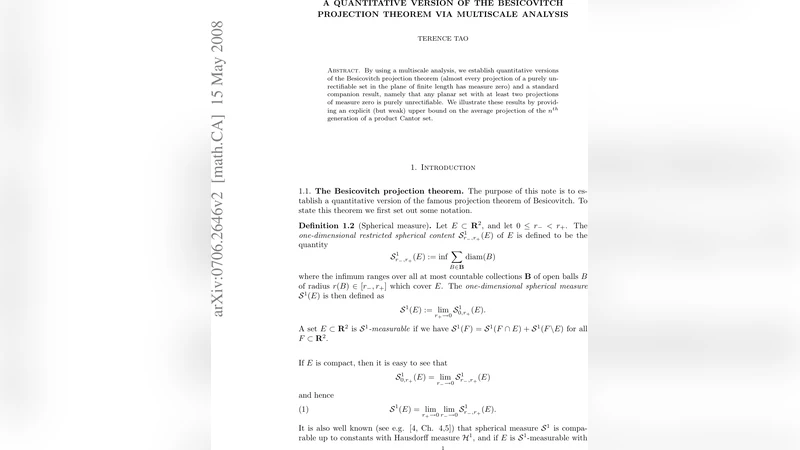
By using a multiscale analysis, we establish quantitative versions of the Besicovitch projection theorem (almost every projection of a purely unrectifiable set in the plane of finite length has measure zero) and a standard companion result, namely that any planar set with at least two projections of measure zero is purely unrectifiable. We illustrate these results by providing an explicit (but weak) upper bound on the average projection of the $n^{th}$ generation of a product Cantor set.
💡 Research Summary
The paper presents a quantitative refinement of the classical Besicovitch projection theorem and its companion result using a multiscale analytical framework. The original Besicovitch theorem states that if a planar set (E\subset\mathbb{R}^{2}) has finite one‑dimensional Hausdorff measure and is purely unrectifiable, then for almost every direction (\theta) the orthogonal projection (\pi_{\theta}(E)) has Lebesgue measure zero. This statement is existential (“almost every”) and provides no explicit bound on how small the projected length typically is.
The authors replace the qualitative “almost every” by a concrete average bound. They first decompose (E) into dyadic squares (\mathcal{D}). For each square (Q) they define a scale‑dependent “energy’’ (E(Q)=\mu(Q)/\ell(Q)) (where (\mu) is the 1‑dimensional Hausdorff measure restricted to (E) and (\ell(Q)) is the side length) and a non‑rectifiability indicator (\beta(Q)) that measures how far (E\cap Q) deviates from a straight line. The (\beta)-numbers are analogous to Jones’ (\beta)-coefficients and are large when the set is highly non‑linear.
A key multiscale inequality is proved:
\
Comments & Academic Discussion
Loading comments...
Leave a Comment