The Case for Cloud Service Trustmarks and Assurance-as-a-Service
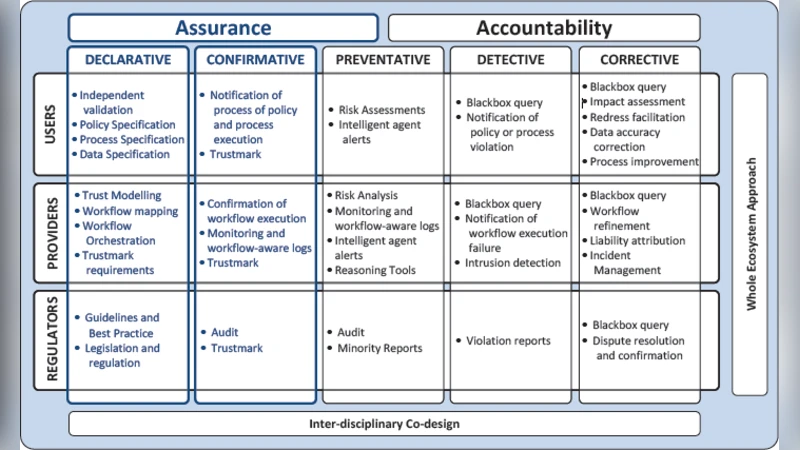
Cloud computing represents a significant economic opportunity for Europe. However, this growth is threatened by adoption barriers largely related to trust. This position paper examines trust and confidence issues in cloud computing and advances a case for addressing them through the implementation of a novel trustmark scheme for cloud service providers. The proposed trustmark would be both active and dynamic featuring multi-modal information about the performance of the underlying cloud service. The trustmarks would be informed by live performance data from the cloud service provider, or ideally an independent third-party accountability and assurance service that would communicate up-to-date information relating to service performance and dependability. By combining assurance measures with a remediation scheme, cloud service providers could both signal dependability to customers and the wider marketplace and provide customers, auditors and regulators with a mechanism for determining accountability in the event of failure or non-compliance. As a result, the trustmarks would convey to consumers of cloud services and other stakeholders that strong assurance and accountability measures are in place for the service in question and thereby address trust and confidence issues in cloud computing.
💡 Research Summary
The paper addresses a fundamental barrier to wider cloud adoption in Europe: the lack of trust and clear accountability mechanisms. While cloud computing promises substantial economic benefits, potential customers remain hesitant because existing certifications are static snapshots that do not reflect the ongoing performance, security posture, or compliance of a service. To overcome this, the authors propose a two‑part solution: a dynamic, “active” trustmark for cloud service providers and an Assurance‑as‑a‑Service (AaaS) model delivered by an independent third‑party assurance entity.
The dynamic trustmark differs from traditional seals by continuously ingesting live operational metrics—such as availability, latency, incident counts, and resource utilization—through provider‑exposed APIs. These metrics are collected, cryptographically signed, and optionally stored on a tamper‑evident ledger (e.g., blockchain) to guarantee integrity. The third‑party assurance service validates the data, applies independent evaluation models (Bayesian trust scoring, machine‑learning anomaly detection, statistical SLA breach prediction), and translates the results into a multi‑modal visual representation (icons, textual summaries, graphs) that can be embedded in web dashboards, mobile widgets, or browser extensions. Users can therefore see, at any moment, a service’s current trust score, SLA compliance status, and any recent incidents.
Beyond visibility, the AaaS framework incorporates a remediation scheme. When a provider violates an SLA or breaches a compliance rule, the assurance platform automatically triggers alerts, initiates pre‑defined compensation or corrective actions, and records the event for auditability. This creates a transparent chain of evidence that customers, auditors, and regulators can follow to determine liability and enforce remediation.
The authors argue that this combination of real‑time transparency and enforceable remediation addresses three core trust dimensions: (1) information asymmetry—customers receive objective, up‑to‑date performance data; (2) credibility—providers can publicly demonstrate continuous compliance, turning the trustmark into a competitive differentiator; and (3) accountability—regulators gain a standardized, auditable data feed that aligns with EU legal frameworks such as GDPR and eIDAS, facilitating automated compliance checks and swift sanctions.
Implementation challenges are acknowledged. Standardizing metric definitions across heterogeneous cloud platforms, securing API channels, ensuring the independence and governance of the assurance provider, and making the scoring models explainable are identified as critical hurdles. The paper recommends collaboration with standards bodies (ISO/IEC) to define a common metric taxonomy, the use of cryptographic techniques to protect data in transit, and periodic third‑party audits of the assurance organization itself.
In conclusion, the proposed dynamic trustmark and Assurance‑as‑a‑Service model aim to transform trust from a static, pre‑contractual claim into a continuously observable property of cloud services. By making performance and compliance data publicly visible and coupling it with an automated remediation pathway, the approach promises to lower the trust barrier, accelerate cloud adoption, and support the growth of Europe’s digital economy.
Comments & Academic Discussion
Loading comments...
Leave a Comment