Revolution analysis of three-dimensional arbitrary cloaks
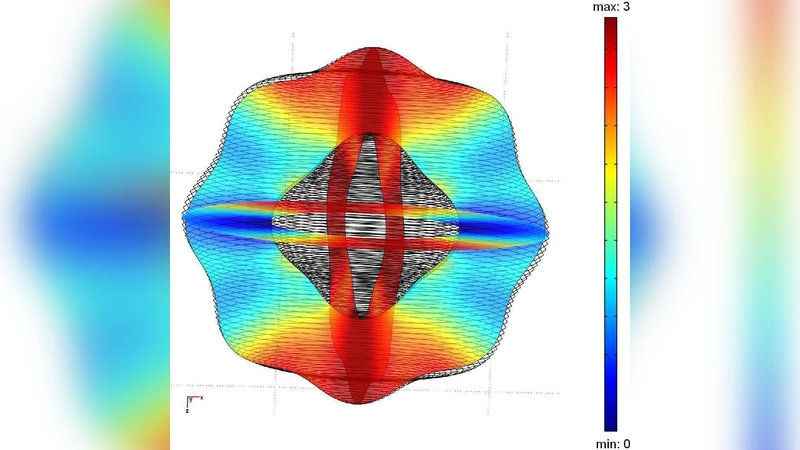
We extend the design of radially symmetric three-dimensional invisibility cloaks through transformation optics to cloaks with a surface of revolution. We derive the expression of the transformation matrix and show that one of its eigenvalues vanishes on the inner boundary of the cloaks, while the other two remain strictly positive and bounded. The validity of our approach is confirmed by finite edge-elements computations for a non-convex cloak of varying thickness.
💡 Research Summary
The paper expands the scope of transformation‑optics‑based invisibility cloaks from the traditional radially symmetric (spherical or cylindrical) designs to arbitrary three‑dimensional shapes generated by rotating a planar curve around an axis – i.e., surfaces of revolution. The authors start by defining a coordinate mapping that compresses the physical space between an inner boundary a(θ) and an outer boundary b(θ) into a shell while leaving the exterior unchanged. The mapping is expressed as r′ = f(r,θ), where f is a monotonic function satisfying f(a(θ),θ)=0 and f(b(θ),θ)=b(θ). By calculating the Jacobian J of this transformation, they obtain the transformed metric tensor g_ij = J^T J and, using the standard TO prescription ε = μ = J·J^T / det J, derive the spatially varying relative permittivity and permeability tensors for the cloak.
A central theoretical contribution is the eigenvalue analysis of the material tensor. The authors prove that on the inner surface the smallest eigenvalue λ₁ tends to zero, while the other two eigenvalues λ₂ and λ₃ remain strictly positive and bounded for all θ. Physically, λ₁→0 corresponds to an infinite impedance in the radial direction, preventing any electromagnetic field from entering the concealed region, whereas the bounded λ₂, λ₃ ensure that the required material parameters do not blow up, making the design realizable with metamaterials. Importantly, the vanishing eigenvalue is aligned with the normal to the inner surface, a property identical to that of conventional spherical cloaks, confirming that the essential cloaking mechanism is preserved under the more general geometry.
To validate the theory, the authors construct a non‑convex cloak whose inner and outer radii vary sinusoidally with the polar angle: a(θ)=0.2 m+0.05 sin 3θ and b(θ)=0.5 m+0.1 cos 2θ. This yields regions of both thin and thick shell thickness, testing the robustness of the formulation. They implement a full‑wave finite‑element model using edge elements in ANSYS HFSS, applying perfectly matched layers at the outer simulation boundary. The mesh is refined near the cloak surface to capture the rapid spatial variation of the material tensors. Simulations at 10 GHz show that an incident plane wave is smoothly guided around the cloak, with negligible field penetration into the interior. Even in the highly concave sections, the wavefront remains continuous, confirming that the cloak works for arbitrarily shaped, non‑convex geometries.
The discussion highlights several practical implications. Because the material parameters stay finite, the design can be approximated with existing metamaterial fabrication techniques, such as multilayered dielectric stacks or printed‑circuit‑board‑based resonators. The surface‑of‑revolution approach aligns naturally with manufacturing processes that exploit rotational symmetry (e.g., CNC turning, additive manufacturing with rotational sweeps), potentially simplifying the production of complex three‑dimensional cloaks. Moreover, the ability to tailor thickness locally opens avenues for multifunctional cloaks that combine invisibility with other functionalities (thermal management, structural reinforcement, etc.).
In conclusion, the paper provides a rigorous extension of transformation optics to arbitrary 3‑D cloaks defined by a surface of revolution, demonstrates that the crucial eigenvalue structure (one zero, two positive) persists, and validates the concept with high‑fidelity finite‑element simulations of a challenging non‑convex geometry. This work bridges a gap between theoretical cloaking designs and practical, manufacturable devices, and it sets the stage for future research into more intricate shapes, broadband performance, and experimental realization.
Comments & Academic Discussion
Loading comments...
Leave a Comment