On Packing Colorings of Distance Graphs
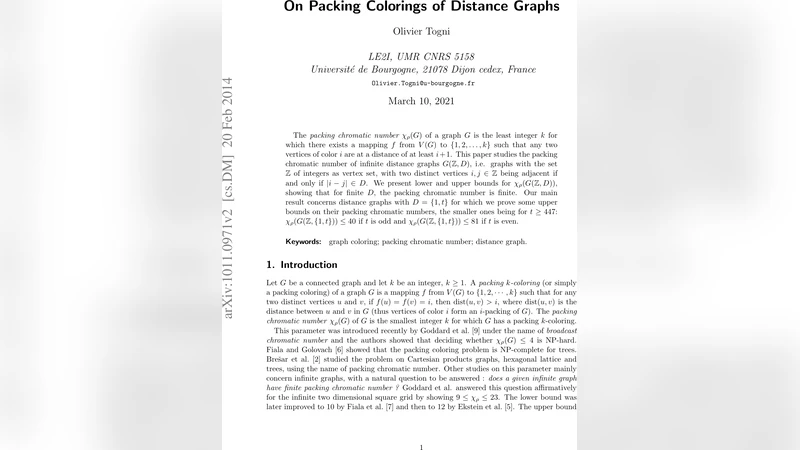
The {\em packing chromatic number} $\chi_{\rho}(G)$ of a graph $G$ is the least integer $k$ for which there exists a mapping $f$ from $V(G)$ to ${1,2,\ldots ,k}$ such that any two vertices of color $i$ are at distance at least $i+1$. This paper studies the packing chromatic number of infinite distance graphs $G(\mathbb{Z},D)$, i.e. graphs with the set $\mathbb{Z}$ of integers as vertex set, with two distinct vertices $i,j\in \mathbb{Z}$ being adjacent if and only if $|i-j|\in D$. We present lower and upper bounds for $\chi_{\rho}(G(\mathbb{Z},D))$, showing that for finite $D$, the packing chromatic number is finite. Our main result concerns distance graphs with $D={1,t}$ for which we prove some upper bounds on their packing chromatic numbers, the smaller ones being for $t\geq 447$: $\chi_{\rho}(G(\mathbb{Z},{1,t}))\leq 40$ if $t$ is odd and $\chi_{\rho}(G(\mathbb{Z},{1,t}))\leq 81$ if $t$ is even.
💡 Research Summary
The paper investigates the packing chromatic number (\chi_{\rho}(G)) of infinite distance graphs (G(\mathbb{Z},D)). In a distance graph the vertex set is the set of all integers and two distinct vertices (i) and (j) are adjacent exactly when (|i-j|) belongs to a prescribed set (D\subset\mathbb{N}). A packing coloring is a mapping (f:V(G)\rightarrow{1,\dots,k}) such that any two vertices receiving the same color (i) are at graph‑distance at least (i+1). The smallest (k) for which such a mapping exists is the packing chromatic number (\chi_{\rho}(G)).
The authors first address the general case where (D) is any finite subset of the positive integers. By constructing a periodic coloring pattern whose period depends on the maximum element of (D), they prove that (\chi_{\rho}(G(\mathbb{Z},D))) is always finite for finite (D). The construction proceeds by fixing a period (L) (typically a multiple of the largest distance in (D)) and assigning colors (1,2,\dots,k) to the positions (0,1,\dots,L-1) in a way that respects the distance constraints for each color. Repeating this pattern over the whole integer line yields a valid packing coloring of the infinite graph. The key insight is that the distance constraints can be satisfied locally within one period, and the periodic repetition does not introduce new conflicts because the period is chosen large enough to dominate the required separations.
The main focus of the paper is the family of distance graphs with (D={1,t}). Here the adjacency relation combines the usual nearest‑neighbour edges (distance 1) with a long‑range edge of length (t). This combination creates two simultaneous distance restrictions: vertices of color 1 must be at least distance 2 apart (i.e., they cannot be adjacent), while vertices of color (i) for (i\ge2) must be separated by at least (i+1) steps, which may involve both the short and the long edges. The authors develop explicit coloring schemes for large values of (t) and obtain concrete upper bounds on (\chi_{\rho}).
For odd values of (t) they prove that when (t\ge 447) the packing chromatic number does not exceed 40. Their construction uses a block of length (2t) (or a multiple thereof) and places colors 1 through 40 in a carefully interleaved fashion. Color 1 is placed on alternating parity positions, guaranteeing the required distance 2. Colors 2 and 3, which need distances 3 and 4, are positioned in separate sub‑blocks that are far enough apart because the block length is proportional to (t). For each subsequent color (i) (up to 40) the authors ensure that the minimal distance (i+1) is respected by leaving sufficient gaps between occurrences of that color; the large value of (t) makes it possible to allocate these gaps without exceeding the block size. The pattern repeats indefinitely, yielding a global packing coloring of the infinite graph with at most 40 colors.
When (t) is even, the symmetry that simplifies the odd‑(t) case is lost, and a more elaborate scheme is required. The authors show that for even (t\ge 447) a packing coloring using at most 81 colors exists. The construction still relies on a periodic block, now of length (4t), but the block is divided into several layers. Colors 1 through 4 are placed similarly to the odd case, while colors 5 through 81 are distributed among the layers so that each color’s required separation is achieved within the block. The extra layers compensate for the reduced flexibility caused by the even spacing of the long edges. Again, the periodic repetition guarantees a valid coloring of the whole integer line.
The paper also discusses the tightness of these bounds. For small values of (t) (e.g., (t\le 20)) exact packing chromatic numbers are known from previous work, and they are considerably lower than the bounds presented for large (t). However, as (t) grows, determining the exact value becomes increasingly difficult, and the authors’ results provide the first non‑trivial universal upper bounds for the regime (t\ge 447). They note that the threshold 447 arises from the technical requirements of their block constructions; lowering this threshold or reducing the number of colors needed remains an open problem.
In summary, the paper establishes two important contributions: (1) a general proof that the packing chromatic number of any infinite distance graph with a finite distance set is finite, via a constructive periodic coloring; and (2) explicit upper bounds for the specific family (G(\mathbb{Z},{1,t})), namely (\chi_{\rho}\le 40) for odd (t\ge 447) and (\chi_{\rho}\le 81) for even (t\ge 447). These results advance the understanding of packing colorings in infinite, highly regular graphs and open avenues for further refinement of bounds and for exploring algorithmic aspects of constructing optimal packings.
Comments & Academic Discussion
Loading comments...
Leave a Comment