Origin and evolution of marginal basins of the NW Pacific: Diffuse-plate tectonic reconstructions
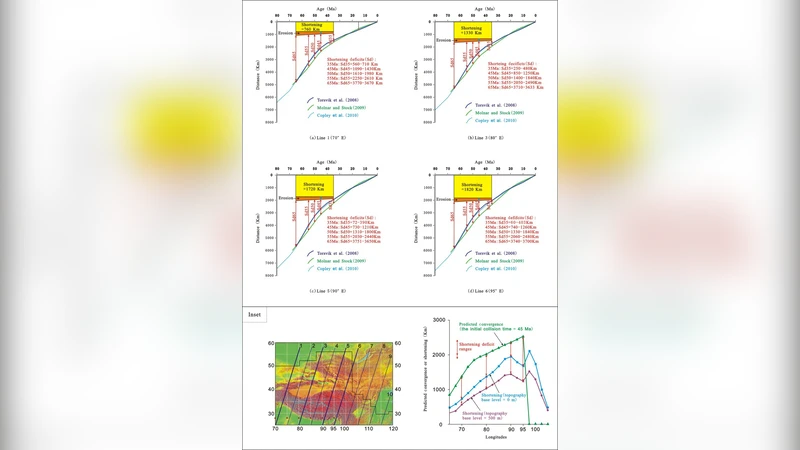
Formation of the gigantic linked dextral pull-apart basin system in the NW Pacific is due to NNE- to ENE-ward motion of east Eurasia. This mainly was a response to the Indo-Asia collision which started about 50 Ma ago. The displacement of east Eurasia can be estimated using three aspects: (1) the magnitude of pull-apart of the dextral pull-apart basin system, (2) paleomagnetic data from eastern Eurasia and the region around the Arctic, and (3) the shortening deficits in the Large Tibetan Plateau. All the three aspects indicate that there was a large amount (about 1200 km) of northward motion of the South China block and compatible movements of other blocks in eastern Eurasia during the rifting period of the basin system. Such large motion of the eastern Eurasia region contradicts any traditional rigid plate tectonic reconstruction, but agrees with the more recent concepts of non-rigidity of both continental and oceanic lithosphere over geological times. Based on these estimates, the method developed for restoration of background diffuse deformation of the Eurasian plate and the region around the Arctic, and the related kinematics of the marginal basins, we present plate tectonic reconstruction of these marginal basins in global plate tectonic settings at the four key times: 50, 35, 15 and 5 Ma. The plate tectonic reconstruction shows that the first-order rift stage and post-rift stage of the marginal basins are correlated with the first-order slow uplift stage and the rapid uplift stage of the Tibetan Plateau, respectively. The proto-Philippine Sea basin was trapped as a sinistral transpressional pop-up structure at a position that was 20{\deg}south of its present position. While the Japan arc migrated eastward during the rifting period of the Japan Sea basin, the Shikoku Basin opened and the Parece Vela Basin widened.
💡 Research Summary
The paper presents a comprehensive reconstruction of the origin and evolution of the marginal basins in the north‑west Pacific, arguing that their development is a direct consequence of the large‑scale northward migration of eastern Eurasia triggered by the Indo‑Asia collision that began around 50 Ma. Three independent lines of evidence are used to quantify this migration: (1) the total amount of dextral pull‑apart measured across the linked pull‑apart basin system, (2) paleomagnetic data from eastern Eurasia and the Arctic region, and (3) the shortening deficit recorded in the Large Tibetan Plateau. All three converge on a northward displacement of roughly 1 200 km for the South China block, with compatible motions of adjacent blocks such as the Korean Peninsula, Japan, and the Philippine Sea region.
This magnitude of motion is incompatible with traditional rigid‑plate reconstructions, which typically limit continental block motions to a few hundred kilometres over the same interval. Instead, the authors adopt a diffuse‑plate framework that allows both continental and oceanic lithosphere to undergo distributed deformation over geological time. They develop a “background diffuse deformation restoration” method that mathematically removes the large‑scale, non‑rigid strain from the Eurasian plate and the surrounding Arctic lithosphere, thereby isolating the kinematics of the marginal basins.
Four key time slices—50 Ma, 35 Ma, 15 Ma, and 5 Ma—are reconstructed within a global plate‑tectonic context. At 50 Ma, the first‑order rift stage is underway: the northward motion of eastern Eurasia creates a system of linked dextral pull‑apart basins extending from the South China Sea through the Japan Sea to the East China Sea. This rift stage coincides with the early, slow uplift of the Tibetan Plateau. By 35 Ma, the rift is largely completed, and the Tibetan Plateau begins a more rapid uplift, marking the transition to a post‑rift stage in the marginal basins. At 15 Ma, the rapid uplift of the plateau is fully expressed, and the marginal basins experience reduced spreading rates, localized transpression, and the development of pop‑up structures. By 5 Ma, the basins have attained their modern geometry, with the Japan arc having migrated eastward, the Shikoku Basin opened, and the Parece Vela Basin widened.
A particularly striking result concerns the proto‑Philippine Sea basin. The authors argue that it originated as a sinistral transpressional pop‑up structure situated about 20° south of its present latitude. Subsequent northward and eastward transport of the Eurasian plate carried this basin to its current position, explaining its anomalous geometry and the timing of its opening relative to neighboring basins.
The study also demonstrates a tight temporal correlation between the uplift history of the Tibetan Plateau and the developmental stages of the marginal basins. The first‑order rift phase aligns with the plateau’s slow, initial uplift, while the post‑rift phase aligns with the plateau’s rapid, later uplift. This suggests that the compressional forces generated by the Indo‑Asia collision were partitioned not only into crustal thickening in the plateau but also into large‑scale lateral extrusion of eastern Eurasia, which in turn drove the opening and subsequent deformation of the marginal basins.
In summary, the paper provides robust quantitative evidence for a ~1 200 km northward translation of eastern Eurasia during the Cenozoic, validates a diffuse‑plate tectonic model for the region, and offers a detailed, time‑resolved reconstruction of the marginal basins that integrates basin‑scale pull‑apart mechanics, paleomagnetic constraints, and plateau‑scale shortening deficits. The methodology and findings have broad implications for re‑evaluating other regions where large‑scale continental extrusion and diffuse deformation may have played a pivotal role in shaping present‑day plate configurations.
Comments & Academic Discussion
Loading comments...
Leave a Comment