Combinatorial Nullstellensatz modulo prime powers and the Parity Argument
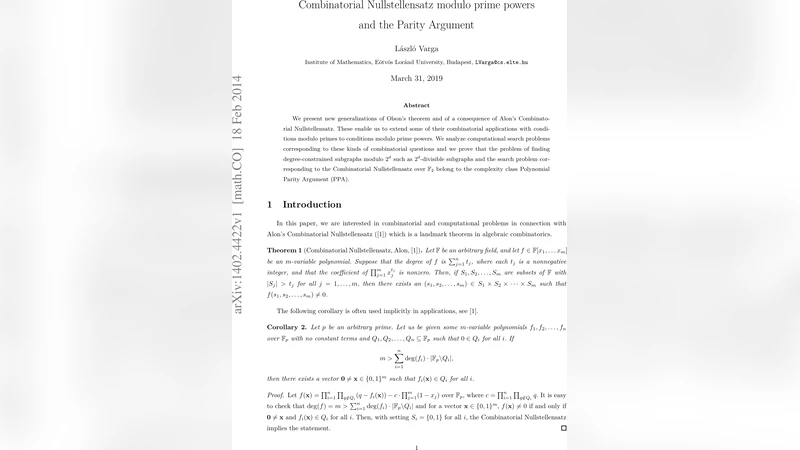
We present new generalizations of Olson’s theorem and of a consequence of Alon’s Combinatorial Nullstellensatz. These enable us to extend some of their combinatorial applications with conditions modulo primes to conditions modulo prime powers. We analyze computational search problems corresponding to these kinds of combinatorial questions and we prove that the problem of finding degree-constrained subgraphs modulo $2^d$ such as $2^d$-divisible subgraphs and the search problem corresponding to the Combinatorial Nullstellensatz over $\mathbb{F}_2$ belong to the complexity class Polynomial Parity Argument (PPA).
💡 Research Summary
The paper presents a substantial extension of Alon’s Combinatorial Nullstellensatz from fields of prime order to rings modulo arbitrary prime powers pⁿ, and explores the algorithmic consequences of this generalization. The authors introduce the notion of “price” for a set B⊆ℤ_{pⁿ}, defined as the minimum total degree of a collection of integer‑valued polynomials that each vanish modulo p on B but not at 0. Using this concept they prove Theorem 6, which states that if m variables satisfy
m > ∑{i=1}^{n} deg(f_i)·price(ℤ{p^{d_i}}\setminus Q_i)
for integer‑coefficient polynomials f_i (without constant term) and target sets Q_i⊆ℤ_{p^{d_i}} containing 0, then there exists a non‑zero Boolean vector x∈{0,1}^m such that each f_i(x) lies in Q_i modulo p^{d_i}. The proof builds auxiliary integer‑coefficient polynomials Ψ_h(f) that encode the evaluation of h∘f on Boolean inputs, and then constructs a master polynomial whose leading monomial satisfies the hypotheses of Alon’s Nullstellensatz.
Applying Theorem 6 to the linear forms f_i(x)=∑j a{ij}x_j yields a new bound (Theorem 7) for the Olson‑type function F(d,Q):
F(d,Q) ≤ ∑{i=1}^{n} price(ℤ{p^{d_i}}\setminus Q_i).
This bound strictly improves the earlier estimate of Alon, Friedland and Kalai (Theorem 4), which used the crude term p^{d_i}−|Q_i|_p (the number of distinct residues of Q_i modulo p). To make the price computable, the authors define a recursive quantity κ(B) that counts, for each residue level r, how many elements of B are forced to be covered by polynomials of degree p^r. They prove (Theorem 14) that price(B) ≤ κ(B). An explicit example with p=5, d=3 demonstrates the calculation.
The paper also identifies a broad class of instances where the bound is tight. For any subset R of {0,…,d−1}, the “R‑zero set” Ω⊆ℤ_{p^d} consists of numbers whose base‑p expansion has zeros in all positions indexed by R. Defining σ(R)=∑_{r∈R}(p−1)p^r, Theorem 16 shows that for such Ω the exact value of F(d,Ω) equals ∑_i σ(R_i). Hence the price‑based bound coincides with the true extremal value for these families, confirming the optimality of the method in many cases.
Beyond the combinatorial bounds, the authors investigate the computational complexity of two natural search problems derived from the theory. First, the “2^d‑divisible subgraph” problem asks, given a graph with sufficiently many edges, to find a non‑empty edge subset whose incident degree at each vertex is divisible by 2^d. By reducing this problem to the search version of the Combinatorial Nullstellensatz over the field F₂, they place it in the complexity class PPA (Polynomial Parity Argument). Second, they address the general search problem for the Nullstellensatz over F₂: given a polynomial f with integer coefficients (presented in a form typical for applications), find a Boolean assignment where f evaluates to a non‑zero element of F₂. They prove that this problem also belongs to PPA, confirming a conjecture of West. The inclusion relies on the parity argument that every finite graph has an even number of odd‑degree vertices; the reductions construct a PPA‑type graph whose odd‑degree nodes correspond to potential solutions, guaranteeing that a solution exists and can be found via a PPA‑oracle.
In summary, the paper achieves three major contributions: (1) a robust algebraic framework extending the Nullstellensatz to modulo prime powers, together with a novel “price” measure that yields sharper extremal bounds for Olson‑type problems; (2) constructive techniques (κ‑function) that make these bounds effectively computable and identify cases of tightness; and (3) a complexity‑theoretic classification of associated search problems, showing that both the 2^d‑divisible subgraph problem and the F₂ Nullstellensatz search problem lie in PPA. These results deepen the connection between algebraic combinatorics and computational complexity, and open avenues for further exploration of modular combinatorial problems and their algorithmic status.
Comments & Academic Discussion
Loading comments...
Leave a Comment