Development of Interactive Instructional Model Using Augmented Reality based on Edutainment to Enhance Emotional Quotient
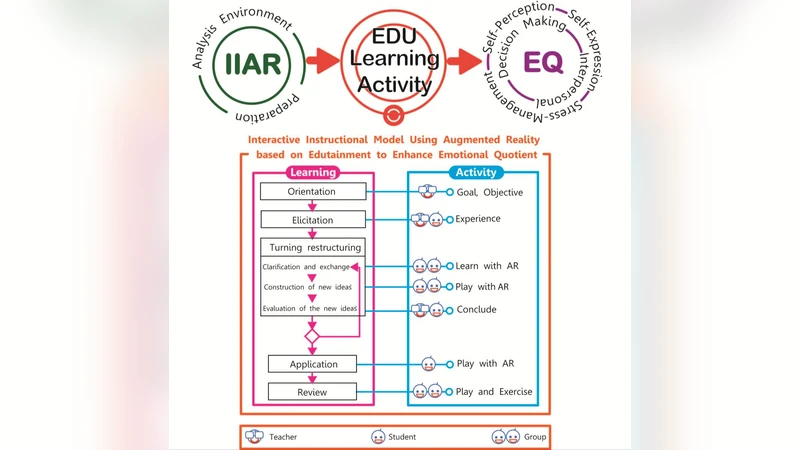
The research aims to develop an interactive instructional model using augmented reality based on edutainment to enhance emotional quotient and evaluate the model. Two phases of the research will be carried out: a development and an evaluation of the model. Samples are experts in the field of IT, child psychology, and 7th grade curriculum management. Ten experts are selected by purposive sampling method. The obtained data are analyzed using mean and standard deviation. The research result demonstrates the following findings: 1) The results of this research show that Model consists of 3 elements: IIAR, EduLA, and EQ. EQ is a means to assess EQ based on Time Series Experimental Design using 2 kinds of tools; i.e. EQ Assessment by programs in tablet computers, and EQ Assessment by behavioral observation. 2) The ten experts have evaluated the model and commented that the developed model showed high suitability.
💡 Research Summary
The paper presents the design, development, and expert validation of an interactive instructional model that integrates Augmented Reality (AR) with edutainment principles to foster the emotional quotient (EQ) of seventh‑grade students. The authors structure the research into two sequential phases: (1) model development and (2) model evaluation.
In the development phase, three core components are defined: (i) IIAR – an Interactive Instructional Augmented Reality layer that overlays digital information onto physical classroom objects, thereby delivering multimodal sensory cues (visual, auditory, and haptic) that align with the cognitive stage of early adolescents; (ii) EduLA – a set of educational learning activities built on edutainment concepts such as gamification, narrative storytelling, level progression, and immediate feedback, all tightly mapped to curriculum objectives; and (iii) EQ – a dual‑method assessment framework for emotional intelligence. The EQ component adopts a Time‑Series Experimental Design, employing (a) a tablet‑based program that quantifies EQ through interactive tasks and (b) systematic behavioral observation by teachers to capture qualitative aspects of affective development. By triangulating these two measurement streams, the model seeks to increase reliability and capture both overt and subtle changes in students’ emotional competencies.
For validation, the authors convened a purposive sample of ten domain experts—specialists in information technology, child psychology, and seventh‑grade curriculum management. Each expert reviewed detailed documentation of the model’s architecture, content alignment, technical feasibility, and the proposed EQ assessment tools. Data were reduced to descriptive statistics (means and standard deviations) on a five‑point Likert scale. All items achieved mean scores above 4.0, indicating a consensus of “high suitability.” Qualitative comments highlighted the novelty of merging AR with edutainment, the potential for heightened motivation and immersion, and the robustness of the dual‑method EQ assessment.
The study acknowledges several limitations. First, the sample size is modest and confined to expert opinion; no empirical data from actual students are presented. Second, the statistical treatment is limited to basic descriptive measures, precluding inference about causal effects. Third, practical implementation concerns—hardware costs, teacher training requirements, and variability in student receptivity—are mentioned only cursorily.
Future research directions proposed include (a) conducting longitudinal field trials with a sizable cohort of seventh‑graders to assess learning outcomes, engagement metrics, and EQ growth over time; (b) employing more sophisticated analytical techniques such as multivariate analysis of variance (MANOVA) or structural equation modeling (SEM) to test hypothesized pathways between AR exposure, edutainment engagement, and EQ improvement; (c) performing cost‑benefit analyses to determine scalability; and (d) developing professional development modules for teachers to ensure effective integration of AR hardware and edutainment pedagogy.
In conclusion, the paper offers an early‑stage proof‑of‑concept that an AR‑enhanced, edutainment‑driven instructional model can be theoretically sound and well‑received by domain experts as a vehicle for enhancing emotional intelligence. While the current evidence is limited to expert validation, the framework establishes a solid foundation for subsequent empirical investigations and for the broader adoption of affect‑focused, technology‑rich learning environments in middle‑school education.
Comments & Academic Discussion
Loading comments...
Leave a Comment