Why do we change whatever amount we found in the first envelope: the Wikipedia "two envelopes problem" commented
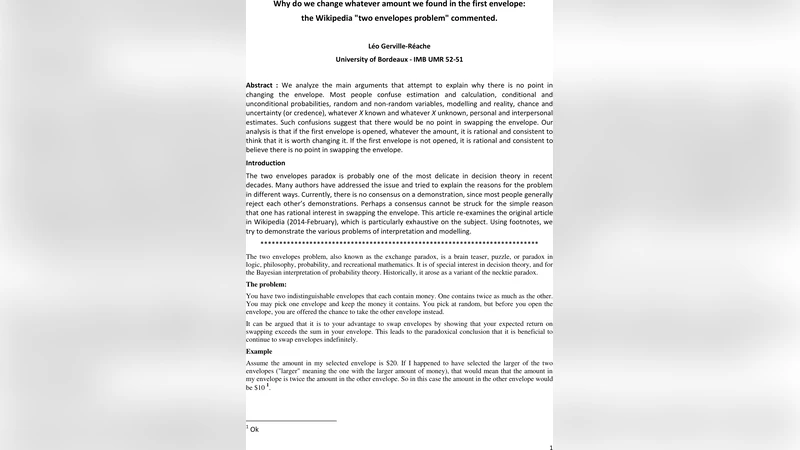
We analyze the main arguments that attempt to explain why there is no point in changing the envelope. Most people confuse estimation and calculation, conditional and unconditional probabilities, random and non-random variables, modelling and reality, chance and uncertainty (or credence), whatever X known and whatever X unknown, personal and interpersonal estimates. Such confusions suggest that there would be no point in swapping the envelope. Our analysis is that if the first envelope is opened, whatever the amount, it is rational and consistent to think that it is worth changing it. If the first envelope is not opened, it is rational and consistent to believe there is no point in swapping the envelope.
💡 Research Summary
The paper revisits the classic “two‑envelopes problem” and clarifies why the decision to switch envelopes depends entirely on whether the first envelope is opened. The author begins by cataloguing the most common misconceptions: conflating estimation with calculation, mixing conditional and unconditional probabilities, treating the amount X as a fixed constant rather than a random variable, and ignoring the distinction between a probabilistic model and real‑world uncertainty.
In the “closed‑envelope” scenario, no information about the contents is available, so the decision must be based solely on the prior distribution P(X). If the prior is symmetric (for example, a uniform distribution over a sufficiently wide range) the expected value of each envelope is identical, and swapping yields no expected gain. Consequently, the rational stance is that there is no point in swapping when the envelope remains unopened.
The paper then turns to the “opened‑envelope” case. Once a specific amount a is observed, two mutually exclusive possibilities arise: (i) a equals the smaller amount X, in which case the other envelope contains 2a; or (ii) a equals the larger amount 2X, in which case the other envelope contains a/2. Assuming the standard prior that X and 2X are equally likely, Bayes’ theorem gives P(a = X | a observed) = P(a = 2X | a observed) = ½. The conditional expected value of switching therefore becomes
E
Comments & Academic Discussion
Loading comments...
Leave a Comment