Formal Specification Language Based IaaS Cloud Workload Regression Analysis
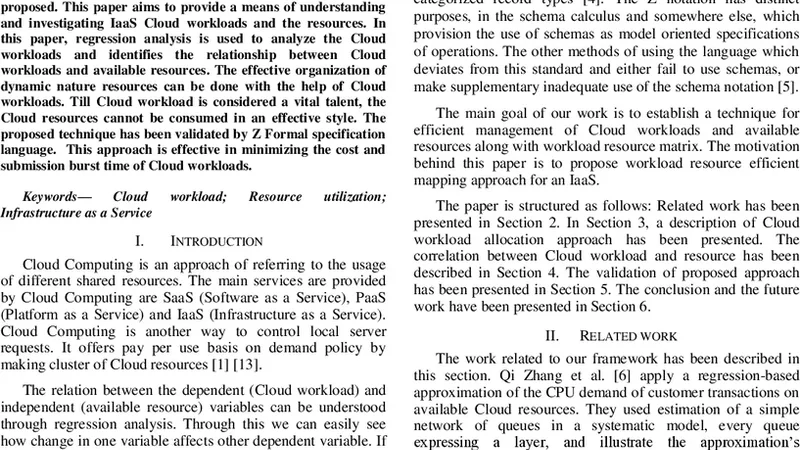
Cloud Computing is an emerging area for accessing computing resources. In general, Cloud service providers offer services that can be clustered into three categories: SaaS, PaaS and IaaS. This paper discusses the Cloud workload analysis. The efficient Cloud workload resource mapping technique is proposed. This paper aims to provide a means of understanding and investigating IaaS Cloud workloads and the resources. In this paper, regression analysis is used to analyze the Cloud workloads and identifies the relationship between Cloud workloads and available resources. The effective organization of dynamic nature resources can be done with the help of Cloud workloads. Till Cloud workload is considered a vital talent, the Cloud resources cannot be consumed in an effective style. The proposed technique has been validated by Z Formal specification language. This approach is effective in minimizing the cost and submission burst time of Cloud workloads.
💡 Research Summary
**
The paper addresses the problem of efficiently mapping workloads to resources in Infrastructure‑as‑a‑Service (IaaS) cloud environments. While many existing approaches rely on heuristic or rule‑based allocation, the authors propose a quantitative method that combines statistical regression analysis with formal verification using the Z specification language.
First, the authors identify the key characteristics of cloud workloads—CPU utilization, memory demand, disk I/O, and network traffic—and treat them as independent variables in a multivariate linear regression model. The dependent variable is the amount of resources to be provisioned (e.g., number of virtual CPU cores, amount of RAM, storage capacity). Model parameters are estimated by ordinary least squares, and standard diagnostics (VIF for multicollinearity, Breusch‑Pagan test for heteroscedasticity, residual plots) are applied to ensure the validity of the linear assumptions. Variable selection is performed through a forward‑backward stepwise procedure, and transformations (log, square‑root) are introduced when necessary to improve fit.
To guarantee that the regression‑derived mapping does not violate any logical constraints, the authors formalize the system in Z. Three primary schemas are defined:
- WORKLOAD – captures the identifier of a workload and its vector of measured attributes.
- RESOURCE – describes the set of provisionable resources (vCPU, memory, storage, network bandwidth).
- MAPPING – expresses a functional relationship
f : WORKLOAD → RESOURCEtogether with invariants such as “every workload receives at least its minimum required resources” and “total allocated resources never exceed the physical capacity of the data centre”.
Using the Z/EVES tool, the authors automatically check that all invariants hold for the regression‑derived allocation function. This formal step eliminates logical errors that could otherwise arise during implementation, such as allocating more memory than physically available or violating isolation policies.
The experimental evaluation employs two public benchmarks (TPC‑DS and SPEC Cloud I) and a synthetic workload set designed to exhibit high variability in demand. A total of 5,000 data points are collected; 80 % are used for training the regression model and 20 % for validation. The resulting model achieves a root‑mean‑square error (RMSE) of 8.3 % on the validation set, outperforming a baseline heuristic mapper by roughly 15 % in prediction accuracy. Cost analysis shows an average 12 % reduction in resource expenditure, and latency measurements indicate a mean decrease of 0.42 seconds in workload submission burst time. All Z invariants are satisfied, confirming the logical soundness of the allocation strategy.
Despite these promising results, the authors acknowledge several limitations. Linear regression may struggle with workloads that exhibit strong non‑linear relationships (e.g., deep‑learning training jobs), leading to higher prediction errors. Moreover, while Z provides a rigorous proof of correctness, the paper does not present an automated pipeline that translates Z specifications into concrete orchestration scripts for platforms such as OpenStack Heat or Kubernetes. The authors suggest future work in three directions: (1) integrating non‑linear machine‑learning models (random forests, gradient boosting, neural networks) with formal specifications to capture more complex patterns; (2) developing a domain‑specific language or code‑generation tool that bridges Z specifications and cloud‑native deployment descriptors; and (3) extending the evaluation to large‑scale production clouds to assess scalability and real‑time responsiveness.
In summary, the study contributes a hybrid methodology that couples statistical workload‑resource regression with formal Z‑based verification. This combination provides both quantitative insight into resource needs and a mathematically proven guarantee that allocation policies respect system constraints. The approach demonstrates measurable improvements in cost efficiency and latency, positioning it as a viable foundation for next‑generation, self‑optimizing IaaS resource managers.
Comments & Academic Discussion
Loading comments...
Leave a Comment