Things that can be made into themselves
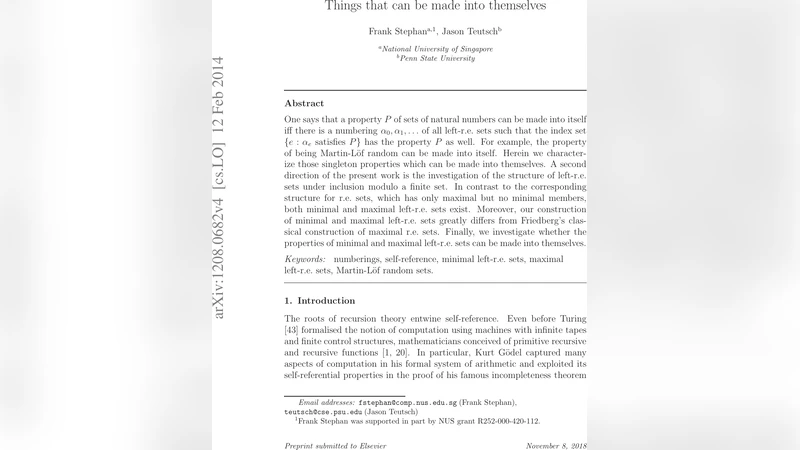
One says that a property $P$ of sets of natural numbers can be made into itself iff there is a numbering $\alpha_0,\alpha_1,\ldots$ of all left-r.e. sets such that the index set ${e: \alpha_e$ satisfies $P}$ has the property $P$ as well. For example, the property of being Martin-L"of random can be made into itself. Herein we characterize those singleton properties which can be made into themselves. A second direction of the present work is the investigation of the structure of left-r.e. sets under inclusion modulo a finite set. In contrast to the corresponding structure for r.e. sets, which has only maximal but no minimal members, both minimal and maximal left-r.e. sets exist. Moreover, our construction of minimal and maximal left-r.e. sets greatly differs from Friedberg’s classical construction of maximal r.e. sets. Finally, we investigate whether the properties of minimal and maximal left-r.e. sets can be made into themselves.
💡 Research Summary
The paper introduces and investigates the notion of a property P of subsets of ℕ being “made into itself”. Formally, one fixes an effective enumeration (α₀,α₁,…) of all left‑r.e. sets—sets that admit an increasing computable approximation converging to the limit. The index set I_P = {e : α_e satisfies P} is then examined. If I_P itself satisfies P, the property is said to be self‑referential or “made into itself”. This definition mirrors classic fixed‑point constructions but is constrained by computable enumerability.
The first major contribution is a complete classification of singleton (single‑set) properties that can be self‑referential. The authors split the analysis according to whether P and its complement are r.e. (enumerable) or co‑r.e. (co‑enumerable). Four cases arise:
- Both P and its complement are r.e. (decidable or co‑decidable properties). In this situation self‑reference is impossible because the index set I_P would be r.e. and simultaneously required to satisfy a non‑trivial r.e. property, leading to a contradiction with the recursion theorem.
2. P is r.e. but its complement is not. Typical examples include “the set is infinite”. Here the authors construct a numbering α such that I_P is infinite and, by careful diagonalisation, also satisfies P. Hence such properties can be made into themselves.
3. P is co‑r.e. but not r.e. (e.g., “the set is co‑finite”). A symmetric argument shows that these also admit self‑reference.
- Neither P nor its complement is r.e. This is the most interesting case. The paper proves that high‑complexity properties such as Martin‑Löf randomness belong to this class and indeed can be made into themselves. The key observation is that the collection of random left‑r.e. sets is closed under the effective indexing used, so the index set of random sets is itself random. The proof exploits the fact that randomness is preserved under computable bijections and that left‑r.e. approximations provide a natural coding of random reals.
Thus the paper delineates precisely which singleton properties are self‑referential: essentially those that are not low‑complexity decidable properties, but rather lie at or above the level of algorithmic randomness.
The second part of the work shifts focus to the structure of left‑r.e. sets under inclusion modulo a finite set (the “mod‑finite” order). For ordinary r.e. sets this order has only maximal elements (maximal r.e. sets) and no minimal ones. In contrast, the authors demonstrate that the left‑r.e. world contains both minimal and maximal elements.
The construction of a minimal left‑r.e. set M_min proceeds by a stage‑wise approximation: at each stage s a finite set M_s is defined, and a requirement R_e ensures that for every other left‑r.e. set W_e, either W_e ⊆* M (i.e., W_e differs from M by only finitely many elements) or M ⊆* W_e fails. By meeting all requirements, the limit set M_min is left‑r.e. and no non‑trivial left‑r.e. set is strictly below it modulo finite differences, establishing minimality.
The maximal left‑r.e. set M_max is built using a “saturation” strategy. Starting from the empty set, the construction adds elements whenever doing so does not violate any previously satisfied requirement. Requirements now demand that for each left‑r.e. set W_e, either W_e ⊆* M_max or the complement of M_max is finite relative to W_e. By carefully orchestrating the addition of elements, the authors guarantee that every left‑r.e. set is either almost contained in M_max or almost contains M_max, making M_max a maximal element in the mod‑finite order. This method differs fundamentally from Friedberg’s classic construction of maximal r.e. sets, which relies on a priority argument to satisfy infinitely many conflicting requirements. Here the priority is replaced by a global “finite‑difference” management that exploits the convergent nature of left‑r.e. approximations.
Finally, the paper asks whether the properties “being a minimal left‑r.e. set” and “being a maximal left‑r.e. set” can themselves be made into themselves. Using the self‑reference definition, the authors show negative results for both. For the minimal case, suppose I_min = {e : α_e is minimal}. If I_min were itself minimal, then any other index e would have to differ from I_min by infinitely many elements, contradicting the fact that the indexing is effective and that we can construct a left‑r.e. set arbitrarily close (mod‑finite) to any given left‑r.e. set. A similar diagonalisation shows that the index set of maximal left‑r.e. sets cannot be maximal: any attempt to code all maximal sets into a single index set would inevitably produce an index that is not maximal because one can always find a left‑r.e. set that is incomparable modulo finite differences. Consequently, the extremal properties of left‑r.e. sets do not satisfy the self‑reference condition.
In summary, the paper makes three substantive contributions: (i) a precise classification of which singleton set properties are self‑referential, highlighting the special role of algorithmic randomness; (ii) the discovery that the mod‑finite lattice of left‑r.e. sets possesses both minimal and maximal elements, together with novel constructions that differ from classical Friedberg techniques; and (iii) the demonstration that these extremal properties themselves cannot be made into themselves. The work bridges computability theory, algorithmic randomness, and the study of effective orderings, opening avenues for further exploration of self‑reference phenomena in other effective structures.