Linials Lower Bound Made Easy
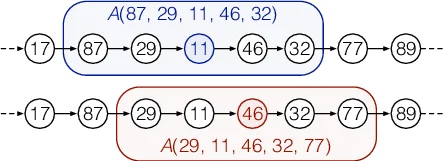
Linial’s seminal result shows that any deterministic distributed algorithm that finds a $3$-colouring of an $n$-cycle requires at least $\log^*(n)/2 - 1$ communication rounds. We give a new simpler proof of this theorem.
💡 Research Summary
The paper revisits Linial’s classic lower‑bound result for deterministic distributed algorithms that 3‑colour an n‑node directed cycle. Linial proved that any such algorithm must run for at least (½ log* n − 1) communication rounds. The authors present a new proof that is self‑contained, avoids heavy graph‑theoretic machinery, and can be explained on a whiteboard in roughly fifteen minutes.
The authors model a distributed algorithm with running time T as a function A that takes a (2T + 1)‑tuple of distinct node identifiers (the identifiers visible within distance T) and outputs a colour from {1,2,3}. The function must satisfy two properties: (i) its output is always one of the allowed colours, and (ii) for any two overlapping (2T + 1)‑tuples that differ by a shift of one position, the outputs must be different. They call any function satisfying these conditions a “k‑ary c‑colouring function”, where k = 2T + 1 and c is the number of colours.
The proof proceeds by two lemmas. Lemma 1 states that a 1‑ary c‑colouring function can exist only if c ≥ n. The argument is a direct pigeon‑hole principle: if fewer than n colours are available, two distinct identifiers would be mapped to the same colour, violating the adjacency condition. Lemma 2 shows how to transform a k‑ary c‑colouring function A into a (k‑1)‑ary 2c‑colouring function B. B is defined by looking at all possible extensions of its (k‑1)‑tuple with a larger identifier and collecting the set of colours that A could output; this set can be encoded as an integer between 1 and 2c. The authors verify that B still satisfies the two defining properties of a colouring function. The crucial part of the verification uses a contradiction: if B assigned the same colour to two overlapping (k‑1)‑tuples, then A would assign the same colour to two overlapping k‑tuples, which is forbidden.
Armed with these lemmas, the authors perform an inductive argument. Starting from a k‑ary 3‑colouring function (the assumed existence of a T‑round algorithm), they repeatedly apply Lemma 2, each time halving the arity and doubling the colour count. After k − 1 applications they obtain a 1‑ary function that uses 3^{k} colours. Lemma 1 then forces 3^{k} ≥ n, which is equivalent to k + 1 ≥ log* n. Substituting k = 2T + 1 yields the desired lower bound T ≥ ½·log* n − 1.
The significance of this proof lies in its simplicity. It does not rely on neighbourhood graphs, line graphs, or Ramsey‑type arguments that appear in many textbook presentations of Linial’s result. Instead, it uses only elementary combinatorial reasoning and a clean abstraction (the colouring function) that captures the essence of locality in distributed computation. This makes the argument highly accessible for teaching and suggests that similar techniques could be applied to other distributed symmetry‑breaking problems, such as maximal independent set or matching, where locality lower bounds are also of interest.
In conclusion, the paper provides a concise, self‑contained proof of Linial’s lower bound, emphasizing pedagogical clarity while preserving the tightness of the original result. The authors hope that this exposition will help disseminate the intuition behind locality lower bounds to a broader audience and inspire further research using comparable elementary methods.
Comments & Academic Discussion
Loading comments...
Leave a Comment