Virtual Learning Environments-A Survey
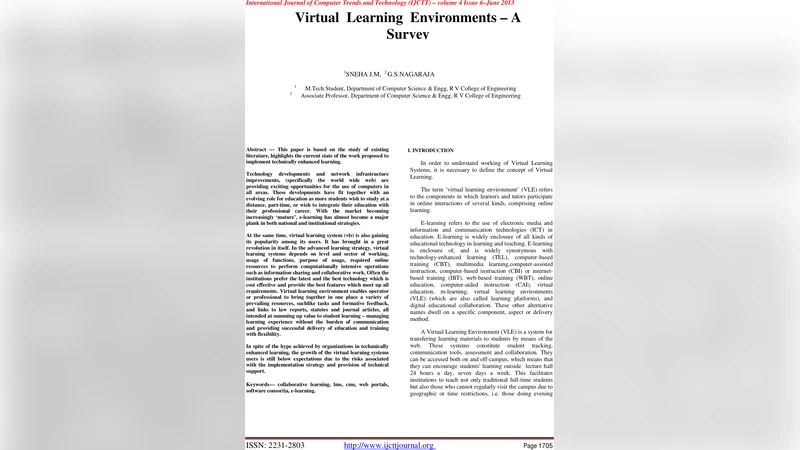
This paper is based on the study of existing literature, highlights the current state of the work proposed to implement technically enhanced learning. Technology developments and network infrastructure improvements, specifically the world wide web) are providing exciting opportunities for the use of computers in all areas. These developments have fit together with an evolving role for education as more students wish to study at a distance, part time, or wish to integrate their education with their professional career. With the market becoming increasingly mature, e learning has almost become a major plank in both national and institutional strategies. At the same time, virtual learning system is also gaining its popularity among its users. It has brought in a great revolution in itself. In the advanced learning strategy, virtual learning systems depends on level and sector of working, usage of functions, purpose of usage, required online resources to perform computationally intensive operations such as information sharing and collaborative work. Often the institutions prefer the latest and the best technology which is cost effective and provide the best features which meet up all requirements. Virtual learning environment enables operator professional to bring together in one place a variety of prevailing resources, suchlike tasks and formative feedback, and links to law reports, statutes and journal articles, all intended at summing up value to student learning managing learning experience without the burden of communication and providing successful delivery of education and training with flexibility. In spite of the hype achieved by organizations in technically enhanced learning, the growth of the virtual learning systems users is still below expectations due to the risks associated with the implementation strategy and provision of technical support.
💡 Research Summary
This paper provides a comprehensive literature‑based survey of virtual learning environments (VLEs), examining their technological foundations, market maturity, adoption drivers, and the risks that hinder wider uptake. The authors begin by linking the rapid evolution of web technologies and high‑speed network infrastructure to the emergence of digitally‑enhanced learning. The ubiquity of the World Wide Web and broadband connectivity has made it possible to deliver large multimedia resources, real‑time lectures, virtual labs, and collaborative tools, effectively digitising the traditional classroom. At the same time, a growing segment of learners—working professionals, part‑time students, and those living in remote areas—are demanding flexible, “anytime, anywhere” education. Governments and institutions have responded by embedding e‑learning into national strategies and institutional plans, treating it as a cornerstone of lifelong learning, workforce development, and competitive advantage.
The market analysis shows that e‑learning has moved from an experimental niche to a mature sector, with a plethora of commercial learning management systems (LMS), cloud‑based platforms, AI‑driven personalization engines, and immersive technologies such as virtual and augmented reality. However, the authors note that actual user growth remains below expectations. Three inter‑related constraints are identified. First, technology selection is complex: while the latest cloud, AI, and immersive tools offer rich functionality, they also entail high upfront costs, licensing fees, and ongoing maintenance burdens that many institutions—especially smaller colleges and corporate training units—cannot sustain. Second, operational support is often insufficient. After deployment, institutions must manage servers, perform regular backups, apply security patches, and provide help‑desk services. Without a dedicated support structure, system reliability deteriorates, leading to user frustration and abandonment. Third, the measurement of learning outcomes in virtual settings is still nascent. Traditional assessment methods do not easily capture online engagement, collaborative quality, or knowledge transfer, and there is a lack of standardized metrics to demonstrate the pedagogical effectiveness of VLEs.
The paper then turns to risk analysis. Four primary risk categories are highlighted: (1) ambiguous requirement definition, which can cause feature over‑engineering or omission of critical functions; (2) budget overruns driven by the pursuit of the “latest and greatest” technology without clear cost‑benefit justification; (3) security and privacy vulnerabilities, as learner data and personal information are stored in cloud environments susceptible to unauthorized access and breaches; and (4) support and operational risks stemming from inadequate staffing and unclear service‑level agreements. To mitigate these risks, the authors recommend a phased implementation strategy. Pilot projects should be launched with a limited set of courses and a small learner cohort, allowing institutions to collect feedback, refine workflows, and validate technical performance before scaling up. A multidisciplinary implementation team—comprising IT specialists, instructional designers, and assessment experts—should be assembled to ensure that pedagogical goals, technical architecture, and evaluation frameworks are aligned from the outset. Security measures such as end‑to‑end encryption, robust access controls, regular vulnerability assessments, and compliance with relevant data‑protection regulations must be embedded in the design. Finally, sustainable support models—formal Service Level Agreements (SLAs) with cloud providers, an internal help‑desk, and an online knowledge base—are essential for maintaining system uptime and user satisfaction.
In conclusion, the authors argue that while virtual learning environments hold great promise for expanding access, personalising instruction, and enhancing collaborative learning, their successful adoption hinges on a balanced approach that integrates cost‑effectiveness, incremental rollout, comprehensive technical support, and rigorous outcome measurement. When these elements are harmonised, VLEs can become a true engine of educational innovation, delivering flexible, high‑quality learning experiences without the burden of excessive risk or unsustainable expense.
Comments & Academic Discussion
Loading comments...
Leave a Comment