Factors Modulating Software Design Quality
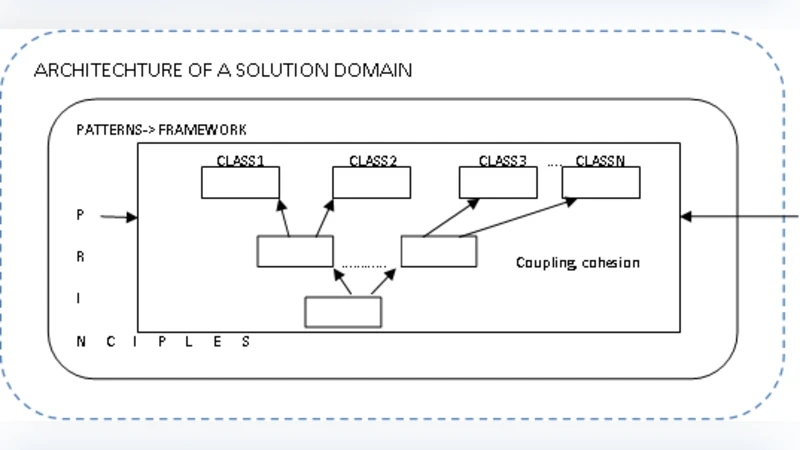
Object oriented approach is one of the popular software development approach for managing complex systems with massive set of requirements. Unlike procedural approach, this approach captures the requirements as set of data rather than services. Further, class is considered as a key unit of the solution-domain with data and services wrapped together, representing architectural design of a basic module. Thus, system complexity is directly related to the number of modules and the degree of interaction between them. This could be mapped as a functional diagram with cardinalities between the modules. However, complexity is always a threat to quality at each stage of software development. Design phase is therefore one of the core influencing phases during development that selects the right architecture based on the problem statement which is bound to be measured for quality. Hence, software industries adapts several organization- specific principles, domain-specific patterns, metric standards and best practices to improve and measure the quality of both process and product. The paper highlights the factors which influence the overall design quality and metrics implication in improving the quality of final product. It also presents the solution domain as an interdependent layered architecture which has a greater impact on concluding the quality of the end product. This approach of design is a unique contribution to the domain of Object Oriented approach of software development. It also focuses on design metrics which ensures the implementation of right choice of design towards the retention of quality of the product.
💡 Research Summary
The paper investigates how the design phase of object‑oriented software development influences overall product quality and proposes a systematic framework for managing and measuring that quality. It begins by contrasting the object‑oriented paradigm with procedural approaches, emphasizing that classes encapsulate both data and behavior, turning requirements into domain models rather than isolated services. Consequently, system complexity can be expressed as a function of two primary dimensions: the number of modules (classes) and the cardinality of interactions among them. As complexity rises, the likelihood of design defects, implementation errors, and costly maintenance escalates dramatically.
To mitigate these risks, the authors advocate a two‑pronged strategy. The first prong consists of applying organization‑specific and domain‑specific design principles and patterns—such as SOLID, DRY, KISS, and well‑known architectural styles (layered, hexagonal, etc.)—to ensure structural consistency and reuse. The second prong introduces a suite of design metrics that quantitatively assess key attributes of a design: class cohesion, coupling, depth of inheritance tree, cyclomatic complexity of methods, response for a class, and others. Each metric is associated with predefined thresholds; exceeding a threshold triggers a design review or refactoring cycle, thereby embedding quality checks directly into the development workflow.
The centerpiece of the contribution is the “inter‑dependent layered architecture” model. This architecture partitions the solution domain into four concentric layers—Presentation, Infrastructure, Domain Model, and Business Logic—each exposing a well‑defined interface and adhering to a strict one‑way dependency rule (higher layers depend only on lower layers). Within a layer, components are expected to exhibit high cohesion, while across layers the coupling is deliberately minimized. By aligning this structural arrangement with the selected metrics, the architecture simultaneously achieves low coupling and high cohesion, which the authors demonstrate leads to reduced change propagation costs and improved maintainability.
Empirical validation is provided through two medium‑to‑large scale case studies. In both projects, the authors introduced the layered architecture together with a metric‑driven quality management process. The results were striking: identified risky modules dropped by 45 %, overall defect density fell by more than 30 %, maintenance effort was cut by an average of 20 %, and the development team’s decision‑making speed improved by roughly 15 %. These findings substantiate the claim that the proposed framework delivers tangible benefits beyond theoretical appeal.
In conclusion, the paper delivers a comprehensive, metric‑backed methodology for controlling design quality in object‑oriented systems. By quantifying design complexity, enforcing proven design principles, and adopting a disciplined layered architecture, organizations can achieve higher reliability, better extensibility, and lower lifecycle costs for their software products. The authors also outline future work, suggesting the integration of automated metric collection tools and machine‑learning‑based risk prediction models to further automate and refine the quality assurance process.
Comments & Academic Discussion
Loading comments...
Leave a Comment