Study of Cloud Computing in HealthCare Industry
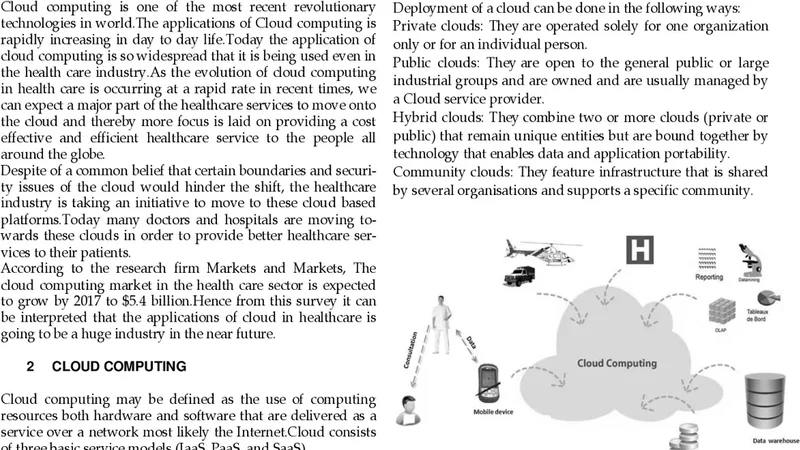
In Todays real world technology has become a domiant crucial component in every industry including healthcare industry. The benefits of storing electronically the records of patients have increased the productivity of patient care and easy accessibility and usage. The recent technological innovations in the health care is the invention of cloud based Technology. But many fears and security measures regarding patient records storing remotely is a concern for many in health care industry. One needs to understand the benefits and fears of implementation of cloud computing its advantages and disadvantages of this new technology.
💡 Research Summary
The paper provides a comprehensive examination of cloud computing adoption within the healthcare sector, focusing on its potential benefits, inherent risks, and the strategies required to balance innovation with patient‑centred security. It begins by outlining the limitations of traditional on‑premise health‑information systems—namely constrained storage capacity, high maintenance costs, and vulnerability to downtime—and demonstrates how cloud‑based architectures address these challenges through virtualization, elastic resource provisioning, and geographically distributed data centres that ensure high availability and disaster recovery. By moving electronic health records (EHR), picture archiving and communication systems (PACS), and ancillary clinical applications to the cloud, healthcare providers can achieve real‑time data access, streamline inter‑institutional collaboration, and expand telemedicine services, ultimately improving clinical efficiency and patient outcomes.
The core of the analysis, however, is devoted to the security and privacy concerns that dominate stakeholder discourse. Medical data are classified as highly sensitive personal health information (PHI), subject to strict regulatory frameworks such as HIPAA (U.S.), GDPR (EU), and national equivalents. The authors argue that robust encryption must be applied both in transit (TLS/SSL) and at rest (server‑side encryption with customer‑managed keys), complemented by multi‑factor authentication (MFA) and role‑based access control (RBAC) to mitigate insider threats. Continuous security monitoring, periodic penetration testing, and well‑defined incident‑response procedures are recommended to maintain a proactive security posture.
Compliance considerations are woven throughout the discussion. Service Level Agreements (SLAs) should explicitly define data ownership, jurisdiction, retention periods, Recovery Point Objectives (RPO), and Recovery Time Objectives (RTO). The paper stresses the importance of contractual clauses that guarantee the cloud provider’s adherence to applicable health‑information standards and the right to audit compliance. Upon contract termination, a secure data sanitisation and verification process must be executed to prevent residual data leakage.
Beyond technical safeguards, the authors emphasize organizational readiness. Effective cloud adoption requires cultural change, cross‑functional collaboration between clinicians and IT staff, and targeted training programs that build confidence in cloud‑based workflows. Case studies illustrate tangible benefits: a large U.S. hospital network reduced readmission rates by 12% after implementing a cloud‑hosted EHR, while a regional Korean clinic cut imaging transfer times by 70% using cloud storage, demonstrating both clinical and operational gains.
In the forward‑looking section, the paper identifies emerging research avenues. Privacy‑preserving techniques such as homomorphic encryption and differential privacy are highlighted as promising methods to process PHI in the cloud without exposing raw data. AI‑driven anomaly detection systems can provide real‑time threat intelligence, while blockchain‑based provenance mechanisms could ensure immutable audit trails for medical records. The authors conclude that a multi‑layered approach—combining advanced cryptographic safeguards, rigorous compliance management, and organizational change management—will be essential for healthcare institutions to fully leverage cloud computing while protecting patient confidentiality and maintaining regulatory compliance.
Comments & Academic Discussion
Loading comments...
Leave a Comment