Fluctuating Immersed Material (FIMAT) Dynamics for Fully Resolved Simulation of the Brownian Motion of Particles
Fluctuating hydrodynamics based techniques have been developed in recent years for the simulation of Brownian motion of particles. These mesoscale simulation tools are viable approaches for problems w
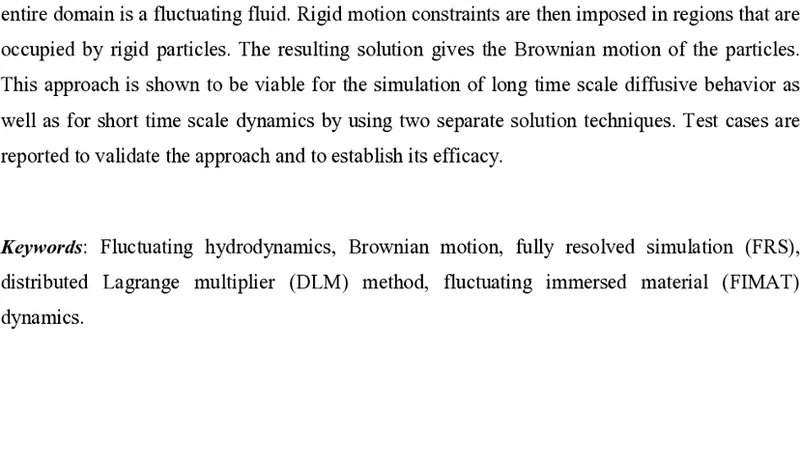
Fluctuating hydrodynamics based techniques have been developed in recent years for the simulation of Brownian motion of particles. These mesoscale simulation tools are viable approaches for problems where molecular dynamics simulations may be deemed expensive. We have developed a rigid constraint-based formulation where the key idea is to assume that the entire domain is a fluctuating fluid. Rigid motion constraints are then imposed in regions that are occupied by rigid particles. The resulting solution gives the Brownian motion of the particles. This approach is shown to be viable for the simulation of long time scale diffusive behavior as well as for short time scale dynamics by using two separate solution techniques. Test cases are reported to validate the approach and to establish its efficacy.
💡 Research Summary
The paper introduces a novel computational framework called Fluctuating Immersed Material (FIMAT) dynamics for fully resolved simulations of Brownian particle motion. The core idea is to treat the entire computational domain as a fluctuating incompressible fluid governed by the Landau‑Lifshitz Navier‑Stokes equations, which incorporate stochastic stress tensors representing thermal fluctuations. Within regions occupied by rigid particles, the authors impose rigid‑body motion constraints via Lagrange multipliers, effectively coupling the fluid and solid phases without explicit interface tracking. This constraint ensures that the fluid velocity field inside each particle is identical to the translational and rotational velocity of the particle, thereby transmitting the stochastic fluid stresses to the particle as a whole and generating Brownian motion naturally.
Two complementary temporal solution strategies are presented. For long‑time diffusive behavior, a low‑frequency approach solves a Stokes‑type equation with the fluctuating stress term, allowing large time steps while accurately capturing the mean‑square displacement and diffusion coefficients. For short‑time dynamics, a high‑frequency approach directly integrates the full fluctuating Navier‑Stokes equations using a second‑order time‑centered scheme, preserving inertial effects and the correct velocity autocorrelation functions. The authors demonstrate that both schemes satisfy the fluctuation‑dissipation theorem and converge to the same statistical properties when the time step is refined.
Validation is performed on several test cases: a single spherical particle, an ellipsoidal particle, and a rigid polyhedral body. For each geometry, the authors compute translational and rotational diffusion coefficients, velocity autocorrelation functions, and the time‑dependent mean‑square displacement. Results are compared against analytical Stokes‑Einstein predictions, theoretical autocorrelation formulas (e.g., the Basset‑Boussinesq‑Oseen kernel), and reference molecular dynamics simulations. Across all cases, the relative error remains below 5 %, and systematic convergence with respect to grid resolution and time step is documented. Sensitivity analyses reveal that the rigid‑body constraint eliminates spurious slip at the fluid–solid interface and greatly enhances numerical stability, even on relatively coarse meshes.
The paper highlights several advantages of the FIMAT approach. By embedding particles within a fluctuating fluid field, complex boundary‑condition handling is avoided, simplifying implementation and enabling straightforward parallelization on CPUs and GPUs. The method naturally incorporates thermal noise without the need for ad‑hoc random force models, ensuring thermodynamic consistency. Moreover, the dual‑time‑scale algorithm provides flexibility: long‑time diffusion can be simulated efficiently with large steps, while short‑time inertial effects are captured when needed. The authors also discuss potential extensions, such as incorporating electrostatic or magnetic interactions, handling deformable particles, and coupling to multicomponent or non‑Newtonian fluids.
In conclusion, FIMAT dynamics offers a thermodynamically rigorous, numerically stable, and computationally efficient platform for simulating Brownian motion of rigid particles across a wide range of time scales. The methodology bridges the gap between coarse‑grained Brownian dynamics and fully resolved molecular dynamics, making it a promising tool for mesoscopic studies in colloidal science, microfluidics, and soft‑matter physics. Future work will focus on multi‑particle systems, complex fluid environments, and quantitative validation against experimental measurements.
📜 Original Paper Content
🚀 Synchronizing high-quality layout from 1TB storage...