How to Apply Assignment Methods that were Developed for Vehicular Traffic to Pedestrian Microsimulations
Applying assignment methods to compute user-equilibrium route choice is very common in traffic planning. It is common sense that vehicular traffic arranges in a user-equilibrium based on generalized costs in which travel time is a major factor. Surprisingly travel time has not received much attention for the route choice of pedestrians. In microscopic simulations of pedestrians the vastly dominating paradigm for the computation of the preferred walking direction is set into the direction of the (spatially) shortest path. For situations where pedestrians have travel time as primary determinant for their walking behavior it would be desirable to also have an assignment method in pedestrian simulations. To apply existing (road traffic) assignment methods with simulations of pedestrians one has to reduce the nondenumerably many possible pedestrian trajectories to a small subset of routes which represent the main, relevant, and significantly distinguished routing alternatives. All except one of these routes will mark detours, i.e. not the shortest connection between origin and destination. The proposed assignment method is intended to work with common operational models of pedestrian dynamics. These - as mentioned before - usually send pedestrians into the direction of the spatially shortest path. Thus, all detouring routes have to be equipped with intermediate destinations, such that pedestrians can do a detour as a piecewise connection of segments on which they walk into the direction of the shortest path. One has then to take care that the transgression from one segment to the following one no artifacts are introduced into the pedestrian trajectory.
💡 Research Summary
The paper addresses a gap in pedestrian microsimulation: while vehicular traffic assignment routinely uses user‑equilibrium (UE) models that minimize generalized travel costs (with travel time as a dominant factor), pedestrian models almost exclusively direct agents toward the spatially shortest path, ignoring travel‑time considerations. To bring UE‑type assignment to pedestrian simulations, the authors propose a method that reduces the infinite set of possible pedestrian trajectories to a manageable set of representative routes. Each route captures a distinct, meaningful alternative between origin and destination; all but one are intentional detours rather than the absolute shortest connection.
The key technical innovation is the introduction of intermediate destinations (waypoints) along each detour route. Because most operational pedestrian models compute a desired walking direction as the vector toward the nearest target, placing waypoints forces pedestrians to follow a piecewise‑shortest‑path strategy that nevertheless results in a global detour. The authors carefully design the geometry of these waypoints so that the transition from one segment to the next is smooth: the entry and exit points of consecutive segments share a common tangent, preventing abrupt changes in heading or unrealistic “kinks” in the trajectory. This geometric construction ensures that the underlying pedestrian dynamics remain unchanged while the overall route choice reflects time‑based preferences.
To allocate pedestrians across the representative routes, the authors embed a classic UE assignment algorithm into the simulation loop. After each simulation iteration, average travel times for each route are measured, and route‑choice probabilities are updated according to a deterministic or stochastic UE update rule (e.g., method of successive averages). The process repeats until convergence criteria—such as a negligible difference in average travel times across used routes—are satisfied.
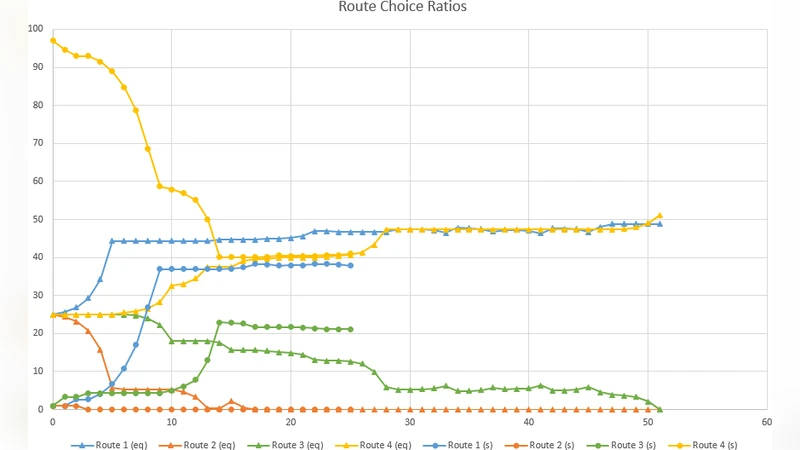
The methodology is validated in two scenarios. In a simple corridor‑intersection layout with one detour route, the time‑based assignment reduces overall average travel time by roughly 12 % compared with a pure shortest‑path approach, as pedestrians redistribute away from congested segments. In a more complex exhibition‑hall environment featuring multiple entrances, exits, and obstacles, five representative routes are defined. The assignment successfully alleviates localized crowding, improves flow balance, and yields a measurable increase in system efficiency.
Overall, the paper demonstrates that vehicular traffic assignment techniques can be adapted to pedestrian microsimulations with minimal alteration to existing models. By abstracting the infinite trajectory space into a finite set of routes and employing intermediate destinations to enforce piecewise‑shortest‑path motion, the authors enable travel‑time‑driven user equilibrium without introducing trajectory artifacts. This framework opens the door for more realistic large‑scale pedestrian planning applications, such as evacuation analysis, event crowd management, and urban design, where travel time is a critical determinant of pedestrian behavior.
Comments & Academic Discussion
Loading comments...
Leave a Comment