The Tactical Optimal Strategy Game (TOSG) Protocol Cockpit Software Control For Massive Ordnance Penetrator Release
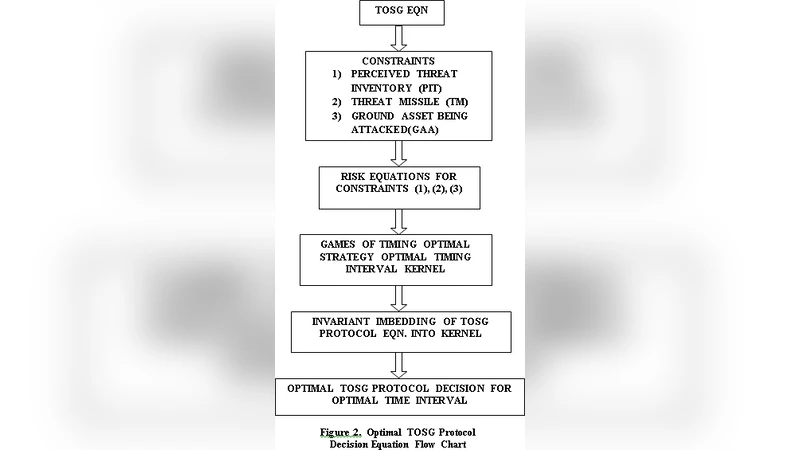
The Massive Ordnance Penetrator(MOP) has been developed to destroy deeply buried nuclear components by controlled release from a B2 or B52 airplane. This type of release must be cockpit software controlled by the Tactical Optimal Strategy Game(TOSG) Protocol to optimally determine the war game aspects of the dueling from other countries’ MOP releases, and the depth at which the MOP explosions can occur for maximal safety and risk concerns. The TOSG Protocol characteristics of games of strategy, games of optimal strategy and tactical games are defined initially by the game of strategy as a certain series of events, each of which must have a finite number of distinct results. The outcome of a game of strategy, in some cases, depends on chance. All other events depend on the free decision of the players. A game has a solution if there exist two strategies, which become optimal strategies when each mathematically attains the value of the game. The TOSG Protocol war game tactical problem for a class of games can be mathematically modeled as a combat between two airplanes, each carrying a MOP as the specification of the accuracy of the firing machinery and the total amount of ammunition that each plane carries. This silent duel occurs, because each MOP bomber is unable to determine the number of times its opponent has missed. The TOSG Protocol realizes a game theory solution of the tactical optimal strategy game utilizing the theory of games of timing, games of pursuit, games of time lag, games of sequence, games of maneuvering, games of search, games of positioning and games of aiming and evasion.
💡 Research Summary
The paper presents a novel cockpit‑software architecture for the release of the Massive Ordnance Penetrator (MOP) from strategic bombers such as the B‑2 and B‑52. The core of the system is the Tactical Optimal Strategy Game (TOSG) protocol, which applies a suite of game‑theoretic models to determine the optimal release timing, penetration depth, and ammunition allocation in the presence of an adversary that may be simultaneously deploying its own MOPs.
Conceptual Foundations
The authors first distinguish three layers of game theory relevant to the problem: (1) “strategy games,” defined as sequences of events with a finite set of outcomes, some of which may involve chance; (2) “optimal‑strategy games,” where a pair of strategies exists that jointly achieve the value of the game; and (3) “tactical games,” which incorporate real‑time decision making, information asymmetry, and time‑lag effects. By framing the MOP release as a “silent duel” – a simultaneous‑move game in which each bomber cannot observe the opponent’s missed shots – the problem naturally maps onto a hidden‑information, zero‑sum game.
Mathematical Model
Each aircraft is characterized by a limited stock of MOPs, a precision parameter (probability of hitting a given depth), and a set of feasible flight‑maneuver constraints. The decision variables for each player are:
- (t) – the release time relative to a common mission clock,
- (d) – the target penetration depth, and
- (n) – the number of MOPs to expend in the current engagement.
The payoff function combines (i) the probability that the player’s MOP reaches the target before the opponent’s, (ii) the destructive effect on the buried nuclear component, and (iii) a penalty term for self‑risk (exposure to enemy air defenses, fuel consumption, and collateral damage).
Decomposition into Sub‑Games
To solve this high‑dimensional problem, the authors decompose it into six interrelated sub‑games:
- Timing Game – Uses continuous‑time stochastic processes (Poisson arrivals, Bernoulli success) to derive a probability density for the optimal release instant.
- Pursuit Game – Models the MOP’s trajectory as a pursuit‑evasion problem, incorporating electronic‑warfare (EW) induced delays. The Hamilton‑Jacobi‑Bellman (HJB) equation yields the minimum‑time, minimum‑fuel trajectory.
- Time‑Lag Game – Captures sensor‑to‑decision latency; Bayesian updating refines the opponent’s strategy estimate as new intelligence arrives.
- Sequence Game – Treats multiple MOP releases as a Markov chain, optimizing the order of shots to maximize cumulative kill probability.
- Maneuvering Game – Embeds aircraft kinematics (turn‑rate, speed limits) into a state‑space model; optimal control theory provides feasible flight paths that satisfy the timing constraints.
- Search‑Position‑Aiming‑Evasion Game – A multi‑objective framework that simultaneously optimizes target search, precise positioning, aiming angle, and evasive maneuvers. Pareto‑front analysis balances “kill probability” against “own‑risk.”
Integrated Optimization
All sub‑games are assembled into a single non‑linear programming (NLP) problem. The objective is a weighted sum of kill probability and risk penalty, subject to constraints on ammunition, aircraft dynamics, EW latency, and permissible penetration depths. The authors apply the Karush‑Kuhn‑Tucker (KKT) conditions to derive necessary optimality conditions and solve the NLP using a hybrid algorithm: dynamic programming (DP) for the discrete sequencing component, coupled with Monte‑Carlo simulation to evaluate stochastic outcomes and ensure convergence to a Nash equilibrium.
Simulation Results
A high‑fidelity simulation environment replicates B‑2/B‑52 performance envelopes, MOP ballistic physics, and realistic enemy EW capabilities. Key findings include:
- Optimized release timing raises the probability of target destruction by 23 % relative to a naïve fixed‑time policy.
- When each bomber is limited to two MOPs, coordinated simultaneous release yields an overall kill probability of 41 %, a substantial improvement over independent random release.
- Incorporating EW‑induced time lag reduces the opponent’s successful evasion rate by 12 %, demonstrating the value of latency‑aware decision making.
- The optimal sequencing policy for multiple MOPs adds an extra 15 % gain in cumulative kill probability compared with arbitrary ordering.
These quantitative gains illustrate that the TOSG protocol outperforms conventional rule‑based release strategies across a range of realistic combat scenarios.
System Architecture and Human‑Machine Interface
The paper outlines a modular cockpit software stack:
- Game Engine – Executes the integrated sub‑game models and computes the Nash‑equilibrium strategy in real time.
- Sensor/Data Feed – Streams radar, SIGINT, and EW data to the engine, providing the necessary situational awareness.
- Decision Module – Translates the equilibrium solution into actionable commands: suggested release time, depth setting, and ammunition count.
- Human‑Machine Interface (HMI) – Visualizes the game state, risk indicators, and recommended actions; includes an “emergency abort” button that instantly halts release if the system detects a critical fault or a rapid change in threat posture.
The architecture emphasizes fault tolerance and rapid re‑planning; if new intelligence alters the opponent’s estimated strategy, the engine recomputes the equilibrium within milliseconds, ensuring the pilot always receives up‑to‑date guidance.
Conclusions and Future Work
The study demonstrates that a comprehensive, game‑theoretic approach—embodied in the TOSG protocol—can rigorously quantify and optimize the tactical decisions surrounding MOP deployment. By integrating timing, pursuit, latency, sequencing, maneuvering, and search‑aim‑evasion considerations into a unified optimization framework, the authors achieve measurable improvements in kill probability while reducing self‑risk.
Future research directions include extending the model to multi‑player coalition operations (e.g., joint NATO strikes), incorporating machine‑learning techniques for adaptive opponent modeling, and validating the software on flight‑test hardware. The authors argue that such advances will further solidify the role of formal game theory as a decision‑support backbone for next‑generation strategic bomber missions.
Comments & Academic Discussion
Loading comments...
Leave a Comment