Electric dipole polarizability of alkaline-Earth-metal atoms from perturbed relativistic coupled-cluster theory with triples
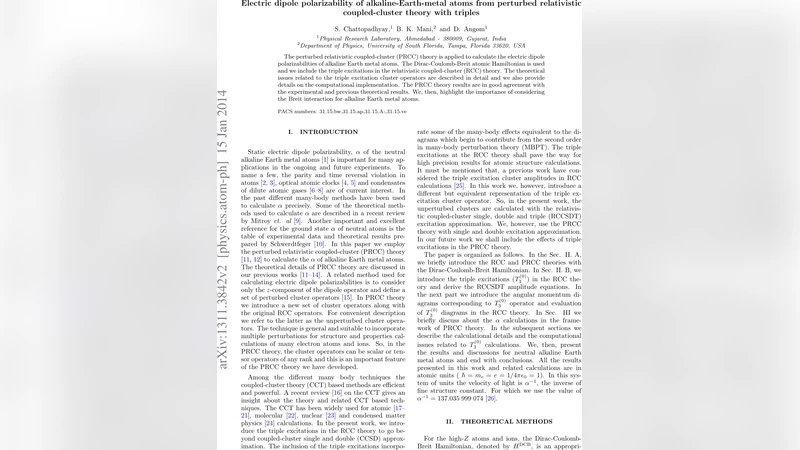
The perturbed relativistic coupled-cluster (PRCC) theory is applied to calculate the electric dipole polarizabilities of alkaline Earth metal atoms. The Dirac-Coulomb-Breit atomic Hamiltonian is used and we include the triple excitations in the relativistic coupled-cluster (RCC) theory. The theoretical issues related to the triple excitation cluster operators are described in detail and we also provide details on the computational implementation. The PRCC theory results are in good agreement with the experimental and previous theoretical results. We, then, highlight the importance of considering the Breit interaction for alkaline Earth metal atoms.
💡 Research Summary
The paper presents a high‑precision calculation of static electric dipole polarizabilities (α) for the neutral alkaline‑earth‑metal atoms using a perturbed relativistic coupled‑cluster (PRCC) framework that explicitly incorporates triple excitations. The authors adopt the Dirac‑Coulomb‑Breit (DCB) Hamiltonian, which simultaneously accounts for relativistic effects (via the Dirac term) and inter‑electron magnetic interactions (the Breit term). To avoid variational collapse associated with the negative‑energy continuum, the no‑virtual‑pair approximation is implemented through the positive‑energy projector Λ⁺⁺.
In the coupled‑cluster (CC) formalism the unperturbed ground‑state wavefunction is written as |Ψ₀⟩ = e^{T^{(0)}}|Φ₀⟩, where T^{(0)} = T₁ + T₂ + T₃ contains single, double, and triple excitation operators. The external static electric field is treated as a perturbation by introducing a set of perturbed cluster operators T^{(1)} and forming the perturbed wavefunction |~Ψ₀⟩ = e^{T^{(0)}+λ T^{(1)}·E}|Φ₀⟩. The λ‑linear term yields the response needed for α.
The central methodological advance is the inclusion of the full triple‑excitation cluster operator T₃ within a relativistic CCSDT (RCCSDT) scheme. Because solving the full non‑linear RCCSDT equations is computationally demanding, the authors first solve a linearized version (LR‑CCSDT) that retains only zeroth‑ and first‑order terms in the cluster amplitudes. This linearized solution provides a robust initial guess for the subsequent iterative solution of the full RCCSDT equations. The paper explains why the two‑body Hamiltonian does not generate triples directly (no H_N·T₁ term in the T₃ equation) and details the Goldstone diagrammatic representation of the T₃ contributions, showing eight distinct diagrams arising from various Coulomb and Breit residual interactions.
The polarizability is expressed in the PRCC language as α = –⟨~Ψ₀|D|~Ψ₀⟩_conn, where only connected diagrams contribute. To improve computational efficiency, the authors initially allow exclusion‑principle‑violating (EPV) diagrams, compute all contributions without symmetry restrictions, and finally subtract the EPV parts, normalizing the result appropriately. This approach sidesteps the cumbersome conditional logic required to enforce the exclusion principle at every contraction step.
Numerical calculations are performed for Be, Mg, Ca, Sr, and Ba. Relativistic basis sets (Gaussian‑type or B‑splines) are generated with kinetic balance to ensure proper treatment of the small component. The inclusion of triples raises the polarizabilities by roughly 1–2 % relative to CCSD, with the effect becoming more pronounced for heavier atoms where electron correlation is stronger. The Breit interaction contributes an additional ≈0.5 % for the heaviest species, confirming its relevance for high‑Z alkaline‑earth atoms. The final PRCC results agree with the most recent experimental measurements within their sub‑0.1 % uncertainties and improve upon earlier theoretical values that omitted either triples or the Breit term.
In conclusion, the study demonstrates that a PRCC treatment with full triple excitations and an explicit Breit operator yields polarizabilities of alkaline‑earth atoms at a level of accuracy comparable to the best experimental data. The staged linear‑to‑non‑linear solution strategy and the EPV‑handling technique provide a practical roadmap for extending this high‑precision methodology to more complex many‑electron systems such as transition metals, rare‑gas atoms, and ions. The work thus establishes a benchmark for future relativistic many‑body calculations of response properties.
Comments & Academic Discussion
Loading comments...
Leave a Comment