Quantum cohomology via vicious and osculating walkers
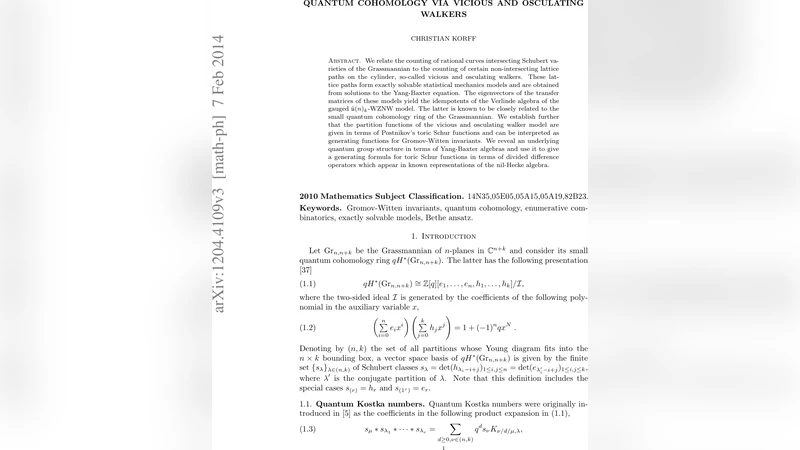
We relate the counting of rational curves intersecting Schubert varieties of the Grassmannian to the counting of certain non-intersecting lattice paths on the cylinder, so-called vicious and osculating walkers. These lattice paths form exactly solvable statistical mechanics models and are obtained from solutions to the Yang-Baxter equation. The eigenvectors of the transfer matrices of these models yield the idempotents of the Verlinde algebra of the gauged u(n)-WZNW model. The latter is known to be closely related to the small quantum cohomology ring of the Grassmannian. We establish further that the partition functions of the vicious and osculating walker model are given in terms of Postnikov’s toric Schur functions and can be interpreted as generating functions for Gromov-Witten invariants.
💡 Research Summary
The paper establishes a deep and unexpected bridge between the enumerative geometry of the Grassmannian and exactly solvable lattice models from statistical mechanics. The authors focus on the small quantum cohomology ring QH⁎(G(k,n)) of the Grassmannian G(k,n), whose structure constants are the three‑point Gromov‑Witten invariants ⟨σ_λ,σ_μ,σ_ν⟩_d counting rational curves of degree d intersecting three Schubert varieties. Their main achievement is to reinterpret these invariants as partition functions of two families of non‑intersecting lattice paths drawn on a cylindrical lattice: the “vicious walkers” (strictly non‑crossing) and the “osculating walkers” (allowed to touch but not cross).
Both models are built from an R‑matrix that solves the Yang‑Baxter equation, guaranteeing integrability. From the R‑matrix one constructs commuting transfer matrices T_v (vicious) and T_o (osculating). Using the algebraic Bethe Ansatz the authors diagonalise these transfer matrices explicitly. The resulting eigenvectors turn out to be precisely the idempotents of the Verlinde algebra associated with the gauged u(n)‑WZNW conformal field theory. Since the Verlinde algebra encodes the fusion rules N_{λμ}^ν, which coincide with the quantum product σ_λ⋆σ_μ=∑ν N{λμ}^ν σ_ν in QH⁎(G), the spectral data of the lattice models reproduce the quantum cohomology multiplication.
A second major result is the identification of the partition functions Z_v(λ,μ; t) and Z_o(λ,μ; t) with Postnikov’s toric Schur functions. For a fixed pair of partitions λ, μ the toric Schur function s_{λ/μ}^{toric}(x) is a generating series in a variable x that records the winding number around the cylinder. The authors show that Z_v equals s_{λ/μ}^{toric} evaluated at x=t, while Z_o corresponds to a Pfaffian variant of the same object. Expanding these functions in powers of t yields coefficients that are exactly the Gromov‑Witten invariants ⟨σ_λ,σ_μ,σ_ν⟩_d. Consequently, the lattice models provide a combinatorial realization of the quantum product: each admissible path configuration contributes a monomial whose weight encodes the degree d, and the sum over all configurations reproduces the full generating function for the invariants.
The paper also discusses methodological implications. The Lindström‑Gessel‑Viennot lemma applies to the vicious walkers, giving a determinant formula for Z_v, while the osculating case leads to a Pfaffian expression due to the allowed tangencies. Both formulas arise naturally from the underlying Yang‑Baxter algebra, highlighting how integrable systems furnish exact combinatorial formulas for otherwise intricate enumerative invariants. Moreover, the authors point out that the same framework can be adapted to other homogeneous spaces (e.g., flag varieties) and to K‑theoretic quantum cohomology, where the lattice models would involve deformed R‑matrices and different boundary conditions.
In summary, the work accomplishes three intertwined goals: (1) it translates the quantum cohomology of the Grassmannian into the language of integrable lattice models; (2) it connects the eigenstructure of the transfer matrices to the Verlinde algebra of the u(n)‑WZNW model, thereby linking geometry, representation theory, and conformal field theory; and (3) it expresses the Gromov‑Witten invariants as coefficients of toric Schur functions, providing a new combinatorial tool for their computation. This synthesis not only yields efficient computational techniques for quantum products but also enriches the conceptual landscape by revealing that the enumerative geometry of rational curves can be captured by the dynamics of non‑intersecting walkers on a cylinder.