Counterflow in Evacuations
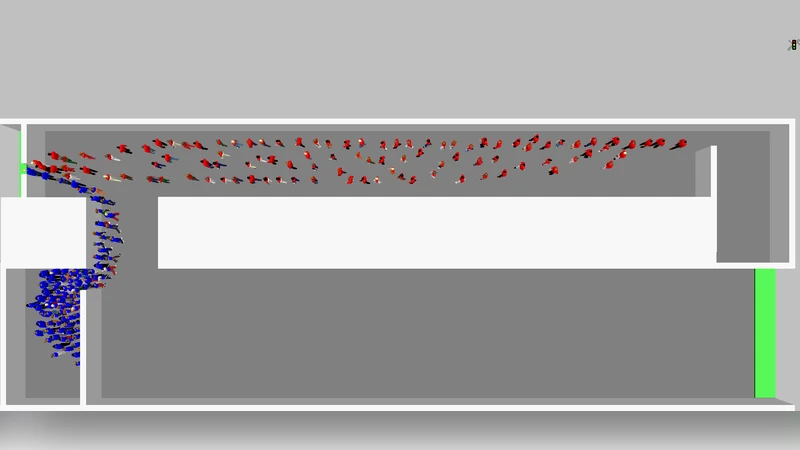
It is shown in this work that the average individual egress time and other performance indicators for egress of people from a building can be improved under certain circumstances if counterflow occurs. The circumstances include widely varying walking speeds and two differently far located exits with different capacity. The result is achieved both with a paper and pencil calculation as well as with a micro simulation of an example scenario. As the difficulty of exit signage with counterflow remains one cannot conclude from the result that an emergency evacuation procedure with counterflow would really be the better variant.
💡 Research Summary
The paper “Counterflow in Evacuations” investigates a counter‑intuitive situation in which allowing bidirectional pedestrian flow (counterflow) can actually reduce overall evacuation times. The authors construct a simple yet illustrative scenario: two rooms each contain 100 occupants, but the two groups differ dramatically in desired walking speed—blue agents walk at about 0.7 m/s while red agents walk at about 2.8 m/s. Two exits are available. Exit A is physically closer to both rooms but has a narrow bottleneck (0.8 m wide), limiting its capacity. Exit B is farther away but extremely wide (9.7 m), effectively offering unlimited capacity.
Four routing strategies are examined: (1) “Shortest Path” where both groups use Exit A, (2) “Maximum Capacity” where both use Exit B, (3) “Separated” where the fast red group uses Exit A and the slow blue group uses Exit B, and (4) “Counterflow” where the slow blue group uses Exit A while the fast red group uses Exit B, thereby creating a bidirectional flow in the connecting corridor.
First, a paper‑and‑pencil calculation reduces the geometry to a network of links with known lengths, speeds, and a specific flow rate of 1.31 person/(m·s). Using these parameters the authors compute evacuation times for each strategy. The counterflow configuration yields the smallest total evacuation time (red ≈ 82 s, blue ≈ 109 s) compared with the other three strategies, where the shortest‑path case suffers from severe bottleneck delays (≈ 205 s for both groups).
Second, the authors validate the analytical results with microscopic simulations using the VISWALK module of VISSIM, which implements a Social‑Force pedestrian model. Each strategy is simulated 20 times with different random seeds. Results are reported for three performance measures: (a) average individual egress time, (b) time when 95 % of agents have reached an exit, and (c) total evacuation time (all agents have left). Across all measures, the counterflow strategy consistently ranks best or near‑best. For example, average individual egress times are 124.5 s (blue) and 112.6 s (red) under counterflow, the lowest among the four strategies. The 95 % completion time for red agents is 58.1 s, again the fastest. Total evacuation time is 206.1 s (blue) and 59.8 s (red), the smallest observed.
Time‑evolution plots of cumulative arrivals further illustrate that the fast red agents quickly occupy Exit A, freeing Exit B for the slower blue agents, thus minimizing queuing at the narrow bottleneck. The authors note that the connecting corridor was deliberately made wide to keep friction from counterflow low; in narrower passages the efficiency gain might diminish.
The discussion acknowledges practical limitations. Real‑world emergency signage is static and cannot convey speed‑dependent routing instructions (“if you are fast, go this way; otherwise, that way”). Implementing such dynamic guidance would require real‑time individualized information, possibly via mobile devices, which is not yet standard. Moreover, the study assumes group‑level routing decisions; allowing each individual to choose based on estimated travel time could produce different equilibria.
In conclusion, the paper demonstrates that when pedestrian populations exhibit a wide distribution of desired speeds and exits have heterogeneous capacities, permitting counterflow can produce a system‑optimal evacuation that outperforms the intuitive “always use the nearest exit” rule. This finding challenges conventional evacuation planning and suggests that future designs might benefit from dynamic, speed‑aware routing systems, especially in complex buildings where bottlenecks are unavoidable.
Comments & Academic Discussion
Loading comments...
Leave a Comment