Alan Turing and the Origins of Complexity
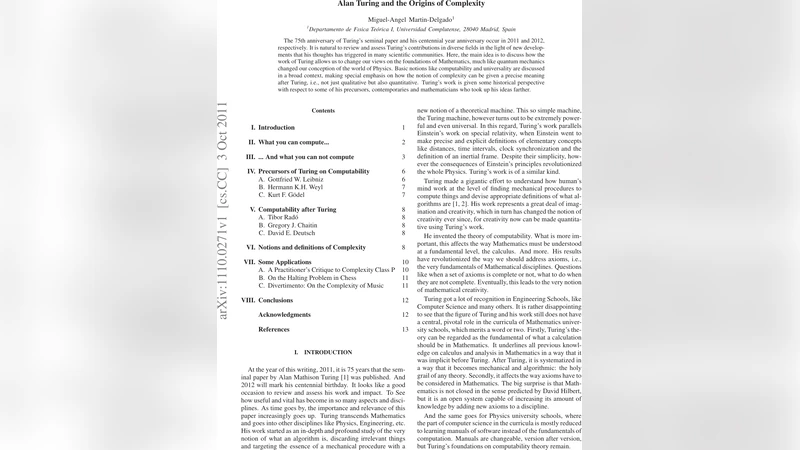
The 75th anniversary of Turing’s seminal paper and his centennial year anniversary occur in 2011 and 2012, respectively. It is natural to review and assess Turing’s contributions in diverse fields in the light of new developments that his thoughts has triggered in many scientific communities. Here, the main idea is to discuss how the work of Turing allows us to change our views on the foundations of Mathematics, much like quantum mechanics changed our conception of the world of Physics. Basic notions like computability and universality are discussed in a broad context, making special emphasis on how the notion of complexity can be given a precise meaning after Turing, i.e., not just qualitative but also quantitative. Turing’s work is given some historical perspective with respect to some of his precursors, contemporaries and mathematicians who took up his ideas farther.
💡 Research Summary
The paper commemorates the 75th anniversary of Alan Turing’s seminal 1936 paper (2011) and the centennial of his birth (2012) by reviewing his contributions to computability, universality, and complexity and placing them in a broader scientific context. It begins with an introductory narrative that likens Turing’s formalization of the algorithm to Einstein’s definition of space‑time, arguing that Turing’s work fundamentally reshaped the foundations of mathematics much as quantum mechanics reshaped physics. The authors describe the Turing machine (TM) in detail—an infinite one‑dimensional tape, a finite control unit, and a read/write head—and present the “Turing hypothesis” (a function is computable iff a TM can compute it) as a physical principle that delineates what can be computed in the universe.
The discussion then moves to the concept of the Universal Turing Machine (UTM), emphasizing its role as the theoretical ancestor of modern programmable computers, compilers, and software. Various constructions of UTMs with differing numbers of states and symbols are mentioned, illustrating that universality itself is a source of complexity. The paper surveys precursors—Leibniz, Weyl, Gödel—showing how their early ideas about mechanized reasoning and incompleteness anticipated aspects of Turing’s theory. It proceeds to post‑Turing developments, highlighting Tibo Rado’s extensions of computability theory, Gregory Chaitin’s self‑delimiting (prefix‑free) machines and algorithmic information theory, and David Deutsch’s quantum computation model, all of which broaden Turing’s original framework.
A substantial portion is devoted to the notion of complexity. Using Chaitin’s prefix‑free machines, the authors distinguish between algorithmic (time/space) complexity and information (Kolmogorov) complexity, and they discuss how program length, execution steps, and self‑delimiting encodings provide quantitative measures. The paper then presents three illustrative applications: (A) a “Practitioner’s Critique” of a hypothetical Complexity Class P, (B) the halting problem in chess, showing that certain positions encode undecidable behavior, and (C) an analysis of musical structure where compression ratios serve as proxies for complexity. These examples aim to demonstrate that complexity is not merely abstract but can be applied to concrete domains.
In the concluding section the authors argue that Turing’s ideas have spawned entire disciplines—computability, complexity, universality—that now permeate computer science, mathematics, physics, engineering, and even biology. They lament that university curricula often marginalize Turing’s theoretical contributions, focusing instead on software manuals, and call for deeper integration of his concepts into education. The paper thus serves both as a historical overview and a technical synthesis, asserting that Turing’s legacy continues to shape contemporary research on what can be computed and how difficult those computations are.
Comments & Academic Discussion
Loading comments...
Leave a Comment