Behaviour and Perception-based Pedestrian Evacuation Simulation
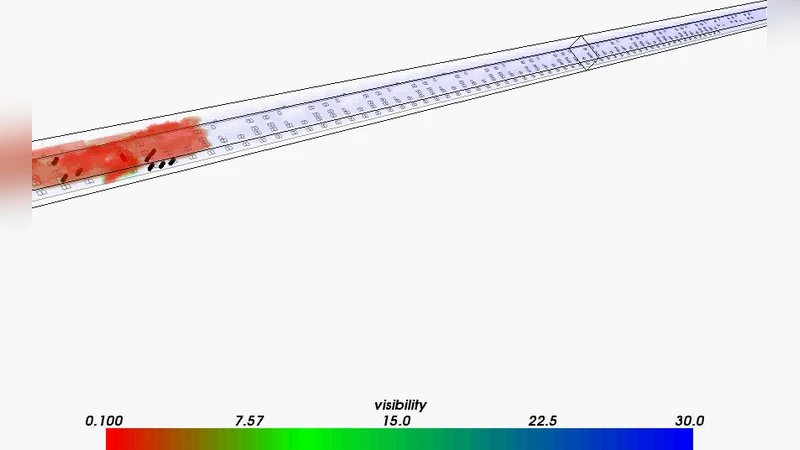
This contribution reports on the research project SKRIBT and some of its results. An evacuation simulation based on VISSIM’s pedestrian dynamics simulation was developed, that – with high time resolution – integrates results from studies on behavior in stress and crisis situations, results from CFD models for e.g. fire dynamics simulations, and considers visibility of signage and – adding a psychological model – its cognition. A crucial issue is the cognition of smoke or fire by the occupant and his / her resulting spontaneous or deliberate reaction to this episode.
💡 Research Summary
The paper presents a comprehensive evacuation simulation framework developed under the German SKRIBT project, which integrates high‑resolution pedestrian dynamics (VISSIM’s Social Force Model), computational fluid dynamics (CFD) for fire and toxic‑gas spread, visual sign visibility calculations, and a psychological‑cognitive decision model. Traditional microsimulation tools typically couple pedestrian flow with simple dose‑response models, but they lack a realistic representation of how occupants perceive and react to hazards such as smoke, fire, or hazardous gases. To fill this gap, the authors extended VISSIM to support multi‑storey buildings, vehicle‑pedestrian interactions, queue formation, and conflict zones, and they added modules that compute line‑of‑sight visibility based on occupant orientation, height, static obstacles (e.g., parked trucks), smoke concentration, and sign luminance. Moving objects are not yet considered in the visibility calculation, a simplification made for computational efficiency.
The cognitive‑behavioral component introduces a “potential for reaction” metric that aggregates internal factors (individual fearfulness, prior knowledge, habitual behavior) and external factors (intensity of danger, social influence). This metric determines when an occupant initiates evacuation, which route is chosen, and the probability of recognizing a sign. The model distinguishes between impulsive (instantaneous) and reflective (deliberate) responses, allowing walking speed and path selection to vary accordingly. For example, reduced visibility due to smoke lowers walking speed, while heightened perceived risk shortens pre‑movement time.
Risk assessment is performed using the Fractional Effective Dose (FED) model, which quantifies the dose of heat, smoke, or toxic gas each occupant receives, enabling the classification of outcomes into fatality, unconsciousness, or minor injury.
Two realistic tunnel scenarios were simulated to validate the framework. The first involved a 1.2 km tunnel with a 3 % gradient where a fuel tanker ignited, producing flames and smoke that propagated at roughly 7 m s⁻¹. The second scenario modeled a 21‑ton chlorine leak in an identical tunnel. In the fire case, occupants who directly saw flames or smoke began to flee immediately, triggering a cascade of evacuations among nearby vehicle occupants. A general alarm was assumed to be broadcast 60 seconds after the incident, after which additional occupants queued at emergency exits. Smoke reduced visibility and caused breathing difficulties, leading to rapid fatalities and unconsciousness.
In the chlorine scenario, visual conditions remained relatively clear because the gas formed a yellow‑green plume that was hard to discern under tunnel lighting. Consequently, only occupants nearest the leak, who could see the leaking vehicle, initiated evacuation. The toxic effects of chlorine were more severe than those of smoke, causing quicker loss of consciousness, but the lack of visibility impairment meant that orientation to exits was less hindered. The gas spread more slowly than smoke, resulting in a longer overall evacuation time. Despite these differences, the total number of casualties was comparable to the fire scenario.
The simulation outputs include quantitative metrics such as evacuation start times, queue lengths at exits, and casualty counts for each scenario. These results can be directly fed into risk‑analysis tools to evaluate the effectiveness of design choices (e.g., exit spacing, sign brightness, alarm placement) and emergency response strategies (e.g., sprinkler activation, gas detection).
The authors conclude that the integrated model offers a more realistic reproduction of evacuation dynamics than conventional approaches that treat physical hazards and human behavior separately. However, they acknowledge several limitations: moving objects are not considered in visibility calculations; the CFD models are simplified; the assumption that all occupants evacuate after the alarm may not hold in real life; and demographic variations (age, mobility, cultural factors) are not yet incorporated. Future work will address dynamic visibility occlusion, multimodal perception (auditory, tactile cues), and individualized decision‑making models that reflect a broader range of human factors, thereby enhancing the fidelity and applicability of the simulation for safety planning in critical infrastructure.
Comments & Academic Discussion
Loading comments...
Leave a Comment