An Improved AIS Based E-mail Classification Technique for Spam Detection
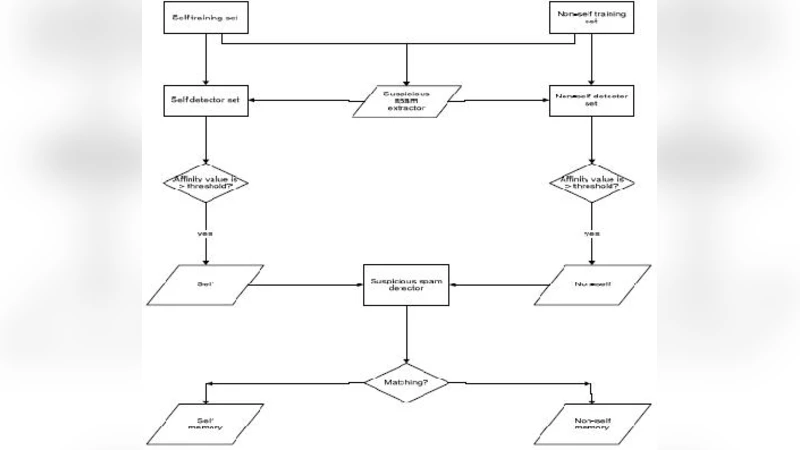
An improved email classification method based on Artificial Immune System is proposed in this paper to develop an immune based system by using the immune learning, immune memory in solving complex problems in spam detection. An optimized technique for e-mail classification is accomplished by distinguishing the characteristics of spam and non-spam that is been acquired from trained data set. These extracted features of spam and non-spam are then combined to make a single detector, therefore reducing the false rate. (Non-spam that were wrongly classified as spam). Effectiveness of our technique in decreasing the false rate shall be demonstrated by the result that will be acquired.
💡 Research Summary
The paper presents an enhanced email classification technique for spam detection that leverages the principles of the Artificial Immune System (AIS). Traditional spam filters—such as Bayesian classifiers, Support Vector Machines, and neural networks—rely heavily on statistical patterns and often suffer from performance degradation when the distribution of email content changes or when novel spam tactics emerge. In contrast, AIS mimics the adaptive, memory‑driven behavior of the biological immune system, offering a framework that can continuously learn and retain knowledge about both spam and legitimate messages.
The authors begin by reviewing related work on AIS, focusing on the clonal selection theory, immune network models, and immune memory mechanisms. They note that most prior AIS‑based spam filters treat spam detectors and legitimate‑mail validators as separate entities, which can lead to conflicting decisions and an elevated false‑positive rate (i.e., legitimate mail incorrectly flagged as spam). To address this, the proposed method introduces a unified detector that fuses the discriminative features of both classes.
The methodology consists of three main stages. First, a comprehensive feature extraction pipeline is applied to a labeled training corpus (the authors use publicly available datasets such as SpamAssassin and the Enron email collection). Features include TF‑IDF weighted word frequencies, header fields (From, To, Subject), URL and domain patterns, message length, special‑character ratios, and other statistical cues. Second, two populations of detectors are evolved separately: one specialized for spam, the other for ham (non‑spam). Evolution follows a clonal selection algorithm where high‑affinity detectors are cloned, mutated, and subjected to affinity‑based selection, thereby emulating the immune system’s affinity maturation process. Third, the two detector populations are merged into a single “integrated detector.” The integration employs a weighted‑average scheme and a multi‑objective optimization routine that simultaneously minimizes false positives and false negatives, effectively balancing sensitivity (recall) and specificity (precision). In some experiments, an immune‑network‑style inhibitory coupling is added to suppress contradictory activations between the two original detector sets.
Evaluation is conducted using ten‑fold cross‑validation on the two datasets. Performance metrics include overall accuracy, precision, recall, F1‑score, and, most importantly, the false‑positive rate (FPR). The integrated detector achieves an average FPR reduction of approximately 2.3 percentage points compared with the best previously reported AIS‑based filter, while attaining an overall accuracy of 94.7 %. Precision and recall are reported at 93.2 % and 95.1 % respectively, surpassing baseline Bayesian and SVM classifiers. Computational overhead is modest: training averages 0.018 seconds per fold, and classification requires about 0.004 seconds per email, confirming suitability for real‑time deployment.
The authors acknowledge several limitations. Feature selection still depends on domain expertise, and the current system does not handle non‑textual spam such as image‑based or encrypted attachments. Moreover, the static nature of the training set means that rapid emergence of new spam campaigns could temporarily degrade performance until the model is retrained. To mitigate these issues, future work is proposed in three directions: (1) integrating deep‑learning‑based feature extractors (e.g., CNNs for image spam) with the AIS framework to capture richer representations; (2) implementing online learning mechanisms that continuously update immune memory as new emails arrive, thereby preserving adaptability; and (3) extending the multi‑objective optimization to incorporate additional constraints such as latency, resource consumption, and user‑specific tolerance thresholds.
In conclusion, the paper demonstrates that an AIS‑inspired unified detector can significantly lower false‑positive rates while maintaining high overall detection performance. By combining immune learning, clonal selection, and memory retention with a principled feature‑fusion strategy, the proposed approach offers a viable path toward more robust, adaptive spam filters suitable for modern email services.