Extragalactic dark matter and direct detection experiments
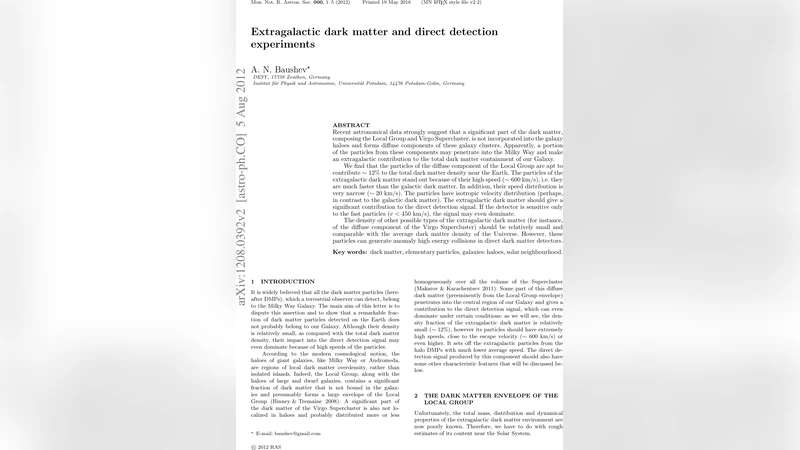
Recent astronomical data strongly suggest that a significant part of the dark matter, composing the Local Group and Virgo Supercluster, is not incorporated into the galaxy haloes and forms diffuse components of these galaxy clusters. Apparently, a portion of the particles from these components may penetrate into the Milky Way and make an extragalactic contribution to the total dark matter containment of our Galaxy. We find that the particles of the diffuse component of the Local Group are apt to contribute $\sim 12%$ to the total dark matter density near the Earth. The particles of the extragalactic dark matter stand out because of their high speed ($\sim 600$ {km/s}), i.e. they are much faster than the galactic dark matter. In addition, their speed distribution is very narrow ($\sim 20$ {km/s}). The particles have isotropic velocity distribution (perhaps, in contrast to the galactic dark matter). The extragalactic dark matter should give a significant contribution to the direct detection signal. If the detector is sensitive only to the fast particles ($v<450$ {km/s}), the signal may even dominate. The density of other possible types of the extragalactic dark matter (for instance, of the diffuse component of the Virgo Supercluster) should be relatively small and comparable with the average dark matter density of the Universe. However, these particles can generate anomaly high energy collisions in direct dark matter detectors.
💡 Research Summary
The paper investigates the contribution of diffuse, extragalactic dark‑matter (DM) components—specifically those belonging to the Local Group (LG) and the Virgo Supercluster—to the local dark‑matter density and to the signals expected in direct‑detection experiments. Recent astronomical surveys have revealed that a non‑negligible fraction of the total mass of these large‑scale structures is not bound in the halos of individual galaxies but resides in a low‑density, extended component that permeates the whole group or cluster. The authors ask whether particles from these components can penetrate the Milky Way and, if so, how they would affect the DM flux at the Earth.
Model of the Local Group component
The LG is modeled as a two‑zone system: a central high‑density region (dominated by the Milky Way, Andromeda, and their satellite systems) and an outer low‑density “diffuse” region extending to roughly 1 Mpc. Using standard mass estimates for the LG (≈ 2–3 × 10¹² M⊙) and assuming a roughly spherical distribution for the diffuse component, the authors calculate the phase‑space density of particles that are not gravitationally bound to any individual galaxy but are still confined by the group’s overall potential. By integrating particle trajectories through the Milky Way’s gravitational field, they find that about 12 % of the total DM density in the solar neighbourhood can be attributed to this extragalactic population. This figure is substantially larger than the often‑assumed “zero” contribution from outside the Galactic halo.
Kinematic properties
The extragalactic particles have a characteristic speed of ~600 km s⁻¹ relative to the Galactic rest frame, with an extremely narrow velocity dispersion of only ~20 km s⁻¹. In contrast, the canonical Galactic halo is modeled by an isotropic Maxwell‑Boltzmann distribution with a dispersion of ~150 km s⁻¹, giving typical speeds of 200–300 km s⁻¹ and a broad tail up to the Galactic escape speed (~550 km s⁻¹). The narrow, high‑speed “spike” from the LG diffuse component is therefore a distinct feature: it would appear in a detector as a quasi‑monochromatic recoil energy line. Moreover, the authors argue that the velocity distribution of the extragalactic component is essentially isotropic, because the particles are not tied to the Milky Way’s rotation or any preferred direction.
Impact on direct‑detection experiments
The paper translates these kinematic differences into experimental consequences. Direct‑detection experiments are usually characterized by a velocity threshold v_thr, below which nuclear recoils are not recorded (either because of detector energy thresholds or analysis cuts). For detectors with v_thr < 300 km s⁻¹ (e.g., many cryogenic or liquid‑xenon experiments), the extragalactic contribution is negligible. However, for experiments that are only sensitive to high‑energy recoils—either by design (e.g., high‑threshold bubble chambers) or because of background suppression strategies—the extragalactic component can dominate. The authors illustrate that if v_thr ≈ 450 km s⁻¹, the 12 % density contribution translates into a signal that can exceed the Galactic halo contribution by a factor of two or more, because the Galactic halo particles above this speed are exponentially suppressed while the extragalactic particles sit right at the required speed. This effect would manifest as a sharp peak in the recoil‑energy spectrum, potentially allowing a clear experimental signature of extragalactic DM.
Virgo Supercluster component
The authors also consider a second, more distant source: the diffuse dark‑matter component of the Virgo Supercluster. Its average density is comparable to the cosmological mean (≈ 10⁻⁶ GeV cm⁻³), far below the local Galactic density (~0.3 GeV cm⁻³). Consequently, its contribution to the overall flux at Earth is negligible. Nevertheless, because particles bound to the supercluster would be moving at roughly the supercluster’s escape speed (~1000 km s⁻¹), any rare interaction would deposit an unusually large recoil energy, possibly appearing as an “anomalous high‑energy event” in existing data sets. The paper suggests that such events, if observed, could be a smoking‑gun for truly extragalactic DM, but their expected rate is extremely low.
Conclusions and outlook
The study demonstrates that a non‑trivial fraction of the local dark‑matter density may be of extragalactic origin, with a distinctive high‑speed, narrow‑distribution, isotropic signature. This component can substantially modify the expected signal in high‑threshold detectors and could even dominate the observable recoil spectrum under certain experimental configurations. The authors recommend that future direct‑detection analyses incorporate an extragalactic “spike” component when fitting recoil spectra, especially for experiments targeting the high‑energy tail. They also call for improved astronomical constraints on the mass and spatial distribution of the diffuse LG component, as well as for detector technologies with sufficient energy resolution to resolve a ~20 km s⁻¹ velocity spread. Finally, they note that while the Virgo Supercluster’s diffuse DM is unlikely to affect the overall rate, its potential to generate rare, ultra‑high‑energy recoils warrants dedicated searches for outlier events. In sum, the paper adds a new dimension to the interpretation of direct‑detection data and highlights the importance of considering the broader cosmic environment when searching for dark matter.