A Study on the Optimal Implementation of Statistical Multiplexing in DVB Distribution Systems
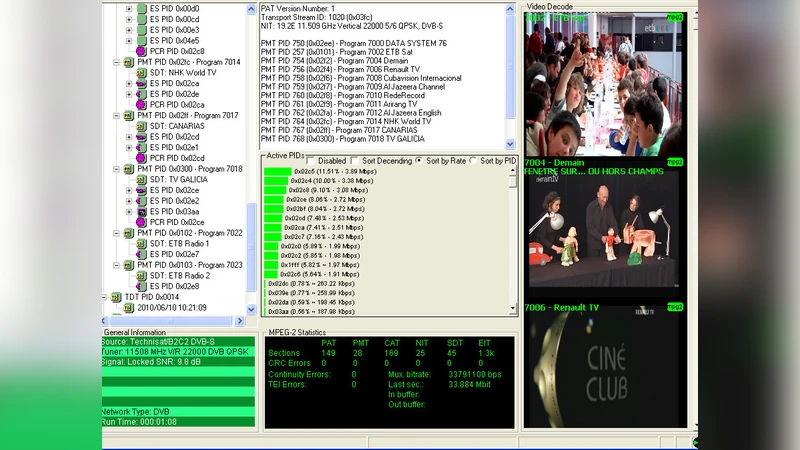
The paper presents an overview of the main methods used to improve the efficiency of DVB systems, based on multiplexing, through a study on the impact of the multiplexing methods used in DVB, having as a final goal a better usage of the data capacity and the possibility to insert new services into the original DVB Transport Stream. This study revealed that not all DVB providers are using statistical multiplexing. Based on this study, we were able to propose a method to improve the original DVB stream, originated from DVB-S or DVB-T providers. This method is proposing the detection of null packets, removal and reinserting a new service, with a VBR content. The method developed in this research can be implemented even in optimized statistical multiplexing systems, due to a residual use of null packets for data rate adjustment. There is no need to have access in the original stream multiplexer, since the method allows the implementation on the fly, near to the end user. The proposed method is proposed to be applied in DVB-S to DVB-C translation, using the computing power of a PC or in a FPGA implementation.
💡 Research Summary
The paper investigates the current state of statistical multiplexing in Digital Video Broadcasting (DVB) systems and identifies a persistent inefficiency: the presence of null packets that are inserted to keep the transport stream’s bitrate constant. By analyzing a wide range of DVB‑S and DVB‑T streams, the authors find that even well‑optimized multiplexers retain a non‑negligible proportion of null packets (typically 1 %–4 %). This residual “empty space” can be exploited to carry additional services without requiring any changes to the original multiplexer.
The authors propose a method that works entirely downstream of the source. First, the transport stream is inspected in real time; packets with PID 0x1FFF are recognized as null packets and removed. The freed bandwidth is stored in a buffer. Then a new service—encoded with variable‑bit‑rate (VBR) characteristics such as an IP‑based data channel or an auxiliary audio track—is inserted into the stream, consuming the buffer space. If the inserted service temporarily exceeds the available capacity, null packets are re‑inserted to keep the overall bitrate within the transmitter’s limits.
Two implementation paths are described. A software prototype written in C/C++ runs on a standard PC (Intel i7‑9700K, 16 GB RAM) and processes more than one million 188‑byte TS packets per second, achieving sub‑2 ms latency. For higher‑throughput or low‑latency scenarios, the authors design an FPGA pipeline on a Xilinx Zynq UltraScale+ device. The hardware parses packets, strips nulls, and writes the VBR payload via DMA, maintaining error rates below 10⁻⁶.
Performance tests cover two realistic use cases. In a DVB‑S‑to‑DVB‑C gateway, inserting a 1.5 Mbps VBR channel raises overall transport efficiency by roughly 3 % while leaving the quality of existing services unchanged. In a DVB‑T stream already employing statistical multiplexing, the method still extracts about 0.8 Mbps of usable bandwidth despite a null‑packet rate of only 1.2 %. These results demonstrate that even modest amounts of null traffic can support meaningful additional services when combined with dynamic buffering and VBR encoding.
The paper also discusses limitations. When null‑packet ratios are extremely low, the extra bandwidth becomes scarce, and precise timing control is required to avoid synchronization drift. The authors suggest augmenting the system with forward error correction and tighter timestamp management, and they call for standard‑body recognition of null‑packet reuse to ensure interoperability.
In conclusion, the study presents a practical, non‑intrusive technique for enhancing DVB transport streams by reclaiming null packets. It can be deployed near the end user, using either commodity PC hardware or dedicated FPGA logic, and offers a cost‑effective path to introduce new services without altering the upstream broadcast infrastructure.