AI Methods in Algorithmic Composition: A Comprehensive Survey
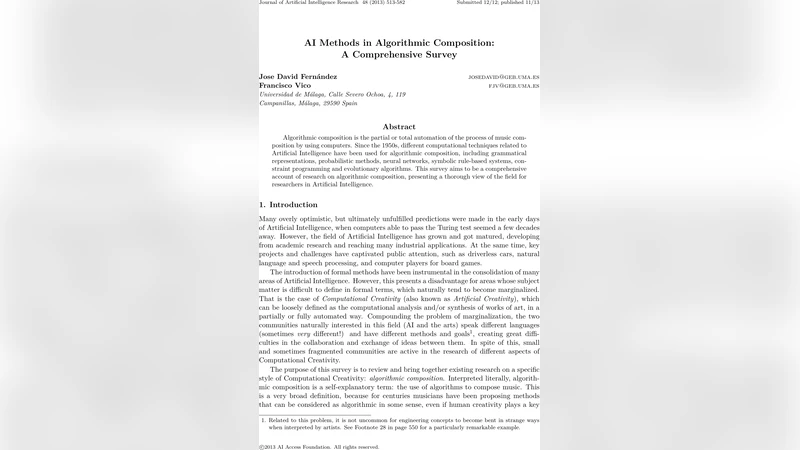
Algorithmic composition is the partial or total automation of the process of music composition by using computers. Since the 1950s, different computational techniques related to Artificial Intelligence have been used for algorithmic composition, including grammatical representations, probabilistic methods, neural networks, symbolic rule-based systems, constraint programming and evolutionary algorithms. This survey aims to be a comprehensive account of research on algorithmic composition, presenting a thorough view of the field for researchers in Artificial Intelligence.
💡 Research Summary
The paper “AI Methods in Algorithmic Composition: A Comprehensive Survey” offers an exhaustive review of more than seven decades of research at the intersection of artificial intelligence and music composition. It begins by defining algorithmic composition as the partial or total automation of the compositional process using computers, and it traces the historical evolution from early rule‑based systems in the 1950s (e.g., Illiac Suite) through to contemporary deep‑learning approaches. The authors organize the literature into six major methodological families, each described in depth with theoretical foundations, representative implementations, evaluation protocols, and identified limitations.
-
Grammar‑Based Approaches – The survey explains how context‑free grammars, L‑systems, and other formal language models have been employed to encode hierarchical musical structures such as phrase forms, harmonic progressions, and rhythmic patterns. By making music theory explicit in rule sets, these methods guarantee theoretical correctness but suffer from scalability issues when the rule base becomes large or when stylistic flexibility is required.
-
Probabilistic and Statistical Models – Markov chains, hidden Markov models, and n‑gram techniques are covered as early data‑driven methods that learn transition probabilities from existing corpora. Their simplicity and low computational cost are highlighted, together with the well‑known drawback of limited long‑range dependency modeling, which often leads to locally plausible but globally incoherent pieces.
-
Neural Network Models – The authors chart the progression from early perceptrons and multilayer perceptrons to recurrent neural networks (RNNs), long short‑term memory (LSTM) units, and gated recurrent units (GRUs). They discuss landmark systems such as DeepBach, MusicVAE, and MuseGAN, emphasizing how LSTM‑based architectures capture temporal dependencies essential for melody and harmony generation. Recent generative models—variational autoencoders, generative adversarial networks, and flow‑based models—are examined for their ability to perform style transfer, interpolation, and controllable generation.
-
Constraint Programming and Symbolic Rule‑Based Systems – This section details how constraint satisfaction problems (CSP) and constraint logic programming (CLP) encode music theory (scale, voice leading, rhythmic constraints) as hard constraints, ensuring rule compliance during generation. While this guarantees theoretical soundness, the search space can become severely restricted, limiting creative exploration.
-
Evolutionary Algorithms – Genetic algorithms, evolution strategies, and differential evolution are reviewed as population‑based search methods that evolve musical candidates according to fitness functions. The paper surveys diverse fitness designs, ranging from music‑theoretic rule compliance to listener‑based preference models and machine‑learned evaluators. Evolutionary approaches excel at producing novel variations but are computationally intensive and heavily dependent on the subjective design of the fitness landscape.
-
Recent Deep Learning and Reinforcement Learning Trends – The authors devote a substantial portion to transformer‑based models (e.g., Music Transformer, MuseNet) that leverage self‑attention to capture global musical structure and benefit from large‑scale pre‑training. Reinforcement learning is presented as a framework that treats composition as a sequential decision‑making problem, allowing the incorporation of complex reward signals such as tonal stability, emotional expression, and user feedback. The survey notes that despite impressive results, challenges remain in data bias, evaluation subjectivity, real‑time interaction, and the integration of symbolic and audio modalities.
In the final discussion, the paper proposes a forward‑looking research roadmap. It advocates hybrid systems that combine the strengths of multiple paradigms—e.g., grammar‑guided neural generation, constraint‑aware evolutionary search, or reinforcement‑driven fine‑tuning of transformer outputs. The authors also emphasize the importance of multimodal inputs (score, audio, textual description) and human‑in‑the‑loop interfaces to foster collaborative composition. Ethical considerations, including copyright, authorship attribution, and the societal impact of automated music creation, are highlighted as essential topics for future work.
Overall, this survey serves as a comprehensive reference for AI researchers, music technologists, and composers interested in the state‑of‑the‑art algorithmic composition techniques. It not only catalogues existing methods but also synthesizes insights that can guide the design of next‑generation, expressive, and controllable music generation systems.