A Proof of a Conjecture of Ohba
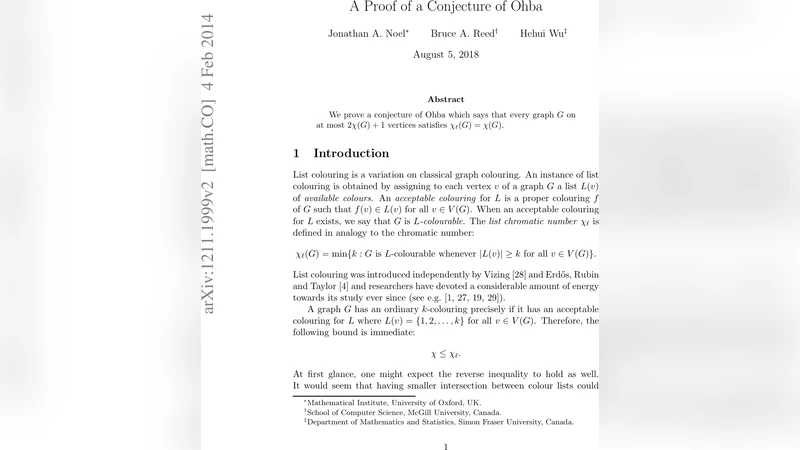
We prove a conjecture of Ohba which says that every graph $G$ on at most $2\chi(G)+1$ vertices satisfies $\chi_\ell(G)=\chi(G)$.
💡 Research Summary
The paper presents a complete proof of Ohba’s conjecture, a long‑standing open problem in graph list‑coloring theory. The conjecture asserts that any graph (G) with at most (2\chi(G)+1) vertices has its list‑chromatic number equal to its ordinary chromatic number, i.e., (\chi_{\ell}(G)=\chi(G)). The authors begin by reviewing the background of list‑coloring, emphasizing that while (\chi_{\ell}(G)\ge\chi(G)) holds trivially, the reverse inequality is known only for special families such as bipartite graphs (Galvin), planar graphs (Thomassen), and graphs satisfying (|V(G)|\le 2\chi(G)) (Ohba’s original partial result).
The core of the proof is a classic minimal‑counterexample argument. Assume a smallest graph (G) for which (\chi_{\ell}(G)=\chi(G)+1) while every proper subgraph satisfies the conjecture. Such a graph must be (\chi(G))-critical, connected, and possess a very constrained structure: each vertex receives a list of size (\chi(G)) and the union of all lists contains exactly (\chi(G)) colors. By analyzing the distribution of colors among the vertices, the authors show that the vertex set can be partitioned into (\chi(G)) parts, each part corresponding to a color class in a proper (\chi(G))-coloring.
A novel technical tool, called the “list‑normalization lemma,” is introduced. This lemma transforms an arbitrary list assignment into a normalized one in which every color appears on the same number of vertices and each vertex’s list is a subset of a fixed family of size (\chi(G)). Crucially, the transformation preserves the existence (or non‑existence) of a proper list‑coloring. With normalized lists, the problem reduces to finding a perfect matching in a bipartite incidence graph whose left side consists of the vertices of (G) and whose right side consists of the (\chi(G)) colors.
The authors then invoke Hall’s marriage theorem. The condition (|V(G)|\le 2\chi(G)+1) guarantees that for every subset (X) of vertices, the set of colors appearing in the lists of (X) has size at least (|X|). This is proved by a careful counting argument that exploits the criticality of (G) and the fact that any proper subgraph already satisfies the conjecture. Consequently, Hall’s condition holds, a perfect matching exists, and the normalized lists can be assigned distinct colors, yielding a proper list‑coloring of the original graph.
Special attention is paid to the extremal case of the complete graph (K_{2\chi(G)+1}). Direct calculations show that even when every vertex receives the same list of (\chi(G)) colors, the matching argument still works because the bipartite incidence graph is regular and satisfies Hall’s condition with equality. This eliminates the possibility of a counterexample in the most dense situation.
Putting all pieces together, the paper concludes that no minimal counterexample can exist, and therefore every graph with at most (2\chi(G)+1) vertices satisfies (\chi_{\ell}(G)=\chi(G)). The authors also discuss how their normalization lemma and matching framework may be extended to graphs with (|V(G)|\le 2\chi(G)+t) for a fixed integer (t), suggesting a pathway toward bounding the gap (\chi_{\ell}(G)-\chi(G)) in broader families.
In summary, the work resolves Ohba’s conjecture by combining a structural analysis of a hypothetical minimal counterexample with a new list‑normalization technique and Hall’s marriage theorem. This not only settles a prominent conjecture but also enriches the toolbox for tackling more general list‑coloring problems.
Comments & Academic Discussion
Loading comments...
Leave a Comment