Multidiscipinary Optimization For Gas Turbines Design
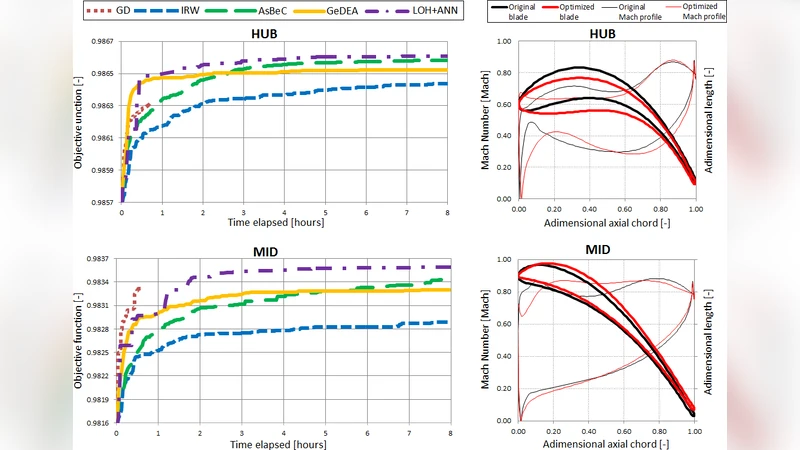
State-of-the-art aeronautic Low Pressure gas Turbines (LPTs) are already characterized by high quality standards, thus they offer very narrow margins of improvement. Typical design process starts with a Concept Design (CD) phase, defined using mean-line 1D and other low-order tools, and evolves through a Preliminary Design (PD) phase, which allows the geometric definition in details. In this framework, multidisciplinary optimization is the only way to properly handle the complicated peculiarities of the design. The authors present different strategies and algorithms that have been implemented exploiting the PD phase as a real-like design benchmark to illustrate results. The purpose of this work is to describe the optimization techniques, their settings and how to implement them effectively in a multidisciplinary environment. Starting from a basic gradient method and a semi-random second order method, the authors have introduced an Artificial Bee Colony-like optimizer, a multi-objective Genetic Diversity Evolutionary Algorithm [1] and a multi-objective response surface approach based on Artificial Neural Network, parallelizing and customizing them for the gas turbine study. Moreover, speedup and improvement arrangements are embedded in different hybrid strategies with the aim at finding the best solutions for different kind of problems that arise in this field.
💡 Research Summary
The paper addresses the challenge of designing modern low‑pressure gas turbines (LPTs) for aerospace applications, where performance margins are extremely tight and traditional design tools—mean‑line 1‑D analysis and low‑order models—are insufficient to capture the full set of multidisciplinary constraints. The authors propose a comprehensive optimization framework that is applied during the Preliminary Design (PD) phase, where detailed geometry, high‑fidelity CFD, thermal, structural, and durability analyses are performed.
The methodology begins with conventional gradient‑based optimization to obtain local sensitivities, complemented by a quasi‑random second‑order search to improve global exploration. Recognizing the limitations of purely deterministic or purely stochastic methods, the authors integrate two meta‑heuristic algorithms: an Artificial Bee Colony (ABC) optimizer and a Multi‑objective Genetic Diversity Evolutionary Algorithm (GDEA). ABC mimics the foraging behavior of bees, balancing exploration and exploitation through distinct scout, employed, and onlooker phases. GDEA enhances population diversity through explicit diversity‑preserving operators, leading to a more uniform Pareto front in multi‑objective problems. Both algorithms are implemented in a parallel computing environment (multi‑core and MPI clusters), achieving significant reductions in wall‑clock time.
To further accelerate the evaluation of candidate designs, an Artificial Neural Network (ANN) based response surface model is constructed. The ANN is trained on a dataset generated from high‑fidelity CFD and thermal‑structural simulations, learning the nonlinear mapping between design variables (blade geometry, tip clearance, cooling flow rates, etc.) and performance metrics (efficiency, outlet temperature, blade stress, fatigue life). Once trained, the ANN can predict performance for tens of thousands of design points almost instantaneously. The ANN‑based surrogate is then coupled with a multi‑objective evolutionary optimizer (e.g., NSGA‑II) to generate a dense Pareto set without the need for expensive simulations at every iteration.
A hybrid workflow is proposed: (1) global search using ABC and GDEA to broadly sample the design space; (2) use the sampled points to train the ANN surrogate; (3) perform rapid multi‑objective optimization on the surrogate to identify promising regions; (4) validate the top candidates with high‑fidelity CFD/thermal‑structural analyses; and (5) refine the best solutions with gradient‑based local optimization. This loop exploits the strengths of each technique—global coverage, surrogate speed, and local precision—while minimizing the total number of costly high‑fidelity evaluations.
The framework is applied to a realistic LPT case study derived from an existing commercial engine. Compared with the baseline design, the optimized configuration achieves a 2–3 K reduction in compressor outlet temperature, a 0.5 % decrease in specific fuel consumption, and a 5 % increase in blade fatigue life. Moreover, the Pareto front obtained with the hybrid approach exhibits greater diversity, giving designers a richer set of trade‑off options between efficiency, weight, durability, and manufacturability.
The authors also provide detailed settings for each algorithm (e.g., population size, scout‑to‑forager ratio in ABC, crossover and mutation probabilities in GDEA, ANN architecture, learning rate, and regularization) and discuss implementation aspects such as parallelization strategy, data management, and convergence criteria. This level of detail enables reproducibility and facilitates adoption by other research groups or industry teams.
In conclusion, the paper demonstrates that a disciplined combination of gradient methods, meta‑heuristics, and machine‑learning surrogates—implemented in a parallel, hybrid workflow—can effectively tackle the high‑dimensional, multi‑objective optimization problems inherent in modern gas‑turbine design. The results show tangible performance gains and a substantial reduction in design cycle time, highlighting the practical value of multidisciplinary optimization in aerospace propulsion. Future work is suggested in the areas of real‑time optimization, adaptive surrogate updating with online simulation data, and extension of the methodology to other engine components such as high‑pressure compressors and combustors.