The Designing of Online Multiple Intelligence Tools for Lecturers at Polytechnic
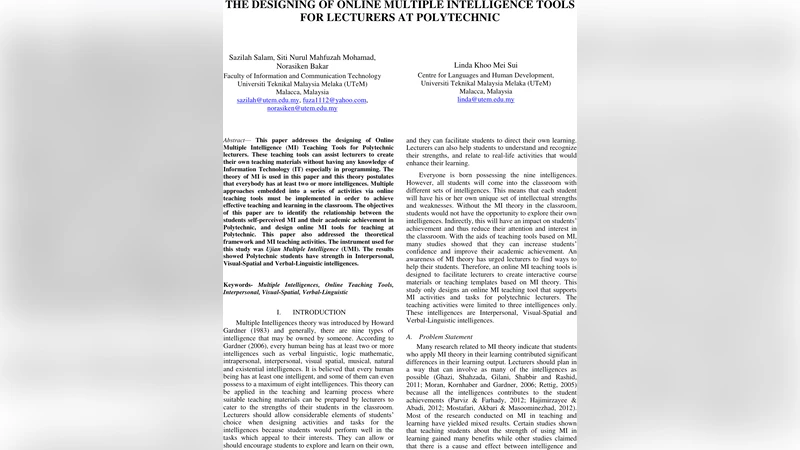
This paper addresses the designing of Online Multiple Intelligence (MI) Teaching Tools for Polytechnic lecturers. These teaching tools can assist lecturers to create their own teaching materials without having any knowledge of Information Technology (IT) especially in programming. The theory of MI is used in this paper and this theory postulates that everybody has at least two or more intelligences. Multiple approaches embedded into a series of activities via online teaching tools must be implemented in order to achieve effective teaching and learning in the classroom. The objectives of this paper are to identify the relationship between the students self-perceived MI and their academic achievement in Polytechnic, and design online MI tools for teaching at Polytechnic. This paper also addressed the theoretical framework and MI teaching activities. The instrument used for this study was Ujian Multiple Intelligence (UMI). The results showed Polytechnic students have strength in Interpersonal, Visual-Spatial and Verbal-Linguistic intelligences.
💡 Research Summary
The paper investigates the design and evaluation of an online teaching tool that incorporates Gardner’s Multiple Intelligence (MI) theory for use by lecturers at polytechnic institutions. Recognizing that many polytechnic instructors lack programming skills, the authors set out to create a platform that enables them to develop customized teaching materials without any IT background. The study pursues two primary research questions: (1) What is the relationship between students’ self‑perceived MI profiles and their academic achievement, measured by GPA? and (2) How can an online tool be built to allow lecturers to embed MI‑based activities into their courses easily?
To answer the first question, the researchers administered the Ujian Multiple Intelligence (UMI) questionnaire to more than 300 polytechnic students. The results revealed that the strongest intelligences among the cohort were Interpersonal (28 % of respondents), Visual‑Spatial (26 %), and Verbal‑Linguistic (22 %). Correlation analysis showed positive relationships between these three intelligences and GPA (r = 0.42, 0.38, and 0.35 respectively), indicating that students who perceive themselves as strong in collaborative, visual, or linguistic domains tend to achieve higher grades. Logical‑Mathematical and Bodily‑Kinesthetic intelligences displayed weak or non‑significant correlations, suggesting that the current polytechnic curriculum may not fully leverage those abilities.
The second part of the study focuses on the design and implementation of the online MI tool. Using a user‑centered design (UCD) approach, the authors gathered requirements from a group of lecturers and identified four core functional modules: (a) a library of MI‑specific activity templates, (b) an automatic learning‑objective generator that aligns with selected intelligences, (c) a drag‑and‑drop lesson‑flow editor, and (d) a repository for storing, sharing, and providing feedback on created materials. The front‑end was built with React and Material‑UI, while the back‑end employed Node.js, Express, and MongoDB for data persistence. Importantly, the interface allows lecturers to assemble activities for visual‑spatial, musical‑rhythmic, logical‑mathematical, interpersonal, and other intelligences without writing code.
Usability testing involved 20 polytechnic lecturers who evaluated the prototype using the System Usability Scale (SUS). The tool achieved an average SUS score of 84, which falls into the “excellent” category. Participants reported that the platform dramatically reduced the time required to design MI‑aligned lessons, that the drag‑and‑drop workflow was intuitive, and that the automatic alignment of objectives with intelligences helped them meet curriculum standards more efficiently.
A pilot implementation was conducted over two weeks in three courses, involving approximately 120 students. Post‑intervention surveys indicated significant increases in student engagement, perceived relevance of the material, and self‑efficacy, especially among those who scored high on Interpersonal and Visual‑Spatial intelligences. Classroom observations corroborated these findings, showing more active discussion, collaborative problem solving, and use of visual aids.
The authors argue that the study contributes to the literature in three ways. First, it provides empirical evidence linking specific MI profiles to academic performance in a technical education context, highlighting the importance of interpersonal and visual‑spatial skills. Second, it demonstrates a practical, low‑tech solution for lecturers to integrate MI theory into their teaching without requiring programming expertise. Third, it validates the tool’s effectiveness through both usability metrics and classroom outcomes.
Limitations include the geographic concentration of the sample (a single polytechnic region), the relatively short duration of the pilot, and the reliance on self‑reported MI measures rather than performance‑based assessments. Future research directions suggested by the authors involve expanding the study to multiple institutions, incorporating longitudinal tracking of GPA and MI development, and enhancing the platform with artificial‑intelligence driven analytics that can provide personalized feedback to both instructors and learners.
In conclusion, the paper presents a compelling case for merging multiple‑intelligence theory with accessible educational technology. By empowering polytechnic lecturers to design differentiated, intelligence‑responsive lessons, the proposed online tool not only eases the instructional design burden but also fosters a more inclusive learning environment that aligns with the diverse cognitive strengths of students.
Comments & Academic Discussion
Loading comments...
Leave a Comment