Introduction to Perl module lb2d.pm 0.1 for basic Lattice Boltzmann simulations
The Lattice Boltzmann method has been gaining acceptance for hydrodynamic problems involving complex boundaries, non-equilibrium dynamics and interfacial phenomena in multiphase or multicomponent syst
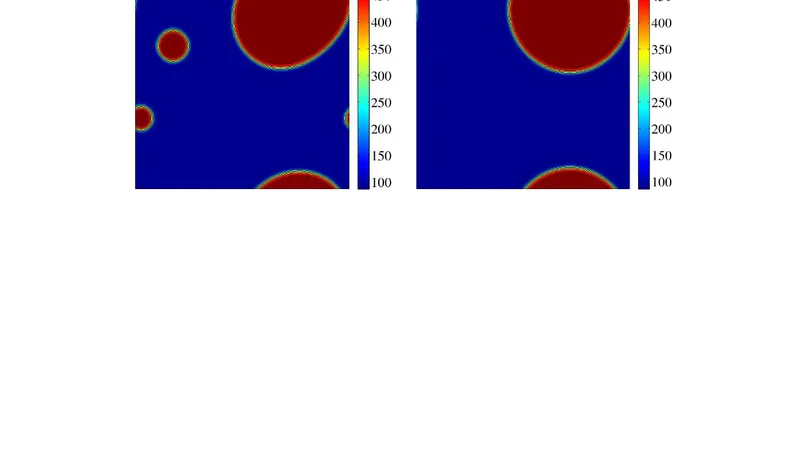
The Lattice Boltzmann method has been gaining acceptance for hydrodynamic problems involving complex boundaries, non-equilibrium dynamics and interfacial phenomena in multiphase or multicomponent systems. lb2d.pm is a Perl module offering a clear framework for simple Lattice Boltzmann simulations in 2D. The syntax and some basic applications are presented. Mainly, the new version 0.1 enables solute transport and accounts for reactive boundaries leading to surface growth.
💡 Research Summary
The paper presents lb2d.pm version 0.1, a Perl‑based module that implements a two‑dimensional Lattice Boltzmann Method (LBM) framework for basic fluid‑dynamics simulations and, for the first time, adds solute transport together with reactive boundary conditions that can drive surface growth. The authors begin by reviewing the fundamentals of LBM: a discrete velocity set (the D2Q9 lattice), the collision‑stream algorithm, and the BGK single‑relaxation‑time model that links the relaxation time τ to physical viscosity. They argue that most existing LBM codes are written in compiled languages (C, C++, Fortran), which, while fast, present a steep learning curve for newcomers and make rapid prototyping cumbersome. By contrast, Perl offers high‑level data structures, easy text handling, and an interactive development style that can accelerate the creation and testing of new models.
The module’s architecture is described in detail. The initialization routine (init_lb) reads a simple key‑value text file that specifies lattice dimensions, time step Δt, lattice spacing Δx, fluid viscosity, and, when needed, solute diffusion coefficient. It allocates the distribution arrays for the fluid (f_i) and, newly introduced, the solute (g_i). The collide subroutine applies the BGK operator to both sets of distributions, computing equilibrium functions f_i^eq and g_i^eq from local density, velocity, and solute concentration. The stream subroutine then propagates each distribution along its nine lattice vectors, handling periodic, no‑slip, slip, and bounce‑back boundaries through a dedicated apply_boundary routine.
The novel features of version 0.1 are the solute transport capability and the reactive‑boundary implementation. Solute transport is modeled by a second set of distribution functions g_i that obey the same collision‑stream steps as the fluid but with a separate relaxation time τ_g, allowing the user to set an arbitrary diffusion coefficient D. Reactive boundaries are realized by adding a source/sink term S_i to the solute distributions at selected lattice nodes. The source term is supplied as a user‑defined Perl subroutine, enabling a wide range of reaction kinetics—from simple first‑order decay (k c) to more complex, temperature‑dependent or catalytic expressions. When the accumulated solute at a boundary exceeds a prescribed threshold, the module can optionally “grow” the solid surface by shifting the boundary one lattice spacing outward, thereby mimicking precipitation or deposition processes.
Three illustrative examples are provided. (1) A planar Couette flow demonstrates that the fluid solver reproduces the analytical linear velocity profile and that no‑slip and moving‑wall conditions are correctly enforced. (2) A coupled advection‑diffusion test shows a solute plume being convected by a prescribed velocity field while simultaneously diffusing, confirming that the g_i dynamics are correctly coupled to the fluid velocity. (3) A reactive‑boundary case places a first‑order reaction on the lower wall; solute generated at the wall accumulates, and once a critical concentration is reached the wall is advanced upward, illustrating surface growth. For each case the authors supply the Perl input file, the sequence of function calls, and a gnuplot script that renders density, velocity vectors, and solute concentration fields.
Performance measurements indicate that, despite Perl’s interpreted nature, the code can handle a 200 × 200 lattice for 10 000 time steps in roughly 30 seconds on a modern desktop, using less than 50 MB of RAM. The authors acknowledge that the current implementation is limited to two dimensions, lacks built‑in multi‑phase models (e.g., Shan‑Chen), and does not exploit parallelism; they propose future work that includes refactoring the code into an object‑oriented design, adding MPI/OpenMP bindings, and creating a plug‑in system for user‑defined physics.
In conclusion, lb2d.pm 0.1 offers an accessible, open‑source platform for researchers, educators, and students who wish to explore LBM concepts without the overhead of compiled languages. Its Perl foundation enables rapid iteration, straightforward file I/O, and easy integration with existing data‑analysis pipelines. By extending the classic fluid‑only LBM to include solute transport and reactive boundaries, the module opens the door to studies of interfacial phenomena such as precipitation, corrosion, and biofilm formation within a unified lattice‑Boltzmann framework. The paper positions the module as a stepping stone toward more sophisticated, possibly three‑dimensional, high‑performance implementations while providing a solid, well‑documented baseline for immediate use.
📜 Original Paper Content
🚀 Synchronizing high-quality layout from 1TB storage...