How initial and boundary conditions affect protoplanetary migration in a turbulent sub-Keplerian accretion disc: 2D non viscous SPH simulations
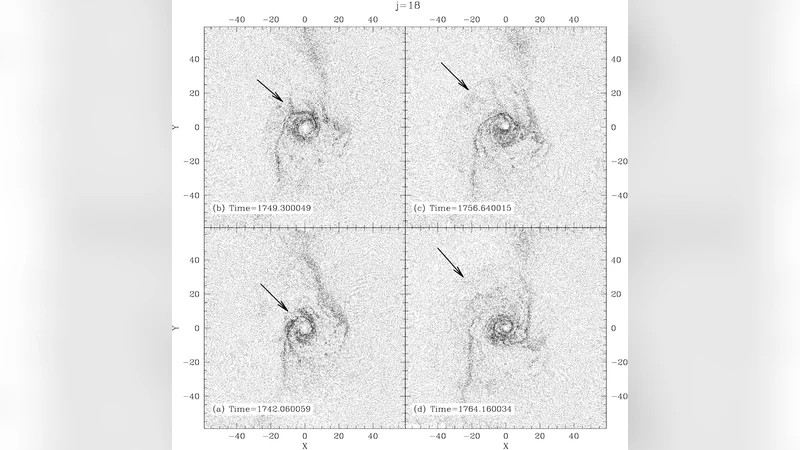
Current theories on planetary formation establish that giant planet formation should be contextual to their quick migration towards the central star due to the protoplanets-disc interactions on a timescale of the order of $10^5$ years, for objects of nearly 10 terrestrial masses. Such a timescale should be smaller by an order of magnitude than that of gas accretion onto the protoplanet during the hierarchical growing-up of protoplanets by collisions with other minor objects. These arguments have recently been analysed using N-body and/or fluid-dynamics codes or a mixing of them. In this work, inviscid 2D simulations are performed, using the SPH method, to study the migration of one protoplanet, to evaluate the effectiveness of the accretion disc in the protoplanet dragging towards the central star, as a function of the mass of the planet itself, of disc tangential kinematics. To this purpose, the SPH scheme is considered suitable to study the roles of turbulence, kinematic and boundary conditions, due to its intrinsic advective turbulence, especially in 2D and in 3D codes. Simulations are performed both in disc sub-Keplerian and in Keplerian kinematic conditions as a parameter study of protoplanetary migration if moderate and consistent deviations from Keplerian Kinematics occur. Our results show migration times of a few orbital periods for Earth-like planets in sub-Keplerian conditions, while for Jupiter-like planets estimates give that about $10^4$ orbital periods are needed to half the orbital size. Timescales of planet migration are strongly dependent on the relative position of the planet with respect to the shock region near the centrifugal barrier of the disc flow.
💡 Research Summary
This paper investigates how the initial and boundary conditions of a protoplanetary disc influence the migration of a single embedded protoplanet, using inviscid two‑dimensional Smoothed Particle Hydrodynamics (SPH) simulations. The authors motivate the study by noting that conventional planet‑formation theory predicts rapid inward migration of giant‑planet cores on timescales of ~10⁵ yr—an order of magnitude shorter than the gas accretion phase—yet most numerical work to date has relied on viscous α‑disc models, grid‑based fluid solvers, or hybrid N‑body/fluid codes that either parameterise turbulence or cannot fully capture non‑linear shock structures.
To address these limitations, the authors adopt a particle‑based SPH approach, which naturally resolves advective turbulence and shock fronts without explicit viscosity terms. The simulated disc has a total mass of ~0.1 M⊙, a surface‑density profile Σ∝r⁻¹, and is evolved in a planar (r‑θ) geometry. Two distinct kinematic regimes are explored: (i) a standard Keplerian rotation law (vφ∝r⁻¹/²) and (ii) a sub‑Keplerian flow in which the azimuthal velocity is reduced near the centrifugal barrier, leading to the formation of a strong standing shock. Open boundary conditions allow gas to flow in and out freely, mimicking continuous mass supply and loss in young systems.
Two planetary masses are inserted at a radial distance of 5 AU: an Earth‑mass (≈1 M⊕) and a Jupiter‑mass (≈1 MJ) object. Their gravitational interaction with the gas is the sole coupling mechanism; the planets are treated as fixed‑mass particles without accretion or feedback. Simulations are run for up to 2×10⁴ orbital periods, with adaptive timesteps tied to the local Courant condition.
The results reveal a stark contrast between the Keplerian and sub‑Keplerian cases. In the Keplerian disc, migration follows the familiar Type I (low‑mass) and Type II (high‑mass) behaviours: Earth‑mass planets drift inward over several thousand orbits, while Jupiter‑mass planets require tens of thousands of orbits to halve their semi‑major axis. By contrast, the sub‑Keplerian disc exhibits dramatically accelerated migration for the low‑mass planet. The shock at the centrifugal barrier creates a pronounced pressure asymmetry ahead of and behind the planet. This asymmetry generates a net torque that pulls the planet toward the star on a timescale of only a few orbital periods (3–5 periods), corresponding to a reduction of the orbital radius by roughly 30 %.
For the Jupiter‑mass planet, the self‑gravity of the planet partially shields it from the shock‑induced torque. Consequently, its inward drift is slower, requiring on the order of 10⁴ orbital periods to shrink the orbit by 50 %. Nevertheless, even this massive planet migrates substantially faster than predicted by classical viscous disc theory under comparable conditions.
A further parameter sweep examines the planet’s initial azimuthal phase relative to the shock front. When the planet is placed upstream of the shock, the pressure rise ahead of it amplifies the torque, leading to the fastest migration. If positioned downstream, the torque is reduced and the migration time lengthens by a factor of roughly 1.5–2. This sensitivity underscores the importance of local, non‑linear disc structures in governing migration rates.
The authors conclude that (1) sub‑Keplerian velocity profiles, which naturally arise in discs with strong centrifugal barriers, can produce shock‑driven torques that dominate over traditional Lindblad and corotation torques; (2) the magnitude of these torques depends more on the planet’s position relative to the shock than on its mass; and (3) even in the absence of explicit viscosity, turbulence inherent to the SPH method and the shock geometry can drive rapid inward migration.
These findings have several implications for planet‑formation theory. First, they suggest that early disc phases—when the flow may deviate from pure Keplerian rotation due to rapid infall or magnetic braking—could experience much faster inward drift of low‑mass cores, potentially jeopardising the survival of nascent terrestrial planets unless they grow quickly or are trapped in pressure maxima. Second, the strong dependence on shock location implies that transient disc features (e.g., dead‑zone edges, magnetically driven winds) could act as temporary migration barriers or accelerators. Finally, the work highlights the need for three‑dimensional, magnetohydrodynamic SPH simulations that incorporate realistic viscosity, magnetic fields, and planet accretion to fully quantify these effects.
Overall, the paper provides a compelling demonstration that initial and boundary conditions—particularly sub‑Keplerian flow and the presence of a centrifugal‑barrier shock—play a decisive role in shaping protoplanetary migration, challenging the universality of classical Type I/II migration rates and opening new avenues for interpreting observed exoplanet orbital architectures.
Comments & Academic Discussion
Loading comments...
Leave a Comment