Conflict Packing: an unifying technique to obtain polynomial kernels for editing problems on dense instances
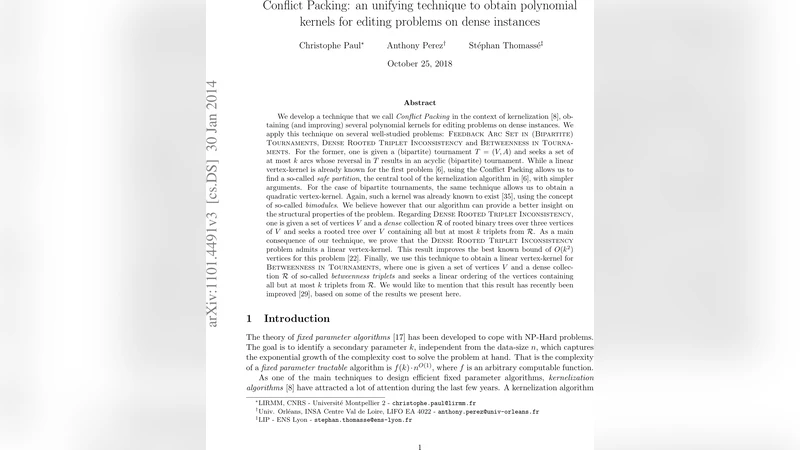
We develop a technique that we call Conflict Packing in the context of kernelization, obtaining (and improving) several polynomial kernels for editing problems on dense instances. We apply this technique on several well-studied problems: Feedback Arc Set in (Bipartite) Tournaments, Dense Rooted Triplet Inconsistency and Betweenness in Tournaments. For the former, one is given a (bipartite) tournament $T = (V,A)$ and seeks a set of at most $k$ arcs whose reversal in $T$ results in an acyclic (bipartite) tournament. While a linear vertex-kernel is already known for the first problem, using the Conflict Packing allows us to find a so-called safe partition, the central tool of the kernelization algorithm in, with simpler arguments. For the case of bipartite tournaments, the same technique allows us to obtain a quadratic vertex-kernel. Again, such a kernel was already known to exist, using the concept of so-called bimodules. We believe however that providing an unifying technique to cope with such problems is interesting. Regarding Dense Rooted Triplet Inconsistency, one is given a set of vertices $V$ and a dense collection $\mathcal{R}$ of rooted binary trees over three vertices of $V$ and seeks a rooted tree over $V$ containing all but at most $k$ triplets from $\mathcal{R}$. As a main consequence of our technique, we prove that the Dense Rooted Triplet Inconsistency problem admits a linear vertex-kernel. This result improves the best known bound of $O(k^2)$ vertices for this problem. Finally, we use this technique to obtain a linear vertex-kernel for Betweenness in Tournaments, where one is given a set of vertices $V$ and a dense collection $\mathcal{R}$ of so-called betweenness triplets and seeks a linear ordering of the vertices containing all but at most $k$ triplets from $\mathcal{R}$.
💡 Research Summary
The paper introduces a novel kernelization technique called Conflict Packing and demonstrates its power by obtaining (and improving) polynomial kernels for four well‑studied dense editing problems: Feedback Arc Set in (bipartite) tournaments, Dense Rooted Triplet Inconsistency, and Betweenness in Tournaments.
Core Idea – Conflict Packing.
In each problem a minimal “obstruction” can be identified: a directed 3‑cycle in a tournament, a directed 4‑cycle in a bipartite tournament, a size‑4 inconsistent sub‑instance for rooted triplets, and a size‑4 inconsistent tuple for betweenness constraints. A conflict packing is a maximal collection of such obstructions that are pairwise vertex‑disjoint. Because each obstruction contains a constant number of elements, a conflict packing of size larger than the parameter k immediately yields a NO‑instance (the optimal solution would need to modify more than k elements). Moreover, a conflict packing can be computed in polynomial time by a simple greedy algorithm.
Safe Partition and Matching‑Based Reduction.
Given a vertex ordering σ of the instance, the authors define an ordered partition Pσ of the vertex set into consecutive blocks. The set of external backward arcs A_E consists of arcs that go from a later block to an earlier block. If each external backward arc can be certified by a path whose internal vertices lie in distinct blocks (an external certificate), the partition is called safe. A safe partition enables a reduction rule (Rule 2.2): reverse all external backward arcs, decreasing the parameter by the number of reversed arcs.
To find a safe partition, the authors construct a bipartite graph B whose left side represents external backward arcs and whose right side represents vertices outside the conflict packing. An edge connects an arc to a vertex if the vertex can serve as the middle vertex of a certificate for that arc. By König’s theorem, a minimum vertex cover S of B of size ≤ k exists whenever the instance is a YES‑instance. The cover yields a safe partition: vertices not in S form singleton blocks, and the arcs whose left endpoints belong to S become the external backward arcs that can be safely reversed.
Applications.
-
Feedback Arc Set in Tournaments (k‑FAS).
- Compute a maximal packing C of directed 3‑cycles.
- Build an ordering σ where every backward arc has both endpoints in V(C).
- Construct B as described; if |V| > 4k, the cover S has size ≤ k and yields a safe partition, allowing the reduction.
- Hence any reduced instance has at most 4k vertices, giving a linear kernel (Theorem 2.7).
-
Feedback Arc Set in Bipartite Tournaments (k‑FASBT).
- Use directed 4‑cycles as obstructions; each contributes four vertices.
- The same matching‑cover argument yields a kernel of size O(k²), matching the best known bound but with a unified proof that avoids the earlier “bimodule” machinery.
-
Dense Rooted Triplet Inconsistency (k‑dense‑RTI).
- An obstruction is a set of four leaves that cannot be simultaneously satisfied by any rooted tree.
- A maximal packing of such 4‑leaf inconsistencies is computed; the uncovered vertices admit a topological order.
- By inserting the packed vertices appropriately, all backward triplet constraints involve only packed vertices.
- The bipartite matching technique then produces a safe partition whenever |V| > c·k, leading to a linear‑size kernel (Theorem 3.4), improving the previous O(k²) bound.
-
Dense Betweenness in Tournaments (k‑dense‑BTI).
- Here the obstruction is a size‑4 set of betweenness constraints that cannot be satisfied simultaneously.
- Conflict packing of these 4‑tuples is built, and a safe partition is derived exactly as for the previous problems.
- Additionally, a sunflower‑based reduction rule is applied to handle many identical constraints.
- The result is a kernel with at most 5k vertices; subsequent work refined this to (2 + ε)k + 4 vertices.
Significance.
The paper provides a unified framework: conflict packing → safe partition → matching‑based reduction. This framework replaces problem‑specific structural arguments (e.g., bimodules for bipartite tournaments, PTAS‑derived orderings for tournaments) with a common, conceptually simple approach based on elementary graph theory (Hall’s theorem, König–Egerváry theorem). It not only reproduces known kernels with simpler proofs but also yields genuinely better bounds for two problems (dense rooted triplet inconsistency and betweenness).
Moreover, the technique is modular: any dense editing problem that admits a constant‑size obstruction can potentially be tackled with conflict packing. This opens a pathway for future research on other dense combinatorial problems, such as dense hypergraph editing or dense constraint satisfaction variants.
In summary, the authors have introduced a powerful, broadly applicable kernelization tool that advances the state of the art for several classic dense editing problems, simplifies existing analyses, and paves the way for further extensions in parameterized algorithmics.
Comments & Academic Discussion
Loading comments...
Leave a Comment