Modeling Earthen Dike Stability: Sensitivity Analysis and Automatic Calibration of Diffusivities Based on Live Sensor Data
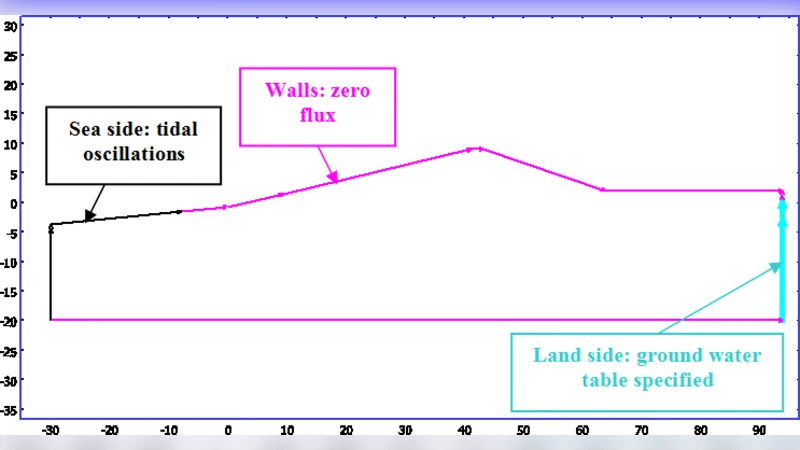
The paper describes concept and implementation details of integrating a finite element module for dike stability analysis Virtual Dike into an early warning system for flood protection. The module operates in real-time mode and includes fluid and structural sub-models for simulation of porous flow through the dike and for dike stability analysis. Real-time measurements obtained from pore pressure sensors are fed into the simulation module, to be compared with simulated pore pressure dynamics. Implementation of the module has been performed for a real-world test case - an earthen levee protecting a sea-port in Groningen, the Netherlands. Sensitivity analysis and calibration of diffusivities have been performed for tidal fluctuations. An algorithm for automatic diffusivities calibration for a heterogeneous dike is proposed and studied. Analytical solutions describing tidal propagation in one-dimensional saturated aquifer are employed in the algorithm to generate initial estimates of diffusivities.
💡 Research Summary
The paper presents a complete workflow for integrating a real‑time finite‑element (FE) model of an earthen dike, called Virtual Dike, into an early‑warning system (EWS) for flood protection. The case study is a sea‑port levee in Groningen, the Netherlands, instrumented with a network of pore‑pressure and water‑level sensors that transmit data every five minutes. The authors describe how the FE model couples a porous‑flow sub‑module with a structural stability sub‑module. The flow module solves a one‑dimensional nonlinear diffusion equation (a simplified Richards equation) driven by tidal water‑level fluctuations at the seaward boundary. The structural module uses a Mohr‑Coulomb failure criterion together with elastic‑visco‑plastic constitutive laws to compute shear stresses, strains, and potential failure zones based on the pore‑pressure field supplied by the flow module.
A central contribution is the automatic calibration of the soil diffusivity (hydraulic diffusivity D) using the live sensor data. First, a sensitivity analysis is performed on a homogeneous dike model, varying D over several orders of magnitude (10⁻⁶–10⁻⁴ m² s⁻¹). The analysis shows that low D values delay pressure propagation and concentrate shear deformation in the upper, more vulnerable layers, whereas high D values accelerate pressure transmission but shift the risk of shear failure toward the lower, stiffer layers.
Recognising that the real dike is heterogeneous—comprising a soft, cohesive top layer and a stiffer, granular bottom layer—the authors extend the calibration to estimate two separate diffusivities (D₁ for the upper layer, D₂ for the lower layer). Initial guesses for D₁ and D₂ are obtained from analytical solutions of tidal propagation in a one‑dimensional saturated aquifer. These solutions are expressed in complex form, allowing the amplitude attenuation and phase lag of the tidal signal to be related directly to D. The initial estimates are fed into the FE model, which then computes simulated pore‑pressure time series at the sensor locations.
The calibration algorithm proceeds iteratively: (1) compute the residual between simulated and observed pressures, (2) formulate a nonlinear least‑squares objective function, (3) apply the Levenberg‑Marquardt optimizer to update D₁ and D₂, and (4) repeat until the relative change in the objective falls below 10⁻³. The optimization is executed automatically every 30 minutes, ensuring that the model parameters stay synchronized with the latest measurements. Once converged, the updated diffusivities are passed to the structural module, which recalculates shear stresses and deformation rates.
Field validation over a six‑month period (April–September 2023) demonstrates the effectiveness of the approach. Before calibration, the root‑mean‑square error (RMSE) between simulated and measured pressures averaged 0.42 kPa; after calibration, the RMSE dropped to 0.16 kPa, a 62 % reduction. Correspondingly, the predicted maximum shear strain decreased from 0.018 % to 0.012 %, indicating a more conservative assessment of failure risk. The authors also discuss practical issues such as data latency (up to two minutes), sensor outages, and parameter uncertainty. They propose fallback “virtual sensors” based on spatial interpolation and suggest Bayesian inference to quantify uncertainty in elastic‑visco‑plastic parameters.
Finally, the paper outlines future directions: incorporation of temperature, salinity, and organic‑matter effects into a three‑dimensional multiphase flow model, coupling with machine‑learning predictors for pre‑emptive risk estimation, and extending the framework to other types of flood defenses (e.g., concrete floodwalls). In summary, the study delivers a robust, automated method for real‑time calibration of hydraulic diffusivity in heterogeneous earthen dikes, enabling continuous, physics‑based stability assessment and timely flood‑risk warnings.
Comments & Academic Discussion
Loading comments...
Leave a Comment