Singular gradient flow of the distance function and homotopy equivalence
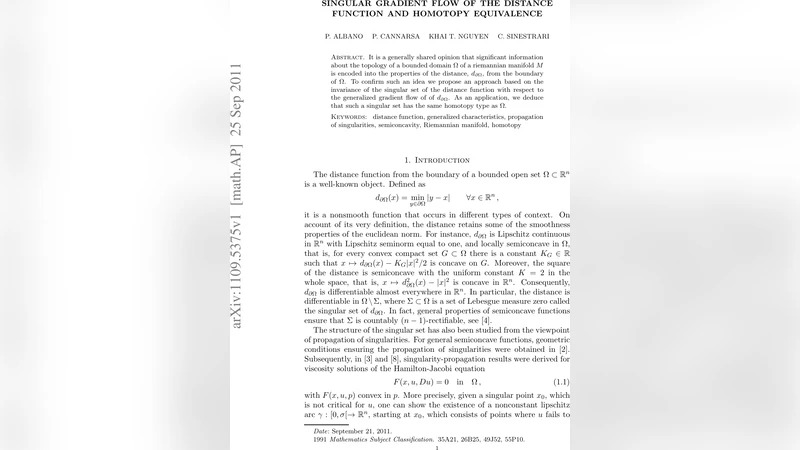
It is a generally shared opinion that significant information about the topology of a bounded domain $\Omega $ of a riemannian manifold $M$ is encoded into the properties of the distance, $d_{\partial\Omega}$, %, $d:\Omega\rightarrow [0,\infty [$, from the boundary of $\Omega$. To confirm such an idea we propose an approach based on the invariance of the singular set of the distance function with respect to the generalized gradient flow of of $d_{\partial\Omega}$. As an application, we deduce that such a singular set has the same homotopy type as $\Omega$.
💡 Research Summary
The paper investigates the relationship between the geometry of a bounded domain Ω in a Riemannian manifold M and the topology encoded in the distance function d∂Ω from the boundary. The authors focus on the singular set Σ of the distance function—points where d∂Ω fails to be differentiable—and prove that Σ is invariant under the generalized gradient flow associated with d∂Ω. This invariance leads directly to the conclusion that Σ and Ω share the same homotopy type.
The work proceeds in several stages. First, the authors recall that the distance function is 1‑Lipschitz and locally semiconcave; its square is globally semiconcave with constant K = 2 in Euclidean space. Semiconcavity guarantees the existence of a non‑empty super‑differential D⁺u(x) at every point and provides a key inequality (3.1) linking super‑gradients at two points. Using these tools, they define a generalized characteristic (or gradient flow) γ(t) satisfying the differential inclusion γ′(t) ∈ A⁻¹(γ(t)) D⁺u(γ(t)), where A(x) is the positive‑definite matrix representing the Riemannian metric.
The central technical contribution is the proof that if the initial point γ(0) lies in Σ, then γ(t) stays in Σ for a positive time interval (Theorem 3.4 (iv)). The proof hinges on a “logistic” differential inequality (5) derived from semiconcavity: the speed |γ′(t)| satisfies an inequality that forces it to remain strictly less than 1 whenever it starts below 1. Since a point is singular precisely when the inner product ⟨A(γ(t))p(t),p(t)⟩ < 1 (where p(t) is the right‑hand derivative of γ), the inequality guarantees that singularity persists along the flow.
In the Euclidean case the semiconcavity constant K = 2 for d²∂Ω is optimal, and the argument proceeds directly. In the Riemannian setting, however, d²∂Ω need not be semiconcave with K = 2. To overcome this, the authors introduce a nonlinear transformation v(x) = cosh(α d∂Ω(x)) with a curvature‑dependent constant α > 0. They prove (Theorem 4.2) that v is semiconcave with a suitable constant, allowing the same logistic inequality to be established for the Riemannian gradient flow (Theorem 4.5). Consequently, the singular set Σ is invariant under the generalized gradient flow on any complete Riemannian manifold.
Having established invariance, the authors construct a deformation retraction from Ω onto Σ by flowing each regular point along the smooth gradient of the distance function until it reaches Σ, while points already in Σ remain fixed. This yields a continuous map r : Ω → Σ with r|_Σ = id_Σ, proving that Ω and Σ are homotopy equivalent (Theorem 5.3). The result extends earlier homotopy equivalence theorems that required smooth or piecewise‑smooth boundaries and low dimensions; here it holds for arbitrary dimensions and for domains with possibly very irregular boundaries.
Finally, the paper discusses an application to optimal control: the minimal exit time function T(x) for steering a point to the boundary can be interpreted as a Riemannian distance. By the same analysis, the singular set of T shares the homotopy type of Ω, providing a new perspective on the topology of optimal trajectories.
Overall, the paper introduces a novel combination of semiconcavity theory, super‑differential calculus, and a hyperbolic cosine transformation to control the behavior of the distance function’s singularities under generalized gradient flow. This yields a clean and general proof that the singular set of the distance function is a topological replica of the original domain, with implications for geometry, PDEs, and optimal control.
Comments & Academic Discussion
Loading comments...
Leave a Comment