Computation with narrow CTCs
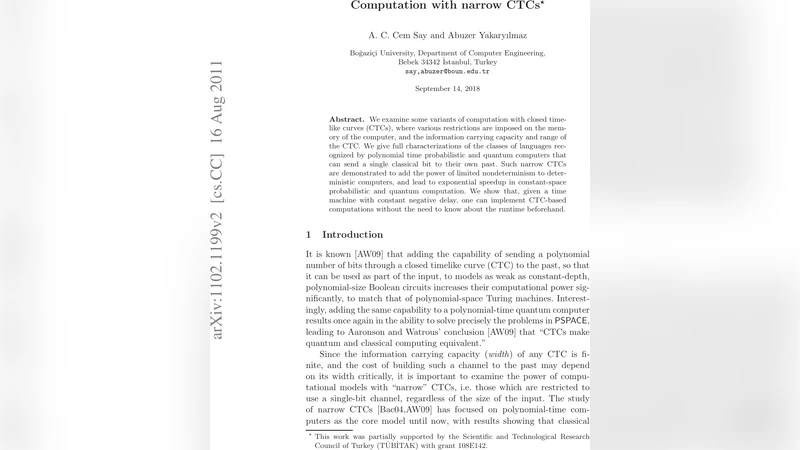
We examine some variants of computation with closed timelike curves (CTCs), where various restrictions are imposed on the memory of the computer, and the information carrying capacity and range of the CTC. We give full characterizations of the classes of languages recognized by polynomial time probabilistic and quantum computers that can send a single classical bit to their own past. Such narrow CTCs are demonstrated to add the power of limited nondeterminism to deterministic computers, and lead to exponential speedup in constant-space probabilistic and quantum computation. We show that, given a time machine with constant negative delay, one can implement CTC-based computations without the need to know about the runtime beforehand.
💡 Research Summary
The paper investigates the computational power of “narrow” closed timelike curves (CTCs), i.e., CTCs that can transmit only a single classical bit from the end of a computation back to its beginning. The authors study a variety of computational models—deterministic, probabilistic, and quantum—augmented with such a one‑bit CTC, and provide complete characterizations of the language classes they can recognize.
First, the authors formalize the model M_CTC1, where a machine of type M (finite automaton, push‑down automaton, polynomial‑time Turing machine, etc.) has access to an extra bit that is set by the future according to the causal‑consistency condition (the fixed‑point requirement x = f(x)). They then establish a fundamental equivalence: a one‑bit CTC provides exactly the power of postselection. Lemma 1 shows that any real‑time probabilistic or quantum finite automaton (PFA, QFA) equipped with postselection can be simulated by an M_CTC1 that simply reads the CTC bit when it reaches a non‑postselection state. Lemma 2 proves the converse: any M_CTC1 can be transformed into a standard M that runs two copies of the underlying machine, one assuming the CTC bit is 0 and the other assuming it is 1, and then postselects on the outcomes. The transition matrix of the CTC bit is a 2×2 stochastic matrix whose unique stationary distribution reproduces exactly the normalized acceptance probability of the postselected computation.
From this equivalence the authors derive clean class identities:
- BPP_path (polynomial‑time probabilistic machines with postselection) = BPP_CTC1 (probabilistic machines with a one‑bit CTC).
- PP = PostBQP = BQP_CTC1 (polynomial‑time quantum machines with a one‑bit CTC).
Thus, a narrow CTC adds only “limited nondeterminism” to the underlying model, in contrast to the dramatic jump to PSPACE that occurs when a polynomial‑width CTC is allowed (as shown in earlier work by Aaronson‑Watrus and Bacon).
The paper then explores the impact of narrow CTCs on constant‑space and real‑time automata. Without a CTC, real‑time PFAs and QFAs can recognize only regular languages with bounded error. With a one‑bit CTC, they can recognize non‑regular languages such as
- L_eq = { w ∈ {a,b}* | #a(w) = #b(w) } (recognizable by a PFA with postselection), and
- L_pal = { w ∈ {a,b}* | w = w^R } (recognizable by a QFA with postselection).
Consequently, QFA_CTC1 strictly outperforms PFA_CTC1, demonstrating that quantum finite‑state machines gain a genuine advantage from a narrow CTC.
For deterministic push‑down automata (DPDAs), adding a one‑bit CTC yields the ability to simulate limited nondeterminism, enabling them to accept languages beyond the deterministic context‑free class. In contrast, one‑way deterministic finite automata (DFAs) and two‑way deterministic models do not gain any extra power from a narrow CTC, because their computation does not involve a “final‑marker” moment where the CTC bit could be written.
A particularly striking result is the exponential speed‑up for constant‑space machines. Classical and quantum finite automata with a narrow CTC can decide certain non‑regular languages in polynomial time, whereas the same languages would require super‑polynomial time (or additional memory) in the standard model. This shows that even a single bit of retrocausal information can dramatically reduce the time complexity of space‑bounded computation.
Finally, the authors address the physical plausibility of such machines. They propose a model of a “time machine with constant negative delay”: a device that, once built, can send a bit to its own past with a fixed offset T, independent of the input length. Using this device, the CTC bit can be generated on‑the‑fly, eliminating the need to know the total runtime in advance—a requirement in the original Aaronson‑Watrus framework where a new CTC must be constructed for each input size. The paper demonstrates how the constructions of Sections 3–5 can be carried out with this constant‑delay machine, thereby providing a more realistic implementation scenario for narrow‑CTC computations.
In summary, the work shows that narrow CTCs are computationally equivalent to postselection, yielding precise characterizations of the resulting language classes. They endow deterministic and probabilistic models with limited nondeterminism, give quantum finite‑state machines a provable advantage over their classical counterparts, and enable exponential speed‑ups for constant‑space computation. Moreover, the authors present a feasible physical model that sidesteps the need for input‑dependent CTC construction, strengthening the bridge between theoretical computer science and speculative physics.
Comments & Academic Discussion
Loading comments...
Leave a Comment