Hydrothermal alteration at the Panorama Formation, North Pole Dome, Pilbara Craton, Western Australia
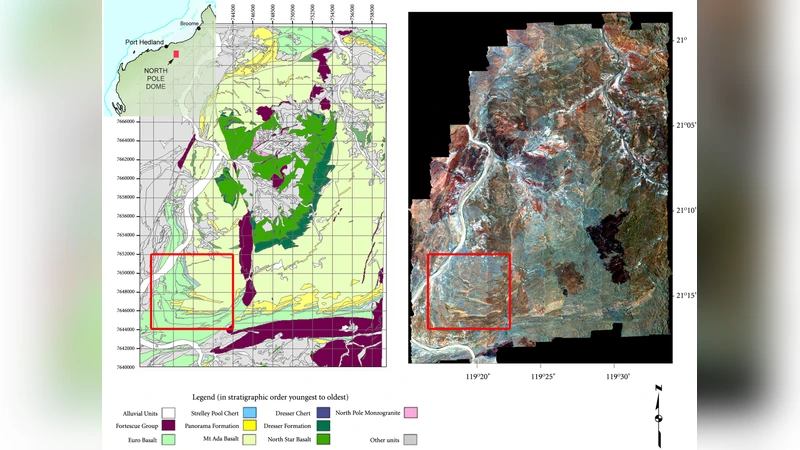
An airborne hyperspectral remote sensing dataset was obtained of the North Pole Dome region of the Pilbara Craton in October 2002. It has been analyzed for indications of hydrothermal minerals. Here we report on the identification and mapping of hydrothermal minerals in the 3.459 Ga Panorama Formation and surrounding strata. The spatial distribution of a pattern of subvertical pyrophyllite rich veins connected to a pyrophyllite rich palaeohorizontal layer is interpreted to represent the base of an acid-sulfate epithermal system that is unconformably overlain by the stromatolitic 3.42 Ga Strelley Pool Chert.
💡 Research Summary
The paper presents a detailed investigation of hydrothermal alteration within the 3.459 Ga Panorama Formation and adjacent strata of the North Pole Dome region in the Pilbara Craton, Western Australia, using an airborne hyperspectral remote‑sensing dataset acquired in October 2002. After rigorous preprocessing—including atmospheric correction, geometric registration, and conversion to apparent reflectance—the authors applied Minimum Noise Fraction (MNF) compression and Spectral Angle Mapper (SAM) classification to isolate diagnostic absorption features of key minerals such as pyrophyllite, quartz, carbonates, and sulfates.
The hyperspectral analysis revealed a distinctive mineralogical pattern: a series of sub‑vertical, pyrophyllite‑rich veins intersecting a broadly continuous, sub‑horizontal pyrophyllite‑enriched layer. The veins display near‑vertical dip angles, while the horizontal layer lies essentially parallel to the modern ground surface. This geometry is interpreted as the structural expression of the base of an acid‑sulfate epithermal system. Pyrophyllite, an Al‑silicate that forms under low‑temperature, acidic conditions, serves as a reliable proxy for such environments, and its spatial distribution mirrors the “flush line” commonly observed in contemporary acid‑sulfate geothermal fields.
Stratigraphically, the Panorama Formation consists of volcanic‑sedimentary sequences deposited around 3.459 Ga. Overlying it, unconformably, is the stromatolitic 3.42 Ga Strelley Pool Chert, a unit renowned for preserving early microbial mat textures. The lack of direct contact between the pyrophyllite veins and the overlying chert, together with the presence of an intervening erosional surface, indicates that the hydrothermal system was active prior to the deposition of the Strelley Pool Chert and was subsequently truncated. This temporal relationship suggests that the acid‑sulfate epithermal activity coincided with early crustal deformation and possibly contributed to the chemical environment that later supported microbial colonization.
The authors argue that the identification of a high‑temperature, acid‑sulfate system at ~3.45 Ga has profound implications for models of early Earth habitability. An acidic, sulfate‑rich hydrothermal fluid would have supplied a suite of dissolved metals and nutrients, while also providing localized thermal energy—conditions that are favorable for pre‑biotic chemistry and early microbial metabolism. Moreover, the presence of such a system predates the widespread emergence of oxygenic photosynthesis, implying that non‑oxygenic, chemolithotrophic pathways could have been supported by these fluids.
Methodologically, the study showcases the power of airborne hyperspectral imaging for Archean terrains. Traditional field mapping and laboratory petrography are limited by accessibility and scale, whereas hyperspectral data enable rapid, non‑destructive detection of mineralogical signatures across tens of square kilometers. The authors recommend integrating hyperspectral surveys with targeted ground truthing—collecting hand specimens, conducting X‑ray diffraction (XRD) and electron microprobe analyses—to refine classification algorithms and quantify mineral abundances.
In conclusion, the paper provides compelling evidence for a buried, acid‑sulfate epithermal system that formed at the base of the Panorama Formation, predating the overlying stromatolitic chert. This system is manifested by sub‑vertical pyrophyllite veins linked to a sub‑horizontal pyrophyllite horizon, both of which are diagnostic of low‑temperature, acidic hydrothermal alteration. The findings enrich our understanding of Archean hydrothermal processes, suggest that early Earth hosted chemically diverse geothermal environments, and demonstrate that hyperspectral remote sensing is an indispensable tool for unraveling the mineralogical architecture of ancient terrains.