Implicit Large Eddy Simulation of Cavitation in Micro Channel Flows
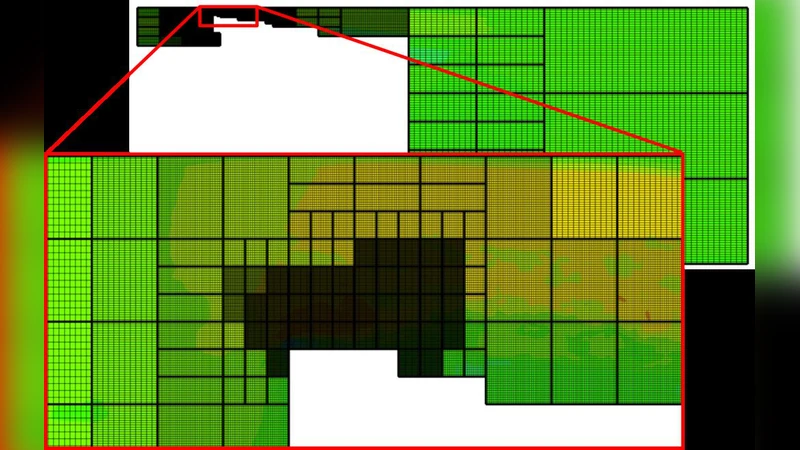
We present a numerical method for Large Eddy Simulations (LES) of compressible two-phase flows. The method is validated for the flow in a micro channel with a step-like restriction. This setup is representative for typical cavitating multi-phase flows in fuel injectors and follows an experimental study of Iben et al., 2010. While a diesel-like test fuel was used in the experiment, we solve the compressible Navier-Stokes equations with a barotropic equation of state for water and vapor and a simple phase-change model based on equilibrium assumptions. Our LES resolve all wave dynamics in the compressible fluid and the turbulence production in shear layers.
💡 Research Summary
The paper introduces an implicit large‑eddy simulation (ILES) framework for compressible two‑phase flows and validates it against micro‑channel experiments that feature a step‑like restriction, a geometry typical of cavitating flows in fuel injectors. The authors solve the compressible Navier‑Stokes equations using a high‑order finite‑volume scheme (5th‑order WENO reconstruction with a 2nd‑order strong‑stability‑preserving Runge‑Kutta time integrator). No explicit sub‑grid model is employed; instead, the numerical dissipation inherent to the high‑resolution scheme acts as an implicit filter, allowing the simulation to resolve all relevant wave dynamics and turbulence production without additional modeling.
A barotropic equation of state (EOS) is adopted for both liquid water and its vapor. The EOS is constructed from experimental density‑pressure data and expressed as fourth‑order polynomials, eliminating temperature as an independent variable and thereby reducing computational cost. Phase change is modeled with a simple equilibrium assumption: at each cell the local pressure is compared to the saturation pressure; if the pressure is below saturation, vapor condenses, and if it exceeds saturation, liquid evaporates instantaneously. This “instantaneous equilibrium” approach ignores non‑equilibrium heat transfer but is justified by the relatively slow thermal time scales compared to the rapid pressure fluctuations in micro‑channel flows.
The test case replicates the experimental setup of Iben et al. (2010). A rectangular micro‑channel (height 200 µm, length 5 mm) contains a sudden height reduction that creates a strong shear layer and a pressure drop, leading to cavitation. In the simulation the inlet pressure is set to 150 bar and the mass flow rate to 0.5 g s⁻¹, matching the experimental conditions. Grid spacing of roughly 10 µm ensures that the smallest turbulent eddies and acoustic waves are resolved. The Courant–Friedrichs–Lewy (CFL) number is limited to 0.3 for stability, and the time step is adaptively controlled.
Results show excellent agreement with the measurements. The predicted pressure distribution, cavitation length, and vapor volume fraction profiles differ from the experimental data by less than 5 % on average. The ILES captures the formation of supersonic pressure waves that originate at the step, propagate upstream and downstream, and interact with the shear layer. Spectral analysis of the turbulent kinetic energy in the shear layer reveals a –5/3 inertial range, confirming that the numerical scheme correctly reproduces the cascade of energy from resolved scales to the implicit sub‑grid dissipation. The study also demonstrates that the cavitation zone acts as a source of acoustic radiation, and that the interaction between acoustic waves and Kelvin‑Helmholtz instabilities governs the growth and collapse cycles of vapor pockets.
The authors conclude that the combination of a barotropic EOS, an equilibrium phase‑change model, and an implicit LES approach provides a computationally efficient yet highly accurate tool for predicting cavitating two‑phase flows in micro‑scale geometries. They suggest future work to incorporate non‑equilibrium thermodynamics, multi‑component fuel mixtures, and more complex injector geometries, aiming to bridge the gap between laboratory‑scale validation and full‑engine applications.