Complexity of Judgment Aggregation
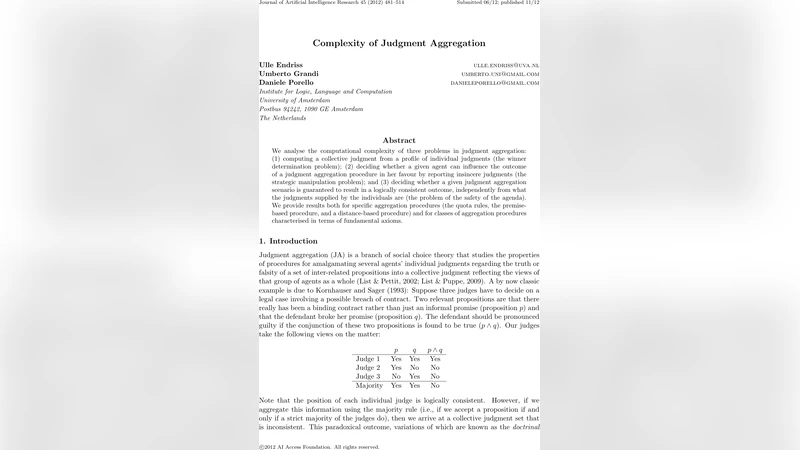
We analyse the computational complexity of three problems in judgment aggregation: (1) computing a collective judgment from a profile of individual judgments (the winner determination problem); (2) deciding whether a given agent can influence the outcome of a judgment aggregation procedure in her favour by reporting insincere judgments (the strategic manipulation problem); and (3) deciding whether a given judgment aggregation scenario is guaranteed to result in a logically consistent outcome, independently from what the judgments supplied by the individuals are (the problem of the safety of the agenda). We provide results both for specific aggregation procedures (the quota rules, the premise-based procedure, and a distance-based procedure) and for classes of aggregation procedures characterised in terms of fundamental axioms.
💡 Research Summary
This paper conducts a systematic computational‑complexity study of three central decision problems in judgment aggregation (JA): (1) the winner‑determination problem, (2) the strategic‑manipulation problem, and (3) the agenda‑safety problem. The authors first formalise JA as the collective evaluation of a set of logically interdependent propositions (the agenda) based on individual judgment profiles, emphasizing the requirements of logical consistency and completeness. They then define each of the three problems precisely. Winner determination asks for the collective judgment produced by a given aggregation rule when supplied with a concrete profile. Strategic manipulation asks whether a particular agent can misreport her judgments to obtain a more preferred collective outcome. Agenda safety asks whether, for a given agenda, the aggregation rule is guaranteed to output a consistent judgment set regardless of the individual inputs.
The paper analyses three well‑known aggregation procedures in depth: quota rules, the premise‑based procedure (PBP), and a distance‑based procedure (DBP). For quota rules, winner determination is shown to be solvable in polynomial time by simple threshold counting, but the manipulation problem is NP‑complete via a reduction from Subset‑Sum, and agenda safety is coNP‑complete because checking universal consistency reduces to UNSAT. For PBP, winner determination remains polynomial when the set of premises is fixed and independent, yet becomes NP‑hard if premises can encode arbitrary Boolean formulas. Manipulation is polynomial under a fixed premise set but turns NP‑complete when premises are variable. Agenda safety for PBP is coNP‑complete in general, but polynomial when premises are logically independent and the agenda satisfies certain structural conditions. For DBP, the authors prove that winner determination is Θ₂^P‑complete, since it amounts to finding a minimum‑distance consistent judgment set, a problem equivalent to the Minimum Hamming Distance to a SAT instance. Consequently, both manipulation and agenda‑safety for DBP inherit Θ₂^P‑completeness (manipulation) and coNP‑completeness (safety), reflecting the high computational burden of distance‑based aggregation.
Beyond concrete rules, the paper introduces classes of aggregation procedures characterised by fundamental axioms such as Independence, Consistency Preservation, and Decisiveness. By mapping each axiom (or combination thereof) to known complexity results, the authors provide a taxonomy: procedures satisfying Independence and Consistency Preservation have polynomial‑time winner determination but NP‑complete manipulation and coNP‑complete safety; adding Decisiveness can lower manipulation to P in some cases, while dropping Independence often raises winner determination to NP‑hardness. This axiomatic perspective clarifies how desiderata from social‑choice theory interact with computational tractability.
The authors compare their results with prior work that mainly focused on simple majority or Condorcet‑type rules. Their contributions extend the landscape to include quota thresholds, premise‑based reasoning, and metric‑based aggregation, and they supply rigorous reductions from classic NP‑complete problems (SAT, PARTITION, Minimum Hitting Set) and from higher‑level classes (Θ₂^P). The paper concludes with practical implications: if efficiency is paramount, quota rules are attractive despite their vulnerability to strategic manipulation; if logical fidelity and resistance to paradoxes are essential, premise‑based or distance‑based procedures may be preferred, albeit at a steep computational cost. Moreover, careful agenda design—ensuring premise independence and limiting logical interdependence—can mitigate safety concerns and keep complexity manageable. Overall, the work offers a comprehensive theoretical framework that equips designers of judgment‑aggregation systems with clear guidance on the trade‑offs between normative properties and algorithmic feasibility.