COLIN: Planning with Continuous Linear Numeric Change
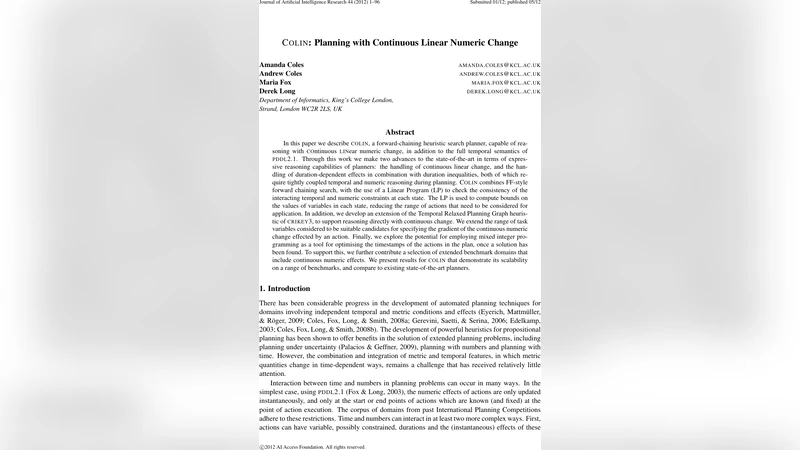
In this paper we describe COLIN, a forward-chaining heuristic search planner, capable of reasoning with COntinuous LINear numeric change, in addition to the full temporal semantics of PDDL. Through this work we make two advances to the state-of-the-art in terms of expressive reasoning capabilities of planners: the handling of continuous linear change, and the handling of duration-dependent effects in combination with duration inequalities, both of which require tightly coupled temporal and numeric reasoning during planning. COLIN combines FF-style forward chaining search, with the use of a Linear Program (LP) to check the consistency of the interacting temporal and numeric constraints at each state. The LP is used to compute bounds on the values of variables in each state, reducing the range of actions that need to be considered for application. In addition, we develop an extension of the Temporal Relaxed Planning Graph heuristic of CRIKEY3, to support reasoning directly with continuous change. We extend the range of task variables considered to be suitable candidates for specifying the gradient of the continuous numeric change effected by an action. Finally, we explore the potential for employing mixed integer programming as a tool for optimising the timestamps of the actions in the plan, once a solution has been found. To support this, we further contribute a selection of extended benchmark domains that include continuous numeric effects. We present results for COLIN that demonstrate its scalability on a range of benchmarks, and compare to existing state-of-the-art planners.
💡 Research Summary
The paper introduces COLIN, a forward‑chaining heuristic search planner that uniquely integrates continuous linear numeric change with the full temporal semantics of PDDL. COLIN builds on the FF‑style forward search but augments each search node with a linear program (LP) that simultaneously checks the consistency of temporal constraints (such as start‑time ordering, minimum and maximum durations, and concurrency restrictions) and numeric constraints (including variables that evolve continuously over time). The LP computes tight bounds on all numeric variables in the current state and treats action start and end times as decision variables, thereby pruning infeasible actions before they are considered for expansion.
A major technical contribution is the handling of duration‑dependent effects together with duration inequalities. Actions can specify a gradient that determines how a numeric variable changes proportionally to the action’s duration; the LP encodes this relationship directly, ensuring that any chosen duration satisfies both the effect equation and any external duration bounds. This tight coupling of temporal and numeric reasoning is essential for domains where the amount of resource consumption, fuel burn, temperature change, or energy discharge depends on how long an action runs.
To guide the search, the authors extend the Temporal Relaxed Planning Graph (TRPG) heuristic from CRIKEY3. The extension incorporates continuous change by adding “gradient” edges between successive planning graph layers, allowing the heuristic to estimate the minimal time and resource cost required to achieve goals under continuous dynamics. The heuristic therefore provides more accurate guidance than a purely discrete relaxed plan, especially in domains with strong continuous effects.
After a feasible plan is found, COLIN optionally refines the timestamps of all actions using mixed‑integer programming (MIP). This post‑processing step optimizes a user‑specified objective—typically makespan or total energy consumption—while preserving the logical ordering and numeric feasibility of the plan.
The authors also contribute a suite of extended benchmark domains that embed continuous numeric effects, such as fuel‑draining navigation, temperature‑controlled chemical processes, and power‑grid charging/discharging scenarios. Experimental evaluation on these benchmarks shows that COLIN scales better than state‑of‑the‑art planners (e.g., POPF, SAPF, Temporal Fast Downward). In many cases COLIN solves problems that other planners cannot, and when both succeed it often finds solutions with lower makespan or resource usage. The results demonstrate that integrating LP‑based consistency checking and a continuous‑aware heuristic yields a powerful combination for planning under intertwined temporal and numeric constraints.
Finally, the paper discusses the modularity of COLIN’s architecture: the LP/MIP solver can be swapped, and alternative heuristics can be plugged in without redesigning the core planner. This opens avenues for future extensions to handle non‑linear continuous dynamics, stochastic effects, or multi‑objective optimization. The work thus represents a significant step toward planners that can operate in realistic, continuously changing environments while still providing strong theoretical guarantees and practical performance.