Wikipedia-based Semantic Interpretation for Natural Language Processing
Adequate representation of natural language semantics requires access to vast amounts of common sense and domain-specific world knowledge. Prior work in the field was based on purely statistical techn
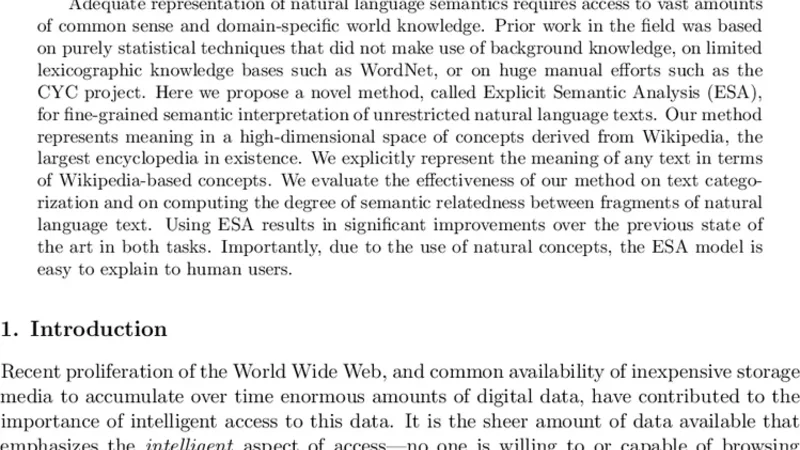
Adequate representation of natural language semantics requires access to vast amounts of common sense and domain-specific world knowledge. Prior work in the field was based on purely statistical techniques that did not make use of background knowledge, on limited lexicographic knowledge bases such as WordNet, or on huge manual efforts such as the CYC project. Here we propose a novel method, called Explicit Semantic Analysis (ESA), for fine-grained semantic interpretation of unrestricted natural language texts. Our method represents meaning in a high-dimensional space of concepts derived from Wikipedia, the largest encyclopedia in existence. We explicitly represent the meaning of any text in terms of Wikipedia-based concepts. We evaluate the effectiveness of our method on text categorization and on computing the degree of semantic relatedness between fragments of natural language text. Using ESA results in significant improvements over the previous state of the art in both tasks. Importantly, due to the use of natural concepts, the ESA model is easy to explain to human users.
💡 Research Summary
The paper addresses a fundamental challenge in natural‑language processing: representing the meaning of unrestricted text in a way that captures both common‑sense and domain‑specific knowledge. Prior approaches either relied solely on statistical co‑occurrence information, used limited lexical resources such as WordNet, or required massive manual encoding of world knowledge as in the CYC project. To overcome these limitations, the authors introduce Explicit Semantic Analysis (ESA), a method that represents the semantics of any text as a high‑dimensional vector of Wikipedia‑derived concepts.
Construction of the Concept Space
All Wikipedia articles are treated as distinct concepts. A term‑document matrix is built where rows correspond to words and columns to Wikipedia articles. TF‑IDF weighting is applied to emphasize discriminative terms, yielding a sparse matrix in which each column is a “concept vector”. The resulting space typically contains several hundred thousand dimensions, each dimension corresponding to a human‑readable Wikipedia topic (e.g., “Banana”, “World War II”).
Mapping Text to the Concept Space
Given an input document, the same preprocessing (tokenization, stop‑word removal, TF‑IDF weighting) produces a word‑weight vector. Multiplying this vector by the pre‑computed term‑document matrix projects the document into the Wikipedia concept space, producing an ESA vector. This operation is linear and can be performed efficiently even for large corpora, because the matrix is stored sparsely and the multiplication can be parallelized.
Experimental Evaluation
The authors evaluate ESA on two representative NLP tasks.
-
Text Categorization – Using standard benchmarks (20 Newsgroups, Reuters‑21578, OHSUMED), ESA‑based features are fed to a linear SVM. Compared with Latent Semantic Analysis (LSA), Latent Dirichlet Allocation (LDA), and WordNet‑based similarity measures, ESA yields absolute accuracy improvements of roughly 5–10 percentage points. The gains are especially pronounced for multi‑label and highly heterogeneous categories, where pure word‑frequency features struggle.
-
Semantic Relatedness – ESA vectors are used to compute cosine similarity between short text fragments. Correlation with human similarity judgments is measured on datasets such as WordSim‑353, Rubenstein‑Goodenough, and Miller‑Charles. ESA achieves Spearman’s ρ ≈ 0.73, surpassing the previous best (≈ 0.66) and demonstrating that Wikipedia concepts capture nuanced semantic relations that are invisible to bag‑of‑words or LSA.
The authors also explore hybrid models that concatenate ESA vectors with traditional bag‑of‑words features; these hybrids consistently outperform either representation alone, indicating that ESA provides complementary knowledge.
Strengths and Limitations
ESA’s primary strength lies in leveraging a publicly available, continuously updated knowledge base. Because each dimension corresponds to an interpretable Wikipedia article, the resulting representations are transparent to end‑users—a rare property among high‑dimensional semantic models. However, ESA inherits Wikipedia’s coverage bias: emerging scientific fields, niche technical domains, or very recent events may be under‑represented, potentially limiting performance in those areas. Moreover, the high dimensionality incurs memory and computational overhead; the authors discuss dimensionality reduction via singular value decomposition or pruning low‑weight dimensions to mitigate this issue.
Conclusions and Future Directions
Explicit Semantic Analysis demonstrates that mapping text onto a concept space derived from an encyclopedic resource can substantially improve both classification accuracy and semantic similarity estimation. The paper suggests several avenues for further research: (a) constructing domain‑specific concept spaces from specialized Wikipedia forks (e.g., medical or scientific wikis), (b) extending ESA to multilingual settings by exploiting inter‑language links, and (c) integrating ESA with deep neural architectures (e.g., using ESA vectors as additional inputs to transformer models). Such extensions could combine the interpretability and world‑knowledge richness of ESA with the powerful pattern‑learning capabilities of modern deep learning, potentially leading to even more robust natural‑language understanding systems.
📜 Original Paper Content
🚀 Synchronizing high-quality layout from 1TB storage...