Water-filled telescopes
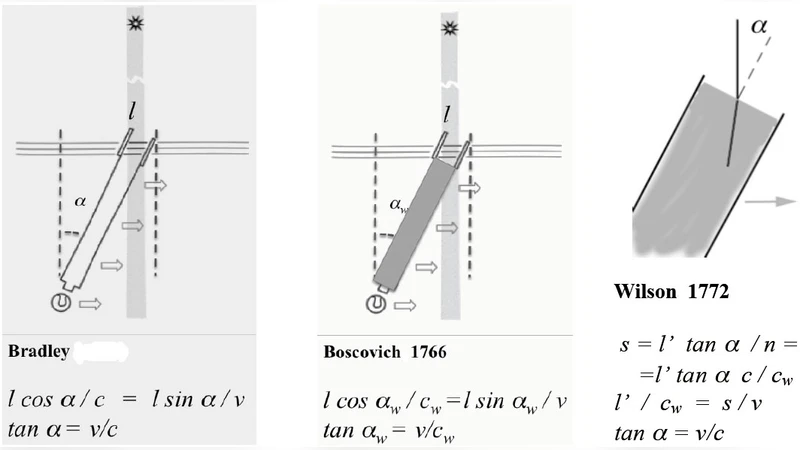
In this short note we discuss the case of the thought experiments on water-filled telescopes and their realizations during 18th and 19th century. The story of those instruments shows that the scientific progress occurs in a curious way, since there was no stringent reason for the construction of a water-filled telescope.
💡 Research Summary
The paper “Water‑filled telescopes” offers a concise yet thorough historical and conceptual examination of a series of thought experiments and actual constructions that attempted to place a column of water inside an astronomical telescope during the eighteenth and nineteenth centuries. The author begins by situating the idea within the broader debate over the nature of light that dominated the early modern period: Newton’s corpuscular theory, which implied that light would travel faster in denser media, versus the emerging wave theory, which suggested the opposite. In the 1760s and 1770s, scholars such as Boscovich, Laplace, and later Arago proposed that if a telescope’s tube were filled with water, the apparent position of a star—measured through the phenomenon of stellar aberration—should shift relative to a conventional air‑filled instrument. This proposal was not driven by any practical need for a water‑filled telescope; rather, it was a clever way to test whether the speed of light truly depended on the surrounding medium, thereby providing an empirical foothold in a largely theoretical dispute.
The narrative proceeds to describe the first genuine attempts to realize the concept. In 1849, Hippolyte Fizeau constructed a modest water‑filled tube at the Paris Observatory and measured stellar positions using the classic method of observing the apparent displacement caused by Earth’s orbital motion. His results showed no measurable difference between the water‑filled and air‑filled configurations. A decade later, George Biddell Airy repeated the experiment at the Royal Greenwich Observatory with improved optics and still found no deviation. The paper details the experimental setups, the precision of the angular measurements (on the order of a few arcseconds), and the systematic errors that were carefully accounted for, such as temperature‑induced refractive index changes and mechanical flexure of the tube.
Interpretation of these null results forms the core analytical section. The author argues that the experiments inadvertently confirmed a principle that would later become central to modern physics: the invariance of the speed of light with respect to the observer’s frame, independent of the intervening medium when the measurement is performed with a closed optical system. In other words, the water inside the telescope altered the optical path length but simultaneously altered the direction of the light ray through refraction, leaving the net stellar aberration unchanged. This subtle cancellation was not anticipated by the original theorists, who assumed a simple additive effect of the medium’s refractive index on the light’s velocity.
The paper then connects these nineteenth‑century findings to the broader evolution of electromagnetic theory. The water‑filled telescope experiments pre‑date the Michelson‑Morley interferometer, yet they share a methodological spirit: using a controlled medium to probe the constancy of light’s speed. When James Clerk Maxwell’s equations unified electricity, magnetism, and optics, the notion of a luminiferous ether fell under increasing scrutiny. The water‑filled telescope’s null result, although not widely cited at the time, provided an additional empirical datum that reinforced the growing skepticism toward any ether‑drag hypothesis. By the early twentieth century, Einstein’s special relativity would formalize the idea that the speed of light is a universal constant, rendering the original motivation for a water‑filled telescope obsolete.
In its concluding remarks, the author reflects on the epistemological lesson offered by this episode. Scientific progress does not always follow a linear path dictated by immediate practical applications; instead, curiosity‑driven experiments—sometimes seemingly “useless” devices—can illuminate hidden inconsistencies in prevailing theories and pave the way for paradigm shifts. The water‑filled telescope, though never adopted for routine astronomical observation, stands as a vivid illustration of how a modest, even whimsical, experimental idea can contribute to the deepening of our understanding of fundamental physics.