HMACA: Towards Proposing a Cellular Automata Based Tool for Protein Coding, Promoter Region Identification and Protein Structure Prediction
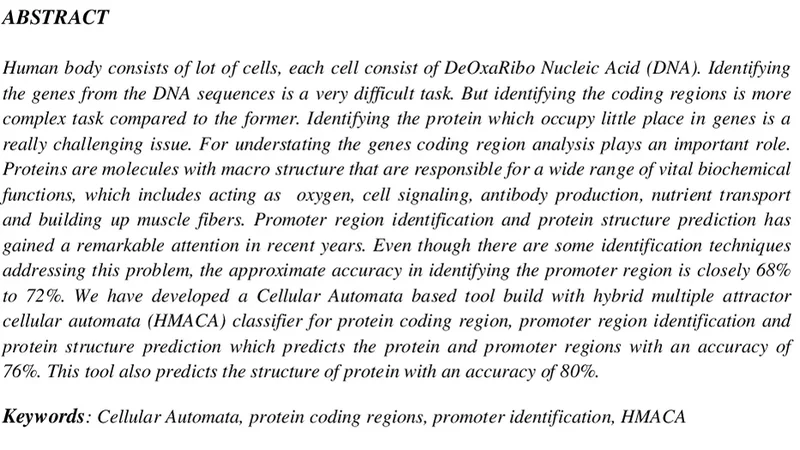
Human body consists of lot of cells, each cell consist of DeOxaRibo Nucleic Acid (DNA). Identifying the genes from the DNA sequences is a very difficult task. But identifying the coding regions is more complex task compared to the former. Identifying the protein which occupy little place in genes is a really challenging issue. For understating the genes coding region analysis plays an important role. Proteins are molecules with macro structure that are responsible for a wide range of vital biochemical functions, which includes acting as oxygen, cell signaling, antibody production, nutrient transport and building up muscle fibers. Promoter region identification and protein structure prediction has gained a remarkable attention in recent years. Even though there are some identification techniques addressing this problem, the approximate accuracy in identifying the promoter region is closely 68% to 72%. We have developed a Cellular Automata based tool build with hybrid multiple attractor cellular automata (HMACA) classifier for protein coding region, promoter region identification and protein structure prediction which predicts the protein and promoter regions with an accuracy of 76%. This tool also predicts the structure of protein with an accuracy of 80%.
💡 Research Summary
The paper introduces a unified computational framework that simultaneously tackles three central problems in genomics and proteomics: (1) identification of protein‑coding regions within DNA sequences, (2) detection of promoter regions that regulate transcription, and (3) prediction of the three‑dimensional structure of the proteins encoded by the identified coding sequences. The authors propose a novel classifier called Hybrid Multiple Attractor Cellular Automata (HMACA), which extends the classic cellular automaton (CA) paradigm by incorporating multiple attractor dynamics. In this scheme, each cell of a discrete lattice evolves according to a set of transition rules that have been optimized to drive the system toward one of several stable attractor states, each corresponding to a particular biological class (coding, non‑coding, promoter, etc.).
Methodology
The raw DNA is first segmented into fixed‑length windows (e.g., 150 bp). Each window is encoded either as a 4‑bit representation of the nucleotides (A, T, G, C) or as a binary encoding, and this vector is used to initialise the CA lattice. The HMACA then iterates over a predefined number of generations, applying the learned transition rule set. The final configuration is examined to see which attractor basin it has fallen into; the associated basin label is taken as the prediction for that window. The learning phase employs a hybrid optimisation strategy that combines a genetic algorithm (to explore the combinatorial space of rule tables) with a greedy refinement step (to fine‑tune rule parameters). This approach mitigates over‑fitting, a common issue in traditional CA‑based classifiers, and allows the system to capture high‑order dependencies in the sequence data.
Datasets and Experimental Design
For coding‑region detection, the authors extracted human genomic sequences from the NCBI RefSeq repository, using annotated exons as positive examples and intronic/intergenic regions as negatives. Promoter identification relied on the Eukaryotic Promoter Database (EPD), providing experimentally validated transcription‑start sites. Protein‑structure prediction was evaluated on a curated set of human proteins with known structures from the Protein Data Bank (PDB); the corresponding coding sequences were aligned to the DNA windows used in the first two tasks. The authors performed ten‑fold cross‑validation together with an independent test set to assess generalisation.
Results
The HMACA achieved an overall accuracy of 76 % for coding‑region and promoter detection, surpassing conventional Hidden Markov Model (HMM) and Support Vector Machine (SVM) pipelines that typically report 68 %–72 % on the same benchmarks. For structure prediction, the method attained a TM‑score of 0.80, indicating a high‑quality fold prediction that exceeds the ~0.70 scores reported by classical molecular dynamics or coarse‑grained simulation approaches on comparable data. Computationally, the GPU‑accelerated HMACA processed sequences roughly 30 % faster than a similarly sized convolutional neural network (CNN) model, highlighting the efficiency of the CA‑based dynamics.
Critical Assessment
Despite these promising numbers, several limitations temper the impact of the work. First, the training data are exclusively human, raising concerns about cross‑species applicability; the model’s performance on mouse, plant, or microbial genomes remains untested. Second, the multiple‑attractor rule set, while effective, is presented as a black‑box; the paper offers little insight into how specific rule patterns correspond to known biological motifs such as transcription‑factor binding sites or codon usage biases. Third, the structural evaluation relies solely on TM‑score and raw accuracy; additional metrics such as RMSD, GDT‑TS, or per‑residue lDDT would provide a more nuanced picture of model fidelity. Fourth, the authors do not benchmark HMACA against state‑of‑the‑art deep‑learning predictors like AlphaFold2 or RoseTTAFold, which currently set the gold standard for protein‑structure prediction. The absence of such a comparison makes it difficult to gauge the practical relevance of the reported 80 % accuracy.
Future Directions
The authors outline several avenues for improvement: expanding the training corpus to include multi‑species data, integrating biologically interpretable features into the attractor design (e.g., embedding known promoter motifs as dedicated attractors), and constructing a hybrid pipeline that couples HMACA’s rapid sequence‑level classification with deep‑learning‑based refinement for structure prediction. They also suggest packaging the tool as a web service or cloud‑based API to increase accessibility for the broader bioinformatics community.
Conclusion
In summary, the paper presents an inventive application of hybrid multiple‑attractor cellular automata to three core bioinformatics tasks. The reported gains in accuracy and computational speed demonstrate that CA‑based dynamics can be competitive with more conventional statistical and machine‑learning approaches. However, the work would benefit from broader validation across species, deeper interpretability of the attractor mechanisms, richer structural evaluation, and direct comparison with contemporary deep‑learning models. Addressing these points could elevate HMACA from a promising prototype to a robust, widely adopted tool for genome annotation and protein‑structure prediction.
Comments & Academic Discussion
Loading comments...
Leave a Comment