Independent subsets of powers of paths, and Fibonacci cubes
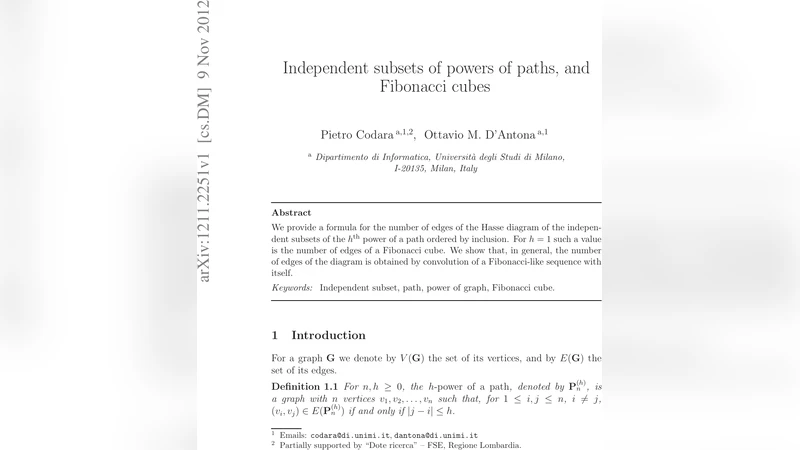
We provide a formula for the number of edges of the Hasse diagram of the independent subsets of the h-th power of a path ordered by inclusion. For h=1 such a value is the number of edges of a Fibonacci cube. We show that, in general, the number of edges of the diagram is obtained by convolution of a Fibonacci-like sequence with itself.
💡 Research Summary
The paper investigates the combinatorial structure of independent subsets of the h‑th power of a path graph and derives an exact formula for the number of edges in the Hasse diagram of the corresponding inclusion poset. Let Pₙ denote a simple path on n vertices. Its h‑th power, Pₙ^{(h)}, is obtained by connecting any two vertices whose distance in the original path does not exceed h. An independent set in Pₙ^{(h)} is a vertex subset containing no adjacent vertices (according to the h‑power adjacency). All independent sets, ordered by inclusion, form a partially ordered set (poset); the Hasse diagram of this poset consists of covering relations, each of which corresponds to adding a single vertex to an independent set while preserving independence. Consequently, the total number of edges Eₙ^{(h)} equals the sum, over all independent sets S, of the number of vertices that can be added to S without violating independence.
The authors first count the total number of independent sets, denoted pₙ^{(h)}. By a standard decomposition of a path, one obtains the recurrence
pₙ^{(h)} = p_{n‑1}^{(h)} + p_{n‑h‑1}^{(h)} for n ≥ h+1,
with initial conditions p₀^{(h)} = 1 and p_i^{(h)} = 2^{i} for 0 ≤ i ≤ h. This recurrence is a direct generalisation of the Fibonacci recurrence; when h = 1 we recover pₙ^{(1)} = F_{n+2}, where F_k denotes the k‑th Fibonacci number.
To pass from the count of sets to the count of covering edges, the paper observes that a vertex v can be added to an independent set S precisely when S contains none of the h‑neighbors of v. This condition depends only on the “available” positions in the path, not on the size of S. By grouping independent sets according to the position of the added vertex, the authors derive the compact expression
Eₙ^{(h)} = Σ_{k≥0} k·p_{n,k}^{(h)} = Σ_{i=0}^{n} p_i^{(h)}·p_{n‑i}^{(h)},
where p_{n,k}^{(h)} counts independent sets of size k. In other words, the edge count is the convolution of the sequence (pₙ^{(h)}) with itself. This result follows elegantly from generating‑function calculus: letting P^{(h)}(x) = Σ_{n≥0} pₙ^{(h)} xⁿ, the generating function for the edge numbers is simply (P^{(h)}(x))², and extracting coefficients yields the convolution formula.
The special case h = 1 reproduces a known result for Fibonacci cubes. A Fibonacci cube of dimension n is the subgraph of the n‑dimensional hypercube induced by binary strings without consecutive 1’s; its vertices correspond to independent sets of Pₙ^{(1)} and its edges correspond exactly to the covering relations in the poset. Since pₙ^{(1)} = F_{n+2}, the edge count becomes
Eₙ^{(1)} = Σ_{i=0}^{n} F_{i+2}·F_{n‑i+2},
which matches the established formula for the number of edges in a Fibonacci cube. Thus the paper not only recovers this classical result but also extends it to arbitrary h, introducing a family of “h‑Fibonacci” sequences that govern the combinatorics of higher‑power path graphs.
Beyond the theoretical derivation, the authors discuss algorithmic and application aspects. The convolution formula enables O(n) computation of Eₙ^{(h)} once the sequence pₙ^{(h)} is known, which can be generated iteratively using the linear recurrence. This efficiency is valuable for large‑scale networks where h‑power path models arise, such as wireless sensor networks with limited communication range (distance ≤ h) or scheduling problems where tasks must be spaced apart by at least h time slots. Independent sets then represent feasible schedules, and the Hasse diagram edges correspond to minimal schedule extensions, making the edge count a measure of the system’s flexibility.
Finally, the paper suggests several avenues for future work. One direction is to explore analogous results for other graph families—cycles, grids, or trees—where the structure of independent sets may still admit a convolution‑type description. Another is to investigate spectral properties of the Hasse diagram, which could reveal deeper connections between the combinatorial enumeration and algebraic graph theory. The authors also hint at potential coding‑theoretic applications, since the independent‑set poset of Pₙ^{(h)} yields a family of binary codes with constrained run‑lengths, generalising the well‑studied Fibonacci codes.
In summary, the paper provides a clean, unified combinatorial framework for counting edges in the Hasse diagram of independent subsets of h‑power path graphs, demonstrates that the count is the self‑convolution of a Fibonacci‑like sequence, and situates the result within the broader context of Fibonacci cubes, algorithmic computation, and practical network design.
Comments & Academic Discussion
Loading comments...
Leave a Comment