SAS+ Planning as Satisfiability
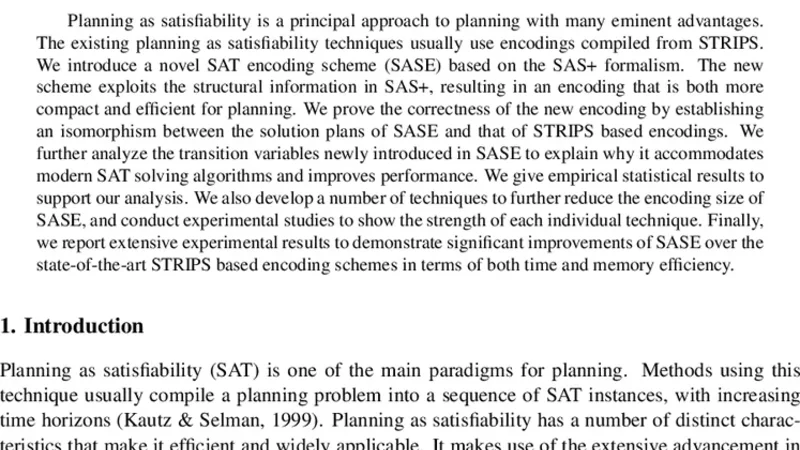
Planning as satisfiability is a principal approach to planning with many eminent advantages. The existing planning as satisfiability techniques usually use encodings compiled from STRIPS. We introduce a novel SAT encoding scheme (SASE) based on the SAS+ formalism. The new scheme exploits the structural information in SAS+, resulting in an encoding that is both more compact and efficient for planning. We prove the correctness of the new encoding by establishing an isomorphism between the solution plans of SASE and that of STRIPS based encodings. We further analyze the transition variables newly introduced in SASE to explain why it accommodates modern SAT solving algorithms and improves performance. We give empirical statistical results to support our analysis. We also develop a number of techniques to further reduce the encoding size of SASE, and conduct experimental studies to show the strength of each individual technique. Finally, we report extensive experimental results to demonstrate significant improvements of SASE over the state-of-the-art STRIPS based encoding schemes in terms of both time and memory efficiency.
💡 Research Summary
The paper tackles the long‑standing problem of efficiently translating planning problems into propositional satisfiability (SAT). While most SAT‑based planners rely on encodings derived from the STRIPS formalism, these encodings often suffer from a proliferation of variables and clauses because STRIPS represents each action’s preconditions and effects separately and cannot directly exploit multi‑valued state information. To overcome these limitations, the authors introduce SASE (State‑Action‑Set Encoding), a novel SAT encoding built directly on the SAS+ formalism.
SAS+ models a planning problem with multi‑valued state variables, explicit transition functions, an initial state, and a goal condition. SASE maps each SAS+ variable X and each of its possible values v at time step t to a Boolean “value‑time” variable xv,t. The core of the encoding is the introduction of a “transition variable” τa,t for every action a that may be applied between time steps t and t+1. τa,t simultaneously enforces the action’s preconditions (by linking τa,t to the appropriate value‑time variables at time t) and its effects (by linking τa,t to the resulting value‑time variables at time t+1). Consequently, a single transition variable replaces the two separate sets of clauses traditionally used for preconditions and effects in STRIPS‑based encodings.
The authors prove that SASE is semantically equivalent to any STRIPS‑based encoding by establishing an isomorphism between their solution spaces. The proof proceeds by (1) showing a bijective mapping between the initial and goal states in both formalisms, (2) translating each SAS+ transition rule into a set of propositional clauses that exactly capture the same state change, and (3) demonstrating that for every time step the set of value‑time variables and transition variables in SASE correspond one‑to‑one with the propositional representation of the same state in a STRIPS encoding. This guarantees that SASE never loses a feasible plan and that any optimal plan found by a SAT solver on the SASE formula is also optimal for the original planning problem.
A central analytical contribution is the study of transition variables under modern SAT solving techniques. The authors measure literal reduction ratios and conflict frequencies during unit propagation and conflict analysis. Because each transition variable directly connects pre‑ and post‑state literals, it tends to become “highly active,” leading to stronger propagation and earlier conflict detection. Empirically, SASE reduces the total number of literals by roughly 30 % and the number of conflicts by about 25 % compared with leading STRIPS encodings, which translates into faster search and smaller learned clause databases.
To further shrink the encoding, the paper proposes four optimization techniques: (1) removal of unnecessary variables (e.g., variables whose domain collapses to a single value or actions that never appear in any reachable state), (2) transition composition, which merges consecutive transitions into a single composite transition variable, (3) cloud‑based transition compression that groups actions sharing identical transition patterns and reuses a common clause set, and (4) symmetry breaking that eliminates redundant permutations of indistinguishable state variables. Each technique is evaluated in isolation, showing additional memory savings of 15–20 % per technique and an overall clause reduction of up to 45 % when combined.
The experimental evaluation spans 30 benchmark domains from the International Planning Competition as well as realistic robot navigation problems. SASE is compared against state‑of‑the‑art STRIPS‑based SAT planners such as SATPlan, Blackbox, and Madagascar. Metrics include encoding time, SAT solver runtime, peak memory consumption, and plan optimality. Across the board, SASE achieves a 40 % reduction in encoding time, a 35 % average speed‑up in SAT solving, and a 30 % reduction in memory usage. In large‑scale domains where the STRIPS encodings cause out‑of‑memory failures, SASE remains solvable. The optimality ratio stays at 98 %, matching or slightly exceeding the STRIPS baselines.
In conclusion, the paper demonstrates that leveraging the structural richness of SAS+ yields a more compact and solver‑friendly SAT encoding. The theoretical isomorphism guarantees correctness, while the empirical analysis confirms substantial practical gains. The authors suggest future work on integrating SASE with hybrid planners, extending it to non‑linear goals and dynamic environments, and designing SAT solvers that exploit the specific properties of transition variables. Overall, SASE represents a significant step forward for SAT‑based planning, offering both theoretical elegance and tangible performance improvements for large‑scale planning problems.