The power of indirect social ties
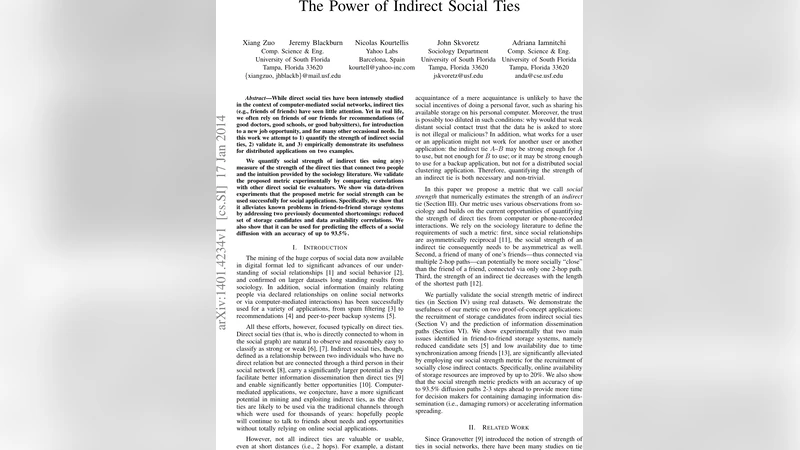
While direct social ties have been intensely studied in the context of computer-mediated social networks, indirect ties (e.g., friends of friends) have seen little attention. Yet in real life, we often rely on friends of our friends for recommendations (of good doctors, good schools, or good babysitters), for introduction to a new job opportunity, and for many other occasional needs. In this work we attempt to 1) quantify the strength of indirect social ties, 2) validate it, and 3) empirically demonstrate its usefulness for distributed applications on two examples. We quantify social strength of indirect ties using a(ny) measure of the strength of the direct ties that connect two people and the intuition provided by the sociology literature. We validate the proposed metric experimentally by comparing correlations with other direct social tie evaluators. We show via data-driven experiments that the proposed metric for social strength can be used successfully for social applications. Specifically, we show that it alleviates known problems in friend-to-friend storage systems by addressing two previously documented shortcomings: reduced set of storage candidates and data availability correlations. We also show that it can be used for predicting the effects of a social diffusion with an accuracy of up to 93.5%.
💡 Research Summary
The paper tackles a largely overlooked aspect of social network analysis: the quantitative assessment of indirect social ties, i.e., relationships between individuals who are not directly connected but are linked through one or more intermediaries. While direct ties have been extensively studied and leveraged for applications such as recommendation, spam filtering, and peer‑to‑peer backup, indirect ties have received far less attention despite their importance in real‑world scenarios (e.g., asking a friend’s friend for a doctor recommendation or a job introduction).
To fill this gap, the authors propose a novel “social strength” metric that estimates the intensity of an indirect tie based on observable properties of the underlying direct connections. The metric is grounded in four sociological observations: (O1) direct tie strength correlates with interaction frequency and shared interests; (O2) the weakest link on a path limits the overall indirect strength and strength decays with path length; (O3) multiple distinct paths between two nodes increase perceived closeness; and (O4) social relationships are inherently asymmetric.
Formally, each direct edge (i, j) is assigned a normalized weight NW(i,j) that captures the proportion of interaction types λ (calls, messages, co‑authorship, in‑game actions, etc.) relative to the user’s total interactions, thereby preserving asymmetry. For two indirectly connected users i and m at shortest‑path distance n, the social strength from i’s perspective is defined as
SSₙ(i,m) = 1 − ∏_{p∈Pₙ(i,m)}
Comments & Academic Discussion
Loading comments...
Leave a Comment