Epidemiological modeling of online social network dynamics
The last decade has seen the rise of immense online social networks (OSNs) such as MySpace and Facebook. In this paper we use epidemiological models to explain user adoption and abandonment of OSNs, where adoption is analogous to infection and abandonment is analogous to recovery. We modify the traditional SIR model of disease spread by incorporating infectious recovery dynamics such that contact between a recovered and infected member of the population is required for recovery. The proposed infectious recovery SIR model (irSIR model) is validated using publicly available Google search query data for “MySpace” as a case study of an OSN that has exhibited both adoption and abandonment phases. The irSIR model is then applied to search query data for “Facebook,” which is just beginning to show the onset of an abandonment phase. Extrapolating the best fit model into the future predicts a rapid decline in Facebook activity in the next few years.
💡 Research Summary
The paper presents a novel application of epidemiological modeling to the dynamics of online social networks (OSNs), focusing on how users join (adopt) and later leave (abandon) a platform. The authors begin by noting the striking rise and fall of major OSNs such as MySpace and Facebook, and argue that these patterns can be understood through the lens of contagion theory, where the “infection” corresponds to a user becoming an active participant. Traditional SIR (Susceptible‑Infected‑Recovered) models capture the spread of an infection but assume a constant recovery rate that is independent of the recovered population. The authors contend that this assumption does not hold for OSNs: users typically stay until their peers begin to disengage, at which point the likelihood of leaving rises. To incorporate this social feedback, they modify the recovery term so that it is proportional to the product of infected and recovered fractions, introducing an “infectious recovery” rate ν. The resulting irSIR (infectious recovery SIR) system is:
dS/dt = –β I S/N
dI/dt = β I S/N – ν I R/N
dR/dt = ν I R/N
Here β is the adoption (infection) rate, ν is the abandonment (recovery) rate, and N is the total potential user base. The model requires five parameters: initial susceptible (S₀), infected (I₀), recovered (R₀) fractions, and the two rate constants β and ν. Crucially, R₀ cannot be zero; a seed of early abandoners is needed for the recovery dynamics to activate.
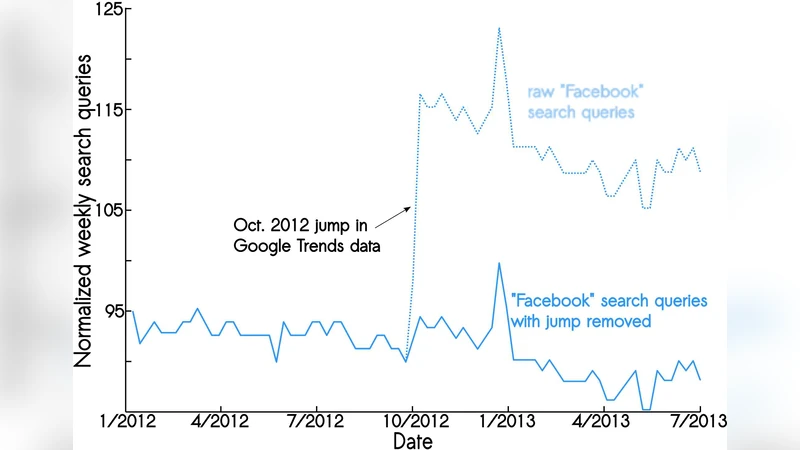
To validate the model, the authors use publicly available Google Trends data as a proxy for OSN activity. Weekly search query volumes for “MySpace” and “Facebook” are normalized to a 0‑100 scale, stitched across overlapping periods, and corrected for a known algorithmic jump in October 2012. The authors argue that search volume correlates with active user interest more faithfully than registration counts, because it reflects ongoing engagement rather than mere sign‑up numbers.
Parameter estimation is performed via MATLAB’s fminsearch (Nelder‑Mead simplex) combined with a Dormand‑Prince Runge‑Kutta (4,5) integrator to solve the ODEs. The objective function minimizes the sum of squared errors (SSE) between the model’s infected curve I(t) and the observed search data. For MySpace, the best‑fit parameters indicate a high adoption rate (β ≈ 0.45) and a low abandonment rate (ν ≈ 0.02), with a tiny initial recovered fraction (R₀ ≈ 0.001). The model reproduces the classic rise‑and‑fall trajectory: rapid growth from 2005, a peak around 2007‑2008, and a steady decline thereafter. The fit achieves a high coefficient of determination, confirming that the irSIR dynamics capture the empirical pattern.
For Facebook, the fitted parameters show a slightly lower adoption rate (β ≈ 0.38) but a higher abandonment rate (ν ≈ 0.05) and a modest initial recovered fraction (R₀ ≈ 0.002). The model captures the steep ascent in the early 2010s and the onset of a modest decline beginning around 2013, consistent with reports of younger users migrating to newer platforms. Extrapolating the fitted model forward predicts a pronounced drop in search interest over the next few years, with activity potentially falling to less than 20‑30 % of its 2020 level by the mid‑2020s.
The authors discuss the implications of the infectious recovery mechanism. Because recovery depends on the presence of recovered individuals, the model predicts that every OSN will eventually experience a decline; there is no parameter regime that yields perpetual growth. This aligns with the observation that even dominant platforms eventually lose relevance as user preferences shift. However, the model abstracts away many real‑world factors: external shocks (policy changes, technological innovations), competition from other platforms, and heterogeneity among user subpopulations. Moreover, Google Trends data, while convenient, can be affected by changes in search algorithms or media coverage, introducing potential biases.
In conclusion, the paper demonstrates that a simple, analytically tractable epidemiological framework—augmented with an infectious recovery term—can effectively describe the full life cycle of OSNs. The approach offers a quantitative tool for forecasting platform health and for understanding how social contagion drives both growth and decay. Future work is suggested to incorporate multi‑network interactions, demographic segmentation, and richer data sources such as login logs, which could refine predictions and aid stakeholders in strategic decision‑making regarding platform development, marketing, and investment.
Comments & Academic Discussion
Loading comments...
Leave a Comment